Ans: Virtual Reality (VR) is a technological method that allows developers to design games that aim to fully immerse the player into its virtual world, allowing them to experience everything, and making it seem very real at the same time.

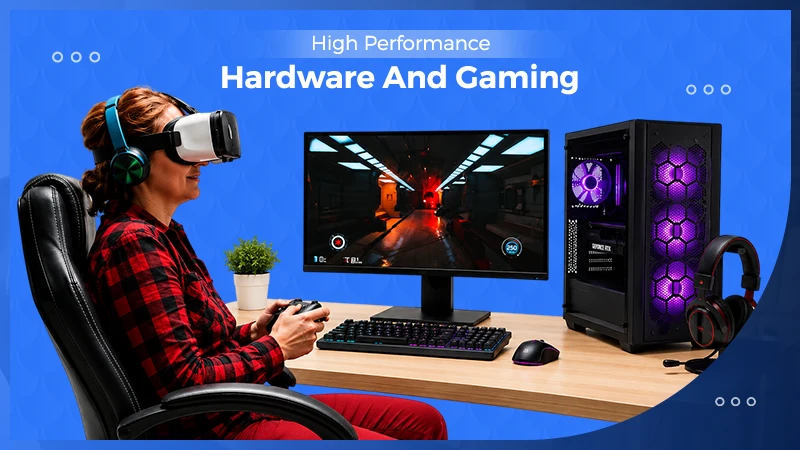
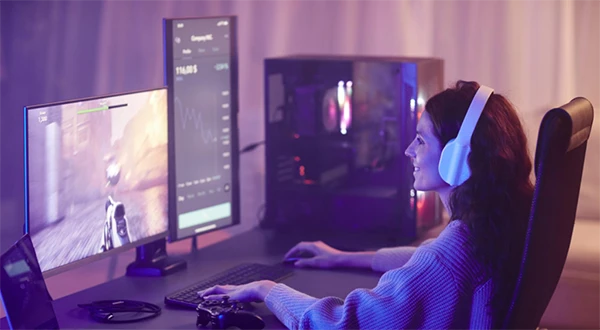
PC gaming has seen a massive hardware boom in recent times, shaping what designers can put on screen and what players have come to expect. Every new GPU generation, each jump in NVMe storage speed, and advancements in high-refresh-rate displays have unlocked experiences that weren’t possible before.
The GPU remains the centerpiece of any serious gaming build, as every high-end and mainstream graphics card produces different experiences for varying audiences. Ray tracing, path tracing, DLSS upscaling, and more are some of the features that have enhanced how developers can design their passion projects and deliver quality to the audience.
This article discusses what these technological upgrades hold for the future of gaming and what it means for game design.
Key Takeaways
- Games can stream higher-resolution textures, larger environments, and more diverse asset libraries than they could on spinning disks
- Hardware progress doesn’t just make existing games look prettier. It changes the kinds of games developers can imagine making
- This has ensured a parallel growth in optimization tools, with upscaling methods that aim to keep older hardware still viable
- Indie creators can design visually striking games on platforms that wouldn’t have run a fraction of those graphics a few years ago
Storage has been the quieter hardware revolution. NVMe SSDs eliminate loading screens in games that are built to take advantage of the fact. DirectStorage, the API that allows games to bypass traditional bottlenecks faced by the CPU and stream data directly from SSD to the GPU, has reached enough adoption to start changing how virtual worlds are actually built.
Games can stream higher-resolution textures, larger environments, and more diverse asset libraries than they could on spinning disks.
When players look at the PC games download scene to see what current hardware can really do, titles with serious DirectStorage integration feel notably different from ones still using older streaming approaches. Load times shrink. Asset pop-in disappears. The seams between zones get harder to spot.
Display technology has moved just as fast. 1440p and 4K monitors at high refresh rates have become affordable enough that most enthusiast builds target them now.
The jump from 60Hz to 144Hz transformed how competitive games feel, and the leap from 144Hz to 240Hz or 360Hz feels subtle, but still real, especially for fast-paced competitive shooters and fighting games where input latency and motion clarity ultimately decide outcomes.
OLED gaming monitors have also hit a price point where it feels like a reasonable choice rather than a luxury, as their response times have changed how dark scenes appear in cinematic stories.
Hardware progress doesn’t just make existing games look prettier. It changes the kinds of games developers can imagine making. Larger seamless worlds. Denser populations of NPCs. More detailed character models with believable cloth and hair simulation.
Volumetric atmospheres that respond to wind and light. Procedurally generated content that can be created on the fly without breaking immersion. Each of these features was unthinkable on consumer hardware a decade ago and is now table stakes for any AAA release.
The flip side is that hardware demands have created clearer segments in the audience. Players on a five-year-old GPU can still enjoy plenty of titles, but cutting-edge releases increasingly require the latest hardware to run as designed.
This has ensured a parallel growth in optimization tools, with upscaling methods that aim to keep older hardware still viable longer than it would otherwise be.
The result is the creation of a more layered gaming ecosystem where the same title can feel considerably different depending on the hardware running it.
Not every game is chasing the bleeding edge. Indie titles often ship with deliberately modest system requirements, which makes them accessible to players on older hardware, work laptops, and lower-end builds. This has created a thriving sub-ecosystem of games that run anywhere. Browser-based titles, including the kind of school-unblocked game someone might play during a break, owe their existence partly to the fact that web technology is now fast enough to handle real interactive experiences without dedicated GPUs.
The democratization works in both directions. Hardware progress has pushed AAA titles into a territory that requires serious investment.
It has also raised the expectations of what’s possible on modest hardware, meaning indie creators can design visually striking games on platforms that wouldn’t have run a fraction of those graphics a few years ago.
Both ends of the spectrum benefit, and the variety of hardware targets is wider than it has ever been.
Fun Fact
GPUs were specifically built to render game worlds. Today, scientists and researchers regularly repurpose gaming GPUs to power supercomputers and machine learning platforms.
A few directions look especially likely to shape the next several years. AI integration into rendering keeps accelerating. Frame generation, which uses AI to interpolate between rendered frames, reduces raw rendering load. AI-assisted asset streaming may eventually let games adapt their quality settings continuously rather than in discrete presets.
VR and mixed reality hardware also keeps maturing. The Steam Deck and similar handheld PCs have created a portable gaming category that didn’t really exist a few years ago. Cloud gaming, usable for almost every title, changes the calculus of what hardware players actually need to own.

The clearest signal that hardware progress is working is when players stop thinking about it. The frame rate is high enough that motion looks clean. The loading screens are gone. The lighting feels real. Character expressions read as expressions rather than as polygons.
At that point, the player stops worrying about the technology requirements and starts being more immersed in the game itself, which is precisely the point of all that engineering work.
The next decade is ready to be defined by how often that invisibility threshold gets cleared.
Ans: Virtual Reality (VR) is a technological method that allows developers to design games that aim to fully immerse the player into its virtual world, allowing them to experience everything, and making it seem very real at the same time.
Ans: Cloud gaming has allowed users to play any game they want without the need to spend thousands of bucks on the hardware required to run it, by simply connecting to the cloud service and experiencing the game, requiring only a monitor and other essentials.
Ans: The advancements in hardware have allowed even indie devs to incorporate features that they previously weren’t able to add to their games. This provides them with all the functions needed to create a truly cutting-edge experience effectively.
Ans: Yes, optimization has improved considerably, allowing users to run most of the titles even on older hardware that wouldn’t usually be able to handle such intense games.