Yes. Most colleges review freshman-year scores because they’re part of your official transcript.

“Success is the sum of small efforts, repeated day in and day out.”
— Robert Collier (Author)
Many students assume college admissions come down to one GPA or a single report card. But it’s much more than that. Colleges want a consistent academic story. They review your transcript year by year to understand how you’ve performed, whether you’ve challenged yourself with tougher classes, and how you’ve grown over time.
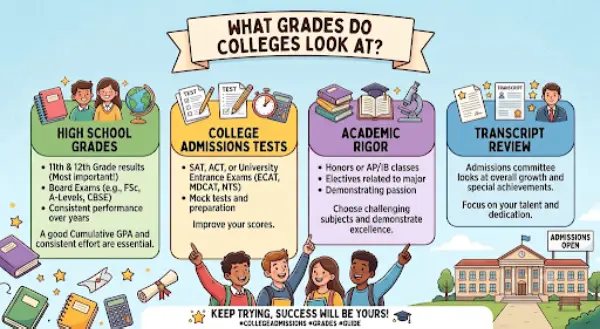
So, what marks do colleges look at? The answer isn’t just your junior-year GPA or final transcript. Colleges evaluate your complete secondary school record, including grade trends, course rigor, senior-year performance, and the subjects you’ve studied, to assess your readiness for college.
Most colleges consider all four high school year grades. Each year provides different information about your preparation and academic habits. But not every year carries the same significance.
Junior year often carries the most weight. It is usually the latest complete academic year available when you submit applications. It also tends to include harder classes that better reflect college readiness.
Your grades generally matter in this order:
This order does not mean freshman scores are ignored. Colleges still see them unless a school follows a specific policy that excludes ninth-grade results from its Grade Point Average (GPA) calculation.
Freshman year is the baseline. A weak start does not automatically prevent admission, especially when later grades show clear improvement.
Sophomore year helps reveal whether you adjusted to high school expectations. Stronger marks during this period can establish a positive trend before the more demanding junior year.
Junior year is often the most closely reviewed. Colleges can compare your grades with the difficulty of your classes and see how you performed in subjects connected to your intended major.
Senior year still matters. Colleges may review your fall scores before making a decision. They can also request your final transcript after admission. A major drop in performance may lead to questions, additional conditions, or an admission decision being reconsidered.
| High School Year | What Colleges May Learn |
| Freshman through sophomore year | Your academic foundation, study habits, and early progress |
| Junior through senior year | Your current ability, course rigor, consistency, and college readiness |
Rather than expecting a universal GPA or letter grade, colleges evaluate your performance relative to their admission standards and the competitiveness of the applicant pool.
Admission teams usually want to see solid performance in core academic subjects:
Marks in these subjects often receive more attention than grades in less academic electives because they show whether you can handle college-level reading, writing, analysis, and problem-solving.
Your intended major may also affect which scores receive closer attention. An engineering applicant may face more scrutiny in mathematics and physics. A prospective English major may need a stronger record in writing-intensive courses.
SURPRISING STAT
74% of NACAC member colleges reported that high school grades were the most important factor in admissions decisions.
Colleges rarely evaluate grades without context. They evaluate your performance considering the courses and level of difficulty you selected.
A high GPA earned mainly in easier courses may not carry the same weight as a slightly lower GPA earned in honors, Advanced Placement, International Baccalaureate, or dual-enrollment classes. Admission officers want evidence that you challenged yourself at a reasonable level.
CollegeCommit can help students understand how GPA, course selection, essays, and activities contribute to a balanced application.
Colleges may examine several transcript details:
An upward trend can help. Moving from average freshman grades to strong junior scores shows growth, persistence, and better academic habits. A downward trend may require context, especially when it continues into senior year.
Grades are one of the strongest indicators of sustained academic performance because they reflect years of classroom work rather than a single exam. It’s a record of how you handle assignments, deadlines, exams, and challenging material.
Colleges use marks to estimate whether you can manage their academic workload. They also review course difficulty because an A in a basic class and a B in an advanced class do not represent the same experience.
Grades can’t predict all aspects of college success. They remain useful because they show consistency across different teachers, subjects, and school years.
High school marks matter most during the admission process. Once you enroll, your college GPA begins as a separate academic record. Your old GPA does not transfer into your college GPA.
College grades decide:
This distinction matters. High school grades help you enter college. College grades measure your performance after enrollment.
Besides marks, your college social life is equally important, so learn to meet new people naturally.
A few low scores do not define your entire application. Colleges value progressive improvement, personal limitations, course difficulty, and extracurricular strengths.
Focus on actions that remain within your control:
Never try excuses. Give clear context when illness, family responsibilities, school changes, or other major events affected your performance. Then explain what changed and how you responded.
While grades are one of the most influential parts of your application, they’re only one piece of the admissions process.
Colleges may also review your essays, recommendations, activities, responsibilities, achievements, test scores, and personal background. The importance of each factor depends on the school and its admission process.
A strong essay cannot erase several years of poor academic performance. It can explain your goals, choices, and growth. Activities can also show leadership, commitment, creativity, or work experience that a transcript does not capture.
Your strongest approach is to build a consistent application. Take suitable courses, protect your senior scores, explain meaningful setbacks, and show how your experiences prepare you for college.
Yes. Most colleges review freshman-year scores because they’re part of your official transcript.
Yes. Colleges often require a final transcript and expect you to maintain your academic performance.
Both. They consider your unweighted GPA alongside the difficulty of your coursework to determine whether you challenged yourself with honors, AP, IB, or dual-enrollment classes.