Business reputation management is a system of monitoring, controlling, and managing the reputation of an organization on the Internet through reviews, ratings, feedback, and online presence.


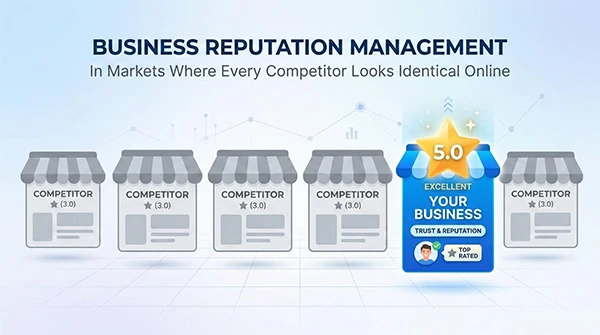
Visibility has become a major problem in recent years since competitors tend to offer websites that look similar in design and content. Using almost identical design templates, stock images, and marketing messages, companies make it difficult for customers to recognize one firm from another.
In this situation, visibility by itself cannot affect customer decision-making. The reputation of the firm starts playing a major role here. An online reputation of a company that is based on genuine reviews and customer experience can help the firm stand out among competitors.
Today’s consumer does not spend much time judging a website visually when choices seem alike. They scan, compare, and hunt for a reason to trust one brand above all others.
That reason almost always lives outside the website itself.
Star ratings, review tone, response behavior, local mentions, and platform consistency form a reputation layer that searchers rely on instinctively. It becomes the deciding factor when everything else looks interchangeable.
Which is why business reputation management plays such an important role in crowded markets.
Templates, generic images, and copy are supposed to give your business credibility. However, in an oversaturated environment, it does the opposite.
Uniform design creates decision fatigue. When three or four options appear indistinguishable, users default to the top result or the most familiar name. Quality becomes secondary to convenience. Lower-ranked competitors suffer, not because they are worse, but because they fail to stand out in any meaningful way.
Search engines reward that behavior. Clicks, dwell time, and user engagement reward the more credible sites. The reputation divide grows faster once the gap is created.
Reputation functions as an invisible comparison chart.
A customer will not even click before he has made up his mind according to the ratings, number, recency, and tone of the reviews. Reputation makes the site more trustworthy for a visitor because it has consistent and considerate reviews, no matter how professionally designed it is.
In practice, this means reputation often outweighs marketing. Businesses that invest in managing how they are experienced online gain an advantage that design alone cannot provide.
Most businesses underestimate how fragmented their digital presence is.
Listing information becomes disorganized. Review information piles up with no action taken. Outdated content remains. Even slight missteps become noticeable when all your competitors are very close by.
Business reputation management starts with visibility. Understanding where your brand appears, what is being said, and how consistently you show up across platforms is the foundation. Without that awareness, even strong service fails to translate into trust.
In identical markets, reviews become the primary proof point.
Not just the star rating, but the story told across multiple reviews. Patterns matter. Recurring praise feels credible. Repeated complaints feel risky. Silence feels evasive.
Companies that address criticism demonstrate accountability. They allow their future customers to see how things are handled, and not how services are offered. Such transparency creates trust that no advertising could ever achieve.
When competitors all say the same thing, saying less but saying it better becomes powerful.
Credibility content is neither stuffed full of keywords nor filled with unsubstantiated hype. Credibility content asks questions and provides answers. Credibility content expresses genuine expertise in ways that are not promotional. Credibility content tells a story that mirrors reality.
Founder perspectives, customer stories, and practical insights humanize brands that otherwise feel generic. Over time, this content reinforces credibility and gives search engines and users alike a reason to see the business as distinct.
In crowded markets, negative reviews are inevitable. What matters is how they are handled.
A defensive approach destroys trust. An indifferent attitude towards criticism means that you have none. A clear, professional response to problems and how they will be solved shows maturity.
Handled well, negative feedback can strengthen a reputation. It reassures future customers that the business is accountable, responsive, and stable even when things go wrong.
Reputation is not abstract. It shows up in measurable ways.
Better star ratings result in higher click-throughs. Regular response increases interaction. Good branded search indicates reliability. A minor shift in perception results in behavioral change in conversion.
Businesses that track these signals understand reputation not as a vanity metric, but as a revenue driver.
When markets become visually indistinguishable, buyers look for certainty.
They will choose the firm that seems safest, most reliable, and most trustworthy. This evaluation process takes place much earlier than even making a phone call or filling out a form.
This is why business reputation management is no longer optional in saturated markets. It is the layer that separates one identical option from another.
And in a landscape where everyone looks the same, being trusted is the most effective way to stand out.
In today’s market environment, where companies look alike on the Internet, reputation may become one of the most precious things a company may have.
Good customer experience, credible reviews, a consistent message from the brand, and prompt responses to customer feedback help build the trust that will make customers decide to buy a product or service from one company rather than another.
While websites and campaigns might make companies stand out to customers’ attention, it is their reputation that makes customers prefer one company to another.
Business reputation management is a system of monitoring, controlling, and managing the reputation of an organization on the Internet through reviews, ratings, feedback, and online presence.
In situations where competing firms provide almost the same type of goods or services, a good reputation plays a crucial role in influencing consumers’ purchasing decisions.
Online reviews that are positive and current, along with good feedback, have a great effect on influencing a customer’s buying decision of a customer.
Businesses can encourage honest customer reviews, respond to comments quickly, ensure accurate information on listings, create quality content, and monitor their online reputation