
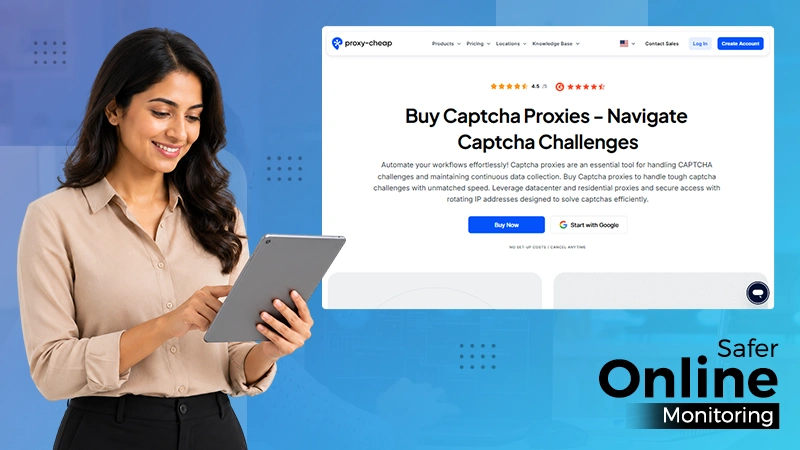
Keeping up with what is happening across the web has become part of staying safe online. Safety-minded tools and the teams behind them regularly scan public pages to see which apps are trending with young people, how platforms’ public content is changing, and where new risks are appearing. This work is automated by necessity – the web is far too large to check by hand, but a monitoring system can revisit thousands of public pages on a schedule.
The difficulty is that repetitive automated checks from a single connection quickly get treated as bot traffic. Sites slow their responses, return errors, or block the address, and the monitoring run stalls or comes back incomplete. For anyone relying on continuous, accurate web checks, that unreliability is a real problem – and datacenter proxies are a fast, affordable way to keep legitimate public-web monitoring running smoothly.
Websites are built around human-paced visits, and monitoring traffic looks nothing like that. Detection systems respond to the difference:
None of this means the monitoring is doing anything wrong – checking public pages for safety information is entirely legitimate. It simply means the automated pattern looks different from ordinary browsing, and the result is stalled checks and incomplete data.
Datacenter proxies are IP addresses hosted on fast, dedicated infrastructure. Routed through a pool of them, a monitoring tool spreads its traffic across many addresses, so each one makes only a modest number of requests and no single address builds up the volume that triggers a block. Because they sit on high-throughput connections, they are also fast and stable enough to run frequent checks without adding delay.
For the high-volume checking of public pages that safety monitoring involves, that speed and low cost make datacenter proxies a practical fit – you can run a large pool affordably and keep checks flowing. Providers such as Proxy-Cheap offer Proxy-Cheap datacenter proxies with large global IP pools, high uptime, and unlimited bandwidth, aimed at exactly this kind of steady, automated public-web checking.
It is worth being clear about scope. This kind of tooling belongs in legitimate, public-web monitoring – checking openly available pages, platform safety pages, and public app listings – not in accessing private accounts, defeating protections around personal data, or monitoring individuals without consent. Responsible monitoring also means respecting each site’s terms and rate limits, pacing requests sensibly, and gathering only the public information a safety check actually needs. Used that way, proxies are a reliability tool for legitimate oversight, not a means of getting around the protections that keep people safe.
For teams running these checks, adding proxies is usually straightforward, since most monitoring and scraping tools support routing through a proxy pool. A few habits keep checks effective and considerate: rotate addresses so no single one carries too much load, keep the request pace reasonable, cache results so unchanged pages are not re-checked, and confirm that returned content is a real page rather than an error screen so gaps are caught early.
Handled this way, the connection layer stays quietly in the background, and the monitoring system simply receives the public safety information it needs, on schedule and in full.
Staying ahead of online risks increasingly depends on automated monitoring, and automated monitoring keeps running into the web’s defenses against bots. Interrupted checks leave the resulting picture patchy, which undermines the very oversight meant to keep people, especially young people, safer online. Datacenter proxies help close that gap affordably. By spreading legitimate