Because it allows the highlighted person to see for which task they are being appreciated.


Have you noticed how employee recognition has changed in the last few decades? Earlier, it was used for annual awards and simple ‘Employee of the Month’ certificates, but now it has advanced to help businesses to track contributions and appreciate them in a more meaningful way.
By using AI and understanding precisely the way employees work and collaborate with teams, managers, and other team leaders can celebrate success in a better way – boosting productivity and confidence.
Read this post to learn how AI and employee data are making workplace recognition more personalized.
Key Takeaways
- AI allow team leaders to find out the most productive employees in real time; it does not leave things for the end of the year.
- Personalized recognition makes the appreciation feel more meaningful. The person can see the exceptional things they have done.
- Employee real time insights can share the crucial data that managers can miss easily. This makes the working structure effective.
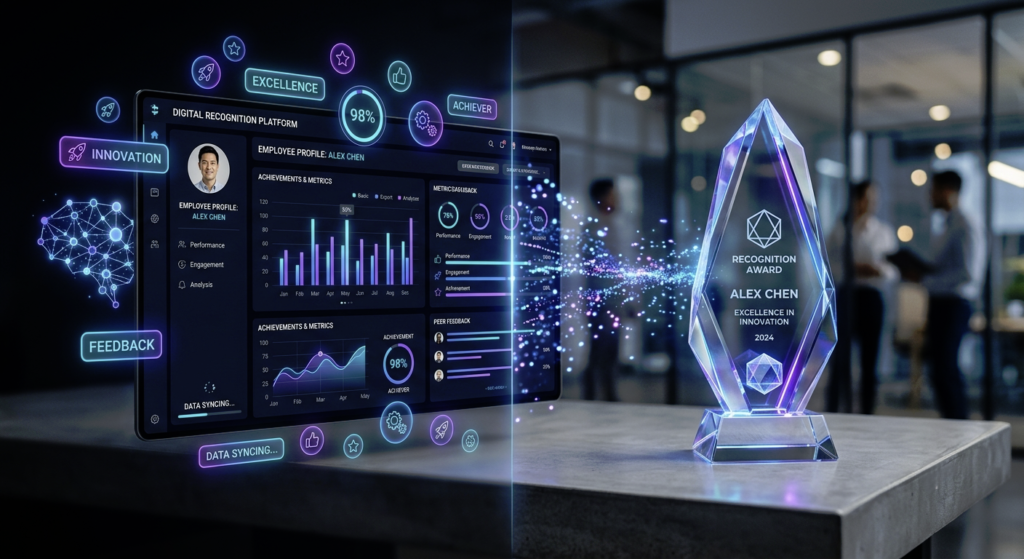
Traditional recognition programs do not succeed because they rely on retrospective visibility. A manager trying to recall twelve months of victories during an annual review frequently forgets the critical, late-night problem-solving that saved a client account in Q2. AI-driven platforms solve this by periodically scanning workflow tools, project management boards, and peer-to-peer discussion channels to flag special efforts in real time.
This constant, passive analysis implies that peer contributions are discovered naturally. Data from recent industry surveys shows that regular milestone appreciation makes employees five times more likely to stay with their current employer long-term. Instead of searching for a calendar milestone, these systems prompt managers to take action exactly when an employee’s impact is highest.
When it comes to physical recognition, data gathered from these platforms can directly drive the award’s design. Combining software insights with physical markers of success such as custom engraved recognition awards removes the gap between digital metrics and visible prestige. An award that symbolizes a specific, data-verified career milestone carries far more weight than a uniform corporate token.
Also, learn ways to create professional AI slides without waiting hours.
Data without a string base is just noise. The true beauty of modern HR tech lies in its capacity to convert raw performance telemetry into human stories. For example, instead of praising a simple sales volume metric, an AI layer can cross-reference CRM data to demonstrate that an employee managed the highest client retention rate during a regional market recession.
This level of individuality changes the entire concept of corporate reward structures. A highly personalized recognition plan relies on three main pillars:
When these pillars function together, the cycle of appreciation becomes sustainable. The system learns what inspires each team member, whether that is public praise, professional development prospects, or custom physical trophies.
Implementing data-driven recognition called for a careful balance to avoid making employees feel constantly watched. If team members believe their every movement is being graded by an algorithm to judge their worthiness for praise, engagement will plummet. The focus must always remain on locating positive outliers rather than policing daily output.
To maintain trust, companies must be clear about what data points feed into their recognition engines. The goal is to showcase excellent work that might otherwise go unreported, especially in remote or hybrid working environments where physical contact is limited. Recent workplace studies have found that weekly recognition makes employees over two times more likely to report high levels of daily efficiency.
By keeping the analytical focus strictly on victories, peer nominations, and collaborative milestones, organizations build a culture of psychological safety. The technology should also act as an assistant to busy managers, providing factual context so they can express genuine, human-to-human appreciation. Even if you’re using virtual assistants and other efficiency practices to streamline operations, having your key people pleased makes a major difference.
Building an appreciative workforce will require more than installing a new software plugin. It demands a cultural commitment to celebrating distinct qualities through clear, data-supported victories.
To explore how other forward-thinking companies are designing their modern operations, and read a range of posts on other topics as well, don’t go anywhere, as our site is overloaded with a library of delightful resources to read.
Also, explore this software testing guide: from manual QA to agentic AI testing.
At the end of the day, technology has truly changed how teams notice the great work. The end goal for the process is still the same—appreciating the person. But the way has evolved and advanced. With AI, teams can easily look for the way employees work, and figure out the ones that are working more actively while maintaining the company standards.
This way, when the team leaders make use of advanced technology with the local approach of appreciating team members, the productivity rises significantly.
Because it allows the highlighted person to see for which task they are being appreciated.
No, real recognition comes from personal chats and appreciation only. AI can just provide better insights.
Businesses should be clear about the reason their data is used and focus on the achievements rather than just monitoring things, which can help a lot.