The following questions can be asked:
- Which marketplaces and retailer websites can you monitor?
- What catalog information is required?
- How are uncertain product matches handled?
- What evidence is preserved for each issue?

Quick Answer
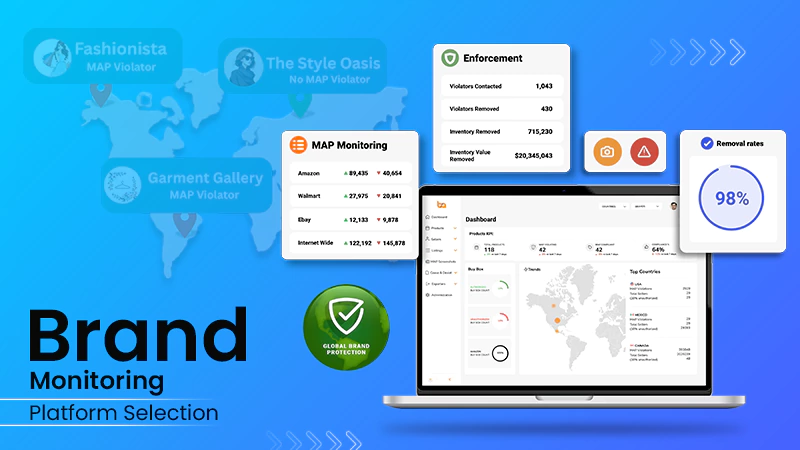
Brands usually pick the wrong Minimum Advertised Price (MAP) monitoring platform because they tend to focus more on low cost over accurate SKU-level matching and real-time tracking functionalities.
Here’s how it often goes wrong. A brand signs with the platform that has the best-looking demo and the longest feature list, the one that scans multiple sites and promises alerts within a few minutes.
Six months later, they realize that all those features turned out to be nothing, and somewhere in that noise, a genuine violation on a marketplace nobody was watching slipped through for weeks before anyone noticed. That is the actual failure mode with MAP monitoring, and nobody buys against it.
This article outlines why brands often select the wrong MAP monitoring platform, and what to actually look at before you sign on the dotted line.
If a platform gets one thing right, it needs to be this, and it’s the thing demos are worst at showing you.
A monitoring system sees a price below your MAP threshold and fires an alert. Fine. But that price may be a temporary promotion, a coupon that remains valid only at checkout, an outdated cache of marketplace information, or the tool matched your product to the wrong listing and is comparing it against a MAP cost that was never yours to begin with.
Every one of those looks exactly like a breach until a human opens it up and checks. And when hundreds of those a week land on a small team, two things happen, both bad. The team burns hours chasing ghosts, and they start firing warning messages at authorized sellers who did nothing wrong, which poisons the exact retailer relationships MAP is supposed to protect.
Worse than the wasted time is what the noise disguises. When most of your alerts are a waste, the team stops trusting any of them, and the real violation sits in the unit looking like one more false alarm.
A tool that flags everything is not protecting you. It is giving you a second full-time job and calling it visibility.
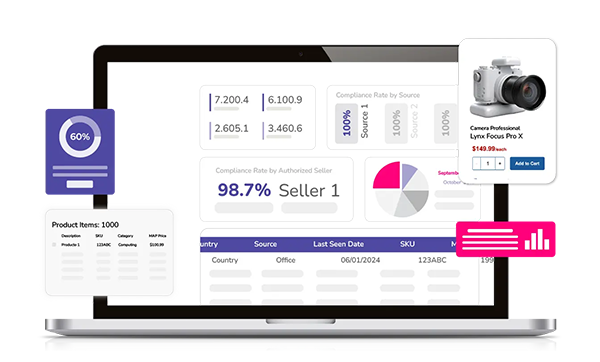
So the question that matters more than any feature count is a boring one: when this thing flags a violation, how confident can you be that it’s real, and how fast can you confirm it? A platform that flags genuine policy breaches rather than raw price movement, and hands you a timestamped screenshot and the listing context alongside each flag, is worth more than one that catches twice as many “violations” you then have to sort by hand.
Everything above traces back to one technical thing that never gets a slide of its own: whether the platform can reliably match your actual product to the listing it found.
On Amazon, this gets genuinely hard because you need matching down to the child SKU and ASIN level, not the parent listing, or you end up comparing a single unit against the price of a twelve-pack and generating nonsense.
The demo will always look clean because the vendor picked the products and the listings they displayed. Your catalog is messier than their demo catalog. So the honest way to test this is to make them run against their worst-performing products, the bundles, the variants, the SKUs that form a listing with three different sellers, before you sign anything. What they match cleanly in a controlled demo tells you very little.

Plenty of tools scan the big marketplaces beautifully and quietly miss half the problem.
A lot of MAP erosion happens off Amazon, on independent retailer sites, on DTC storefronts, in shopping-engine listings, on the marketplaces that aren’t the obvious three. If a network only watches marketplaces, it is blind to any channels where your price is getting undercut, and you won’t find out until an authorized retailer calls, furious, asking why they’re explicitly told to hold MAP while someone else openly isn’t. Before you judge reliability by a big number like “400+ sites,” the real question is narrower: does it cover the specific channels where your products actually sell, including the smaller ones your worst offenders hide on?
There’s a money angle here that applies straight to advertising, and it’s the part brands miss most often. When an unofficial reseller undercuts you and wins the Amazon Buy Box, every dollar you spend on sponsored ads for that product is delivering sales to them, not you. So a coverage gap isn’t just a compliance problem sitting in a spreadsheet. It’s ad budget in quietly funding a competitor
Some of what gets pitched hard is genuinely secondary, and it’s worth saying so plainly so you don’t over-weight it.
Reporting dashboards, for instance. Every platform has a slick one; they all show violation history and trends and chronic offenders, and they blur together. A dashboard is nice, but you’ll live in the alert queue and the evidence files, not the trend charts, so don’t let a beautiful dashboard carry a buying decision the matching accuracy should be making.
Setup and onboarding fees differentiate a lot and are worth a look, but they’re a one-time line item, not the thing that decides whether this works in a year. And “managed versus self-serve” is a real choice, but which side you want depends entirely on whether you have someone in-house who will own enforcement day to day, not on which model the vendor pushes hardest.
Skip the feature-list bake-off. Run a short pilot on your own catalog instead, and watch three things specifically.
The market includes lightweight monitoring tools, broad brand-protection platforms, price-intelligent and software-enabled services. They must not be evaluated as though they solve the same problem in identical ways.
Brands can use a consistent framework to compare MAP monitoring software tools, then narrow the list based on catalog size, required channels, internal capacity, evidence needs, and service preference.
Every shortlisted vendor should answer the same core questions:
– Which marketplaces and retailer websites can you monitor?
– What catalog information is required?
– How are uncertain product matches handled?
– What evidence is preserved for each issue?
– Can users track seller history and repeat activity?
– What does managed support include?
– How does pricing change as the program grows?
Watch how many of the flagged errors turn out to be real once your team checks them, because that false-positive rate is the number that predicts whether the tool gets utilized or completely abandoned.
Watch whether it caught the violations you already knew about, the ones you seeded on the channels you actually sell on. And watch how much manual work each confirmed case takes to package for enforcement.
A platform that gives you fewer, truer alerts with the testimonials already attached will protect your margins better than one that floods you with a bigger, noisier number and lets you sort it out.
The tool with the most features and the widest scan count is not the one to beat. The one to beat is the one your team still trusts and still opens six weeks from now, because its alerts were worth trusting. That is a much harder thing to demo, and a much more important thing to buy.
Finding the error is the easy half. What happens next is where the tool either saves your team or buries them.
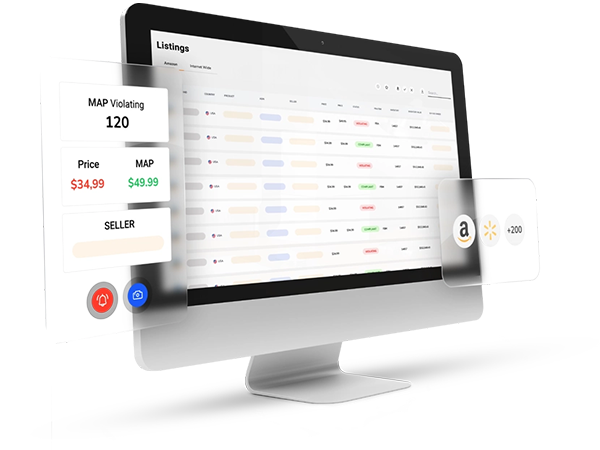
A confirmed violation runs a fairly standard ladder. You verify it’s real, you get timestamped evidence at the SKU level, you send the seller a formal notice with the specific price discrepancy and a correction window, usually 48 to 72 hours, and if they blow the deadline, you escalate to a supply hold, a co-op fund closure, or for a truly unauthorized seller, a takedown notice to the marketplace. The applications that earn their keep automate the tedious middle of that, the evidence capture and the documented notice trail, so a legal or reseller corporation can act without rebuilding the file by hand. The ones that don’t leave your people screenshotting listings manually at 6 pm, which is precisely when they stop bothering.
The following questions can be asked:
The demo will always look clean because the vendor picked the products and the listings they displayed. Your catalog is messier than their demo catalog. So the honest way to test this is to make them run against their worst-performing products.
There’s a money angle here that applies straight to advertising, and it’s the part brands miss most often. When an unofficial reseller undercuts you and wins the Amazon Buy Box, every dollar you spend on sponsored ads for that product is delivering sales to them, not you.