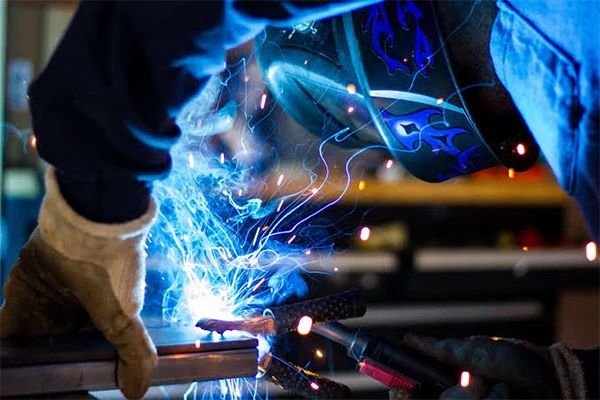
Yes, it works for some short-run jobs, repairs, and jobs where the cost of fanning out the part in a gantry system would outweigh the cost of welding it. However, for high-volume repeat jobs, automatic systems still work better.

Choose the niche before choosing the vendor.
There is a huge difference between the shop that works with thin stainless pipe and the one that works with structural steel, and the company performing well in one task will probably do the worst job in the other one. First, you have to start with the watts provided, and just after that, the wattage is a minor contributor in your choice.
The industrial laser sector was valued at approximately $7.8 billion in 2025 and there will be high growth until 2031 when the estimation of the market is going to reach $10.94 billion. Therefore, a number of businesses are eager to take part in the market.
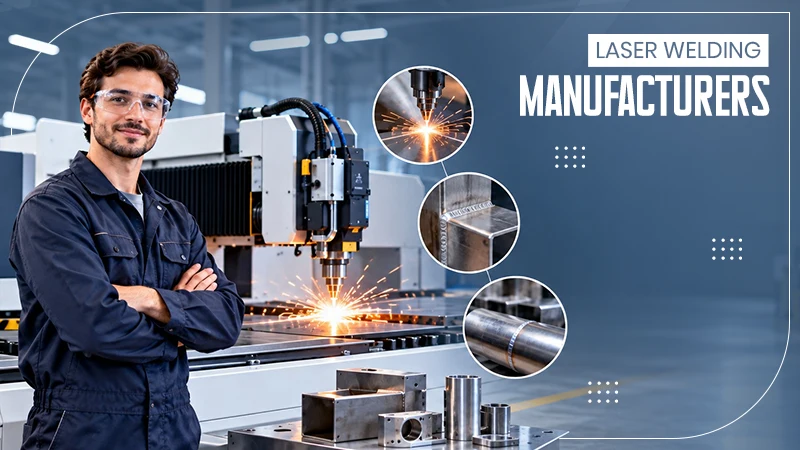
You will find seven names that are worth mentioning.
The parameter that most consumers look at is power output and it’s practically the least informative figure there is after comparing two products for similar operations. Both are capable of melting metal. The fascinating thing is where the difference lies.
The duty cycle is the actual number. A unit of 2000 W and one of 1500 W that operates for the whole work day without any stoppage can be compared with respect to this parameter.
After that, cooling design, beam delivery, and whether the control software lets an operator save parameters per job. Asia-Pacific accounts for roughly 53% of this market, which is why so many of the machines a buyer sees quoted are built there.
Please check out the list:
The German family-owned manufacturer is essentially the benchmark for this field. They supply everything from the light to the machine and hence they appear in automotive and aeronautics since downtime can be more expensive than machines.
Expensive. Rarely the wrong choice.
The handheld welding technology is a different domain from the one mentioned above about gantry systems. The main question is how easy it is to transport the equipment and how quickly it can be adjusted for use without extensive training.
Dynalasers laser welding systems cover continuous-wave handheld units in the 700–1800 W range, with air-cooled designs and a welding gun the company lists at roughly half a kilogram. CE-MD and ISO 13849 safety certification is claimed for the range.
A far smaller operation than the six above. In the portable segment, that matters less than it sounds.
IPG has its own production plant in Oxford, Massachusetts and its fiber laser sources are sold to manufacturers of units using this source. Due to this vertical integration, their source finds its way to many other companies’ machines.
If you have bought a fiber laser welder in the last decade, there is a fair chance the beam came from here.
Han’s is a large company located in Shenzhen and its product range is extensive, always providing very competitive prices which European and Japanese manufacturers struggle to compete with.
The quality spread across their catalogue is wider than TRUMPF’s. Buy at the top of their range rather than the bottom.
Coherent became a considerably broader photonics company after merging with II-VI, and the welding equipment now sits inside a portfolio spanning semiconductors, optics, and communications.
Strong on process development support. Worth a conversation if the joint is unusual and nobody can tell you whether a laser will work on it.
Japan is best described as a sheet metal ecosystem instead of a welding company. The welders of Japan are designed to be used together with punching, bending, and cutting machines and they share the same software and service.
That integration is the selling point. It is also the lock-in.
Swiss, focused on cutting and bending automation, and increasingly on the software tying a fabrication floor together.
Fewer welding-specific options than the others on this list. Where they earn their place is in shops already running Bystronic cutting equipment, where adding a compatible process beats adding a better standalone machine.
The thing that decides whether a laser welder was a good purchase usually is not the laser.
The issue is whether the manufacturer has someone who can talk on the phone in case of problems with their machine and supply parts for it. When you get the quote for the equipment from manufacturers, you have a good chance of getting the same quote from different manufacturers.
Manufacturers that feel confident about their products accept this condition immediately.
So instead of reading the specifications of individual companies and comparing them, just use the equipment of each manufacturer for your own needs. You do not need to wait for million comparisons based on different tables to realize the capabilities of welding machines if you have access to them.
Yes, it works for some short-run jobs, repairs, and jobs where the cost of fanning out the part in a gantry system would outweigh the cost of welding it. However, for high-volume repeat jobs, automatic systems still work better.
Less than most sellers make you believe. You should match the power to the thickest material you usually work with, not the one that you would be able to weld if needed, then check the working cycle of the machine in this mode.
Not really. The majority of machines in the world are produced in this region. The problem lies within servicing and getting spare parts, thus you have to buy where the service is provided rather than only choosing by price.
Yes, mostly with regards to the availability of parts and warranty conditions. Ask about the manufacturer of the source and the warranty in addition to machine.