Ans: Yes, AI can replicate your style when you do not choose to decline data training.

“The currency of the 21st century isn’t just money; it’s the raw data of human emotion and creativity.”
Imagine your heartbreak lyrics topping the charts but under someone else’s name! According to Luminate 2025, 106,000 tracks are streamed to the streamers daily, which has blurred the line between the ‘creative tool’ and ‘data vacuum’.
When you put your soul into an AI, who is the one who really holds the leash? This guide will make you understand the digital ‘black box’ of AI music. This will help you learn where your data goes, who owns the music, and how you can protect your intellectual property from becoming mere training fuel for corporate algorithms.
Protect your creative spark today!
Key Takeaways
- Data is permanent; therefore, assume that everything you upload is stored somewhere.
- AI-generated music occupies a legal gray area, but the human-written lyrics remain yours.
- Paid tiers generally offer better privacy and commercial rights as compared to free versions.
- Use 2FA and private browsing to reduce your digital footprint.
When you click ‘Generate’, a complex process take places behind the scenes. Most of the users think that AI just reads their input, but in reality, it absorbs and processes their data.
Most of the platforms operate on a ‘Data-for-Service’ model. You get a catchy tune; they get a fresh dataset to refine their neural networks. To truly master the craft, many creators are turning to a Lyrics to Song AI, which can bridge the gap between poetry and production, yet some stop to read the fine print regarding data retention.
Before you start to sing along, you need to realize that your input often gets stored on remote servers indefinitely and is categorized by keywords, along with being analyzed for sentiment to improve AI’s future performance.
Companies are taking your personal writing style and creative ideas to train AI, then sell that AI to make new content, and they are doing all this without asking for your permission or paying you.
Fun Fact: The first-ever song that was generated by AI to be covered by a human reached the Billboard charts. This proves that AI may make the music, but humans still provide the soul!
Once the lyrics leave your keyboard, they enter a ‘Lifecycle of Data.’ Generally, your lyrics follow one of the three paths that are explained here. Your words get transformed from a private expression into a permanent digital asset stored within massive corporate servers.
While the convenience is unmatched, you pay for that ease with your privacy. Unless the app says that your data is totally locked (encrypted), assume that the company or even hackers could eventually see your private lyrics.
Most of the AI song makers live in the cloud, which is just a fancy way of saying ‘someone else’s computer’. This brings to notice several vulnerabilities that could compromise your creative ‘special something.’
The Vulnerability Checklist:
Pro Tip: Use a VPN when you are accessing cloud-based AI tools to hide your IP address and location data.
Understanding these technical risks is only half the battle; the real challenge is to keep your actual content safe from prying eyes.
You would not leave your physical notebook on a crowded subway, so why leave your digital data unprotected? Protection starts with being proactive instead of reactive.
First, you need to watermark your intent. Even if the AI generates the music, keeping a timestamped original draft of your lyrics on a local device or a blockchain-based registry can serve as ‘Proof of Creation.’
Using decentralized timestamping will ensure that you have an immutable digital seal, proving that your lyrics existed even before the AI heard them.
Second, look for a tool that offers a ‘Private Mode’ or ‘Incognito Generation.’ Do not get yourself fooled by surface-level privacy; you need to locate the ‘Data Training Opt-Out’ toggle.
These settings will prevent your inputs from being processed into global neural networks, ensuring your unique rhythmic DNA is not used to build a better machine at your cost. You need to keep your creative soul off the public menu.
Action Step: Always check if the tool allows you to delete all your data when you close your account.
“Copyright law was built for the printing press, but we are living in the era of the prompt.”
The legal landscape of AI music is currently a mess! The government says that you can’t ‘own’ a song if an AI made most of it. If the computer does the hard work, anybody can legally copy it or use your track for free because it belongs to the public, not to you.
Let’s figure out who owns what!
To visualize how intellectual property is distributed between the creator and the software, take a close look at the graphic below, as it simplifies the three distinct pillars.
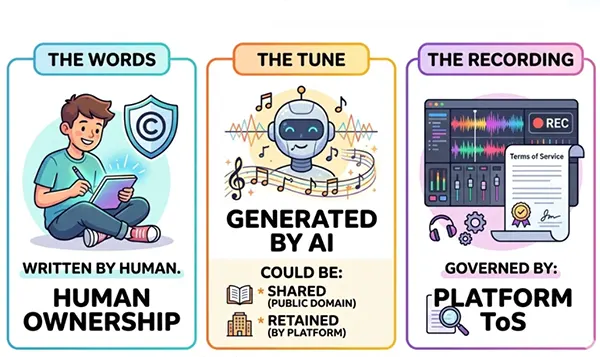
| The Lyrics | If you have written the lyrics, you own them. |
| The Melody | If the music is created by AI, it might belong to the public or the platform. |
| The Master Recording | It is usually governed by the ‘Terms of Service’ (ToS) of the AI provider. |
Many of the platforms claim ‘Commercial Rights’ for the paid users, but this is a license, not necessarily full ownership.
If you plan on putting your AI-generated track on Spotify, make sure that your subscription tier actually permits it, or you might find your royalties redirected to the software developer.
If you fail to verify these legal nuances, it could result in your hard-earned revenue being clawed back during a future copyright audit.
Before you press the ‘Compose’ button, you need to run through this quick security audit to ensure that your brilliance and creativeness stays yours.
Did You Know?
Some AI music platforms actually use ‘human-in-the-loop’ systems where real people review flagged prompts. This means a stranger might read your lyrics if they trigger a content filter.
In an era where digital theft is immediate, taking a few extra moments to harden your creative perimeter is the only way to guarantee your hits remain your legacy.
Ans: Yes, AI can replicate your style when you do not choose to decline data training.
Ans: Mostly, when it is free, your data is unsafe. Free tools would probably use your lyrics to develop their system, or they may also share your work with other companies.
Ans: You can get copyright protection only for the lyrics that you wrote, but the music generated by AI is not yours to own.
Ans: You can email the lyrics to yourself before you upload them, which will create a digital record of your original work.