Age checks ensure that the content provided to the specific age group on the platform is appropriate for their understanding, thus ensuring safety from harmful content.

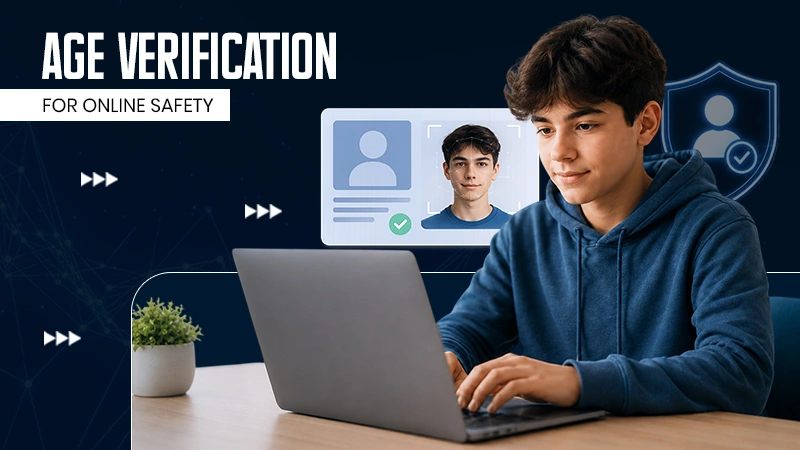

All kids don’t experience the internet in neat age groups. Many move between games, chat applications, video platforms, social spaces, and forums, all of it faster than adults can review each one.
The internet can be a dangerous place, and with unsupervised access, it can massively impact a younger child’s experience by letting them in on the things that may harm them in the future, making age verification a must in virtual environments.
This article explains why this matters and what parents and digital platforms should look for when deciding whether an online space is appropriate for younger audiences.
Key Takeaways
- A 13-year-old and a 17-year-old may both be teenagers, but shouldn’t always receive the same content, permissions, ad targeting, or privacy settings
- Weak age gate becomes a bigger concern on platforms with direct messaging, live chat, user-generated images, location sharing, adult content, or algorithmic recommendations
- A safe system should only ask for what it requires to function, protect that information carefully, and avoid keeping personal data longer than necessary
- Use low-friction age checks for lower-risk environments, stronger verification for restricted areas, and consistent safety monitoring when behavior changes
Age verification is usually treated like a simple process: old enough, come in. Too young, stay out. But practically, this should support a safer experience after the user enters the platform.
A 13-year-old and a 17-year-old may both be teenagers, but shouldn’t always receive the same content, permissions, ad targeting, or privacy settings.
A better age assurance procedure allows platforms to apply age-appropriate defaults, reduce exposure to adult spaces, and limit features that lead to risks for younger audiences.
For parents, this matters because many apps rely on self-declared birthdays. A child can often type an older birth year in seconds. That doesn’t mean every platform is unsafe, but it does mean parents shouldn’t assume an age label in an app store or sign-up form is enough on its own.
The weakest age checks tend to be the easiest to bypass. A pop-up asking “Are you over 18?” does little if there’s no meaningful check behind it. The same problem appears when platforms collect a birthdate but don’t verify it, or when users can simply create a new account after being restricted.
This becomes a bigger concern on platforms with direct messaging, live chat, user-generated images, location sharing, adult content, or algorithmic recommendations. A weak age gate can allow younger users into spaces designed for adults, while adults may also enter teen-focused areas without proper friction.
Some platforms are now exploring stronger methods, including document checks, parental approval flows, device-based signals, and facial age verification. Each option has trade-offs. The goal isn’t to collect more data than necessary. It’s to confirm age in a way that is proportionate to the risk of the platform.
Age verification shouldn’t become an excuse for unauthorized data collection. A safe system should only ask for what it requires to function, protect that information carefully, and avoid keeping personal data longer than necessary.
This is especially important when children are involved. In the United States, the Children’s Online Privacy Protection Rule sets requirements for certain online services that collect personal information from children under 13, including notice and parental consent obligations.
Parents can use this as a practical lens when reviewing an app. Ask: What age does the platform allow? What information does it collect? Can a child message strangers? Are privacy settings strict by default? Does the company explain how age-related data is handled?
A platform that takes child safety seriously should be able to answer those questions clearly.
Did You Know?
Zero-Knowledge-Proofs (ZKPs) allow platforms to verify you are of legal age without ever seeing your birthday or name. Systems like world ID use your device to read secure chips and send only a “yes/no” mathematical token.
Age verification is only one layer of online safety. It works best when combined with parental controls, open conversations, reporting tools, and sensible privacy settings.
Before permitting a child or teen to use a new platform, verify whether the application has age-appropriate account settings. Look for private profiles by default, message restrictions, content filters, screen time limits, and easy block or reporting functionalities.
If the platform comprises anonymous chats or random matching with people, treat that as a high-risk environment.
It also helps to test the sign-up process yourself. If the app says it is for older teens but accepts any birthday without question, that tells you something. If it has stronger checks for adult spaces, restricted features, or sensitive content, that is a better sign.
Most importantly, have a conversation with your child about why these security checks are important. Age restrictions can feel unfair to children, especially when friends are already using the same thing.
Keeping the conversation centered around privacy, pressure, scams, and unwanted contact makes it a lot easier for them to understand the reasoning behind the rule.

Not every website needs the same level of age verification. A homework tool, a general video site, and an adult-oriented social platform carry different levels of risk. The stronger the risk, the stronger the age assurance should be.
Platforms must also avoid designing systems that punish honest users while doing little to nothing to stop dishonest ones.
If a child can easily bypass an age restriction by inputting a false birthday, the rule is mostly decorative, and if an adult is able to enter teen spaces without the necessary checks, the platform has a trust problem.
A comprehensive approach is layered. Use low-friction age checks for lower-risk environments, stronger verification for restricted areas, and consistent safety monitoring when behavior changes.
Combine all of this with moderation, reporting, and clear consequences for users who tend to misrepresent themselves.
Age verification won’t solve every online safety problem. But when it’s thoughtful, privacy-centered, and matched according to risk, it reduces preventable exposure and makes digital spaces safer for everyone involved.
Online safety starts with knowing who a platform is really built for. Stronger age checks help make that clearer for families, platforms, and young users themselves.
Age checks ensure that the content provided to the specific age group on the platform is appropriate for their understanding, thus ensuring safety from harmful content.
Using low-friction age checks for lower-risk environments, stronger verification for restricted areas, and consistent safety monitoring when behavior changes is precisely how a layered approach functions.
Before permitting a child or teen to use a new platform, verify whether the application has age-appropriate account settings. Look for private profiles by default, message restrictions, content filters, and screen time limit functionalities.
A weak age gate can allow younger users into spaces designed for adults, while adults may also enter teen-focused areas without proper friction.