Most are not unlimited in every respect. A plan may remove per-GB charges while limiting bandwidth, concurrency, or session length. Others use unlimited to describe broad pool access or high bandwidth.


Quick Answer –
“Unlimited” residential proxies could mean unlimited traffic, or could imply high bandwidth or huge IP pool sizes. In this article, we’ll analyze five vendors on the basis of price, target audience, bandwidth, and usage.
While looking for unlimited residential proxy solutions, you’ll see that each provider has its unique approach to the term. Certain companies offer users unlimited services without any charges on a per-GB basis. Some may use it to determine high-bandwidth plans or access to large rotating IP pools, even if billing is done by traffic usage.
This article is intended to help you compare five proxy service providers and explain the meaning of unlimited internet.
These five providers all use the word “unlimited”, but they don’t deliver the same type of proxy access. Some remove per-GB charges, while others refer to a large IP pool or high traffic allowance, so the points matter more than the label.
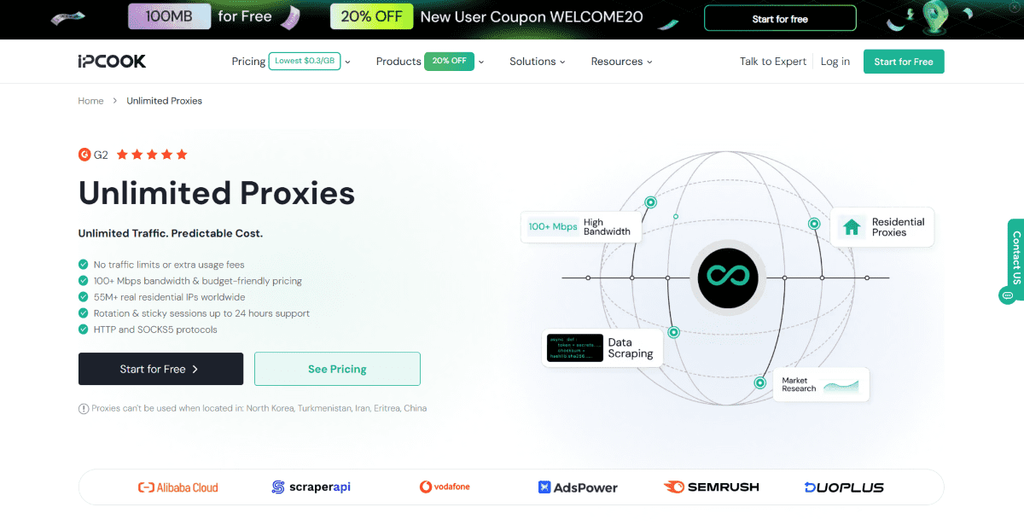
IPcook unlimited proxy service offers residential proxies with no traffic limitation. The service suits continuous monitoring, image collection, and other traffic-heavy workloads. Its large rotating residential pool lets you send requests through different exit IPs, reducing the risk of rate limits caused by repeated access from one address.
Unlike many residential proxy plans that charge for every GB transferred, IPcook unlimited proxy pricing sets a fixed fee for the selected bandwidth tier and service period. Since traffic isn’t billed by volume, higher data usage will not incur extra usage charges, so overall expenses remain easier to predict. If your workload increases, you can move to a higher bandwidth tier without switching to a pay-per-GB plan.
Pros
Cons
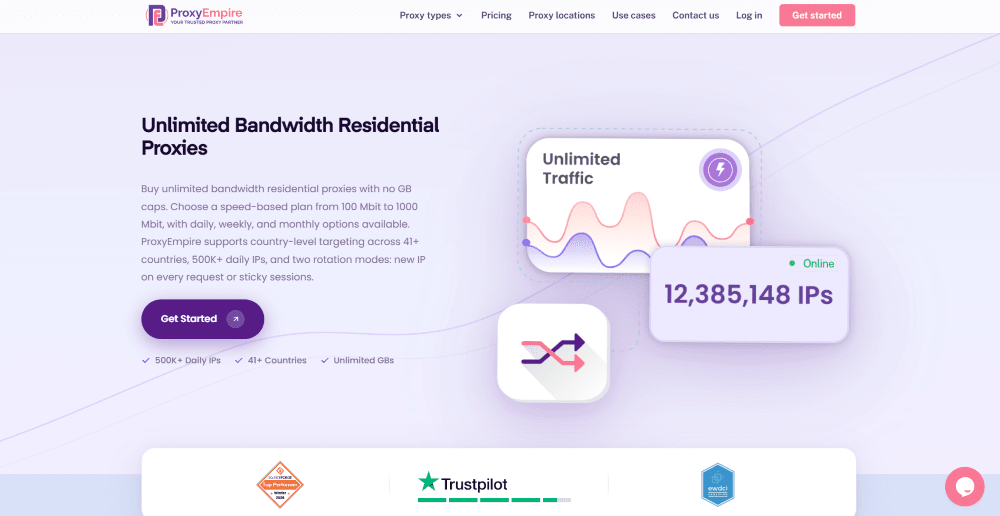
Unlike IPcook, the Unlimited Residential Proxies offered by ProxyEmpire do not have a traffic limit at a selected bandwidth tier instead of a cost per GB. It supports HTTP, HTTPS, SOCKS5, and HTTP/2, making it compatible with browsers, automation tools, and scraping software. Country-level targeting across 41+ countries also makes it suitable for high-traffic projects focused on specific national markets.
Plans are priced by bandwidth and available by the day, week, or month. This flexibility can suit teams with larger budgets that need high throughput for a short, intensive project without committing to a full month. For teams looking for unlimited traffic for a month and cheaper rates, IPcook offers a more affordable 100 Mbps package.
Pros
Cons
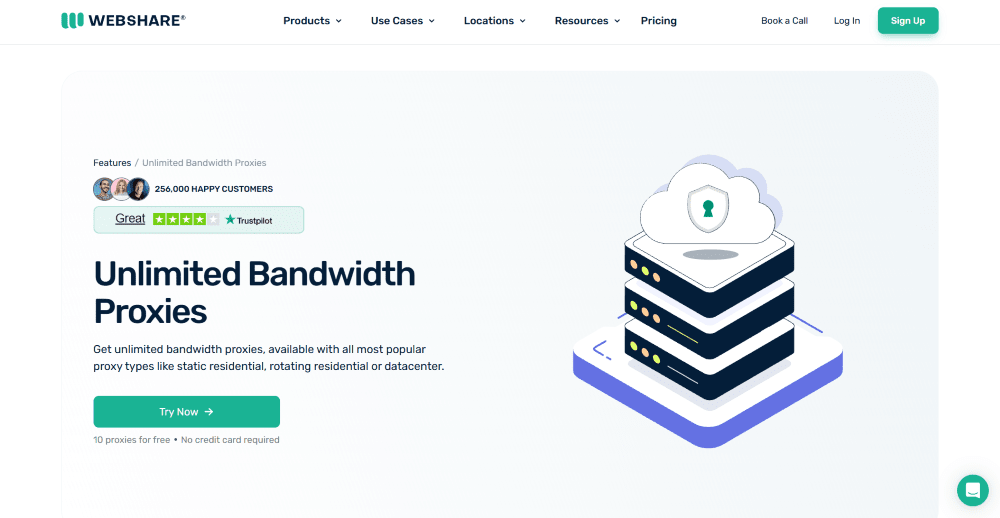
The rotating residential proxy by Webshare is designed for heavy loads, but it does not provide you with unlimited traffic. Each plan comes with a set data allowance rather than unlimited usage. Compared with standard proxies, its residential pool offers a broader mix of IP addresses, making it a practical option for small-to-medium workloads that do not require exceptionally high traffic volumes.
Webshare does not charge by traffic volume on its unlimited-bandwidth ISP and datacenter plans, but connection speed is really not unlimited. These plans remain subject to a fair usage policy, and sustained data use can lead to throttling. If high-speed internet is required for your task, then you should look into this matter carefully.
Pros
Cons
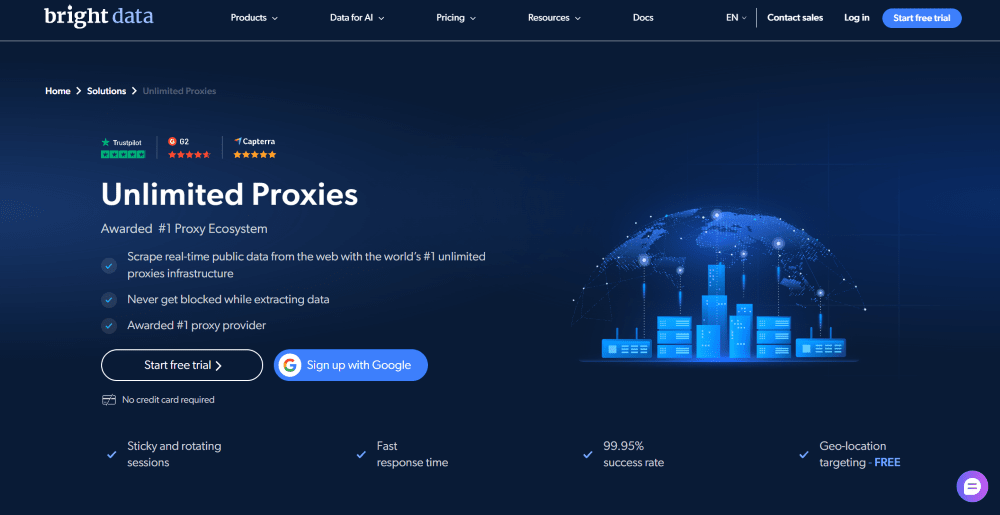
The unlimited proxies provided by Bright Data are related to access to a huge pool of residential IPs, but not to unlimited traffic. Its residential IPs come from real users who have opted into the peer network. This makes the service suitable for global data collection projects that need genuine residential connections across a wide range of locations.
With 400M+ monthly residential IPs across 195 countries, Bright Data operates the world’s largest residential proxy pool. Its scale provides a steady supply of new IPs for large rotation jobs and helps long-running collection tasks maintain consistent access. Nevertheless, residential traffic is charged per GB. Thus, high traffic volumes must be controlled.
Pros
Cons
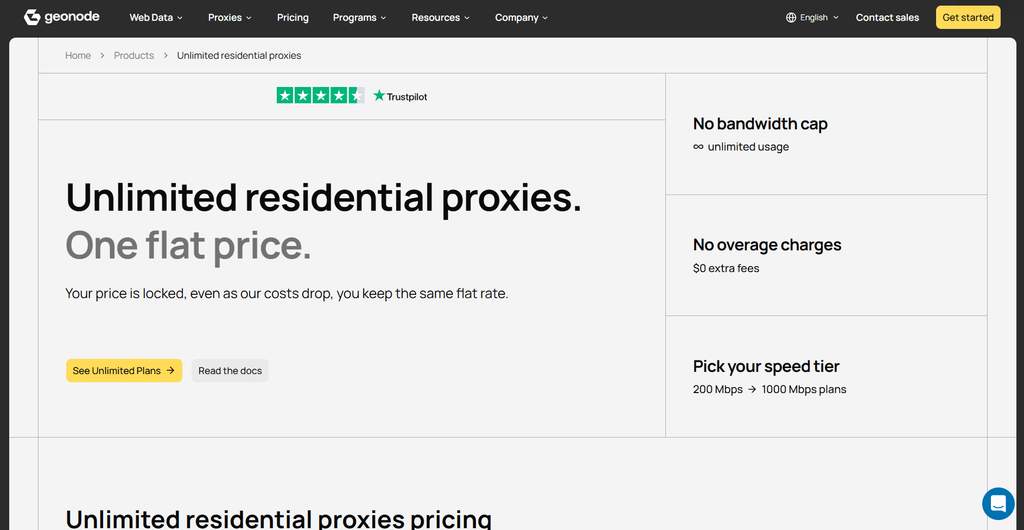
The Geonode unlimited residential proxy is bandwidth-based, meaning that the company charges a monthly fixed fee rather than charging per GB used. The plan has no traffic limit, so higher data usage does not add overage fees. This model suits price tracking, inventory monitoring, and ad verification that runs around the clock. These workloads generate steady traffic, so fixed monthly pricing helps teams plan costs without repeatedly checking balances or pausing tasks.
Geonode operates its own network and maintains separate IP pools for unlimited residential and premium residential. The service currently routes connections through a US gateway, but you can still choose target countries from the live residential pool. It should be noted that there is no restriction on US exit IPs via the US gateway. You can view available countries in the control panel.
Pros
Cons
Unlimited is not the same service offered by all five providers above. Unlimited service is provided by IPcook, ProxyEmpire, and Geonode without any cost per GB of data transfer. Webshare’s rotating residential proxy provides high bandwidth but still charges by data usage. Bright Data uses unlimited access to a large rotating IP pool. The table compares what unlimited means, pricing, proxy pools, targeting, best uses, and main limitations.
| Provider | What Unlimited Means | Price | Pool and Targeting | Best For | Main Limitation |
| IPcook | Unlimited traffic | $350 for 30 days at 100 Mbps | 55M+ IPs across 185+ countries with random global allocation | Heavy-traffic scraping and media collection | No country or city targeting |
| ProxyEmpire | Unlimited traffic | $200 daily or $1,500 monthly at 100 Mbit | 500K+ IPs across 41+ countries with country targeting | Short-term, high-throughput projects | High entry price and country-level targeting only |
| Webshare | High bandwidth | $3.50 for 1 GB, with lower per-GB rates on larger plans | 80M+ IPs across 195 countries with granular targeting | Small-to-medium residential proxy workloads | Traffic remains billed by usage |
| Bright Data | Large rotating IP pool | $8/GB PAYG; currently $4/GB on promotion | 400M+ IPs across 195 countries with precise targeting | Large-scale global data collection | Per-GB costs increase with traffic volume |
| Geonode | Unlimited traffic | $1,800 monthly at 200 Mbps | Separate residential pool with availability-based country targeting | Always-on monitoring | US connection gateway only |
Prices reflect publicly listed rates at the time of writing. Promotional rates may change.
Before purchasing unlimited proxies, it is necessary to know what “unlimited” should include. A team moving large amounts of data each month has different needs from one that mainly wants more IPs or longer sessions. Start with traffic volume and budget, then narrow down the options by targeting, protocol support, bandwidth, and session controls.
Estimate monthly traffic, peak demand, and how long each task runs. High-volume scraping, image collection, and continuous monitoring often benefit from plans with no traffic limit. For smaller or irregular jobs, a pay-per-GB plan may cost less overall. Be sure that if you have several processes going on at once, your bandwidth is enough to cover them.
Check whether the provider charges by traffic, bandwidth tier, IP, or subscription period. Fixed pricing makes recurring workloads more manageable to budget, while pay-per-GB plans suit lighter usage. If you are considering an unlimited data proxy, compare its bandwidth tier and any extra fees with the expected cost of a pay-per-GB plan.
Country targeting may be enough for broad market research and regional price tracking. Local SEO, ad verification, and location testing may need city, ZIP code, carrier, or ASN controls. Review the exact procedure because targeting options usually differ between products from the same provider.
Make sure the proxy works with your browser, scraper, or automation tool. HTTP and HTTPS cover most web-based tasks, while SOCKS5 works with a broader range of traffic. HTTP/2 may also be helpful when both the software and target platform support it.
When picking an unlimited rotating proxy, check how frequently IPs can change and whether sticky sessions are available. Rotating IPs suit large request volumes, while sticky sessions keep the same IP across multiple requests. Bandwidth tiers and concurrency limits also influence how many tasks can run at once.
The components that define unlimited residential proxies vary significantly, and the term can mean either unlimited traffic, high bandwidth, or a large rotating IP pool. It is necessary to also examine targeting, protocols, session controls, and bandwidth when making comparisons since these factors also help determine whether a plan is appropriate for the intended workload.
IPcook seems to be the best choice if the workload involves unlimited residential traffic and there is no payment for each GB uploaded. Other providers may be more appropriate for tasks where wider geography is essential, short billing, or creation of the global IP pool.
Are Unlimited Proxies Really Unlimited?
Most are not unlimited in every respect. A plan may remove per-GB charges while limiting bandwidth, concurrency, or session length. Others use unlimited to describe broad pool access or high bandwidth.
What Are Unlimited Residential Proxies Best Used For?
They work best for large-scale web scraping, competitor price monitoring, image collection, and continuous data feeds. These tasks can quickly transfer enough data to raise per-GB costs. An unlimited traffic plan with a fixed price is often more economical when its bandwidth tier meets the workload’s throughput requirements.
Are Unlimited Residential Proxies Better Than Pay-Per-GB Proxies?
It depends on usage. Plans with no traffic limit offer predictable costs and usually suit continuous, high-traffic collection. Pay-per-GB proxies can be more economical for low, occasional, or highly variable tasks. Estimate expected monthly traffic and compare that cost with the fixed plan before choosing a pricing model.
Most are not unlimited in every respect. A plan may remove per-GB charges while limiting bandwidth, concurrency, or session length. Others use unlimited to describe broad pool access or high bandwidth.
They work best for large-scale web scraping, competitor price monitoring, image collection, and continuous data feeds. These tasks can quickly transfer enough data to raise per-GB costs. An unlimited traffic plan with a fixed price is often more economical when its bandwidth tier meets the workload’s throughput requirements.
It depends on usage. Plans with no traffic limit offer predictable costs and usually suit continuous, high-traffic collection. Pay-per-GB proxies can be more economical for low, occasional, or highly variable tasks. Estimate expected monthly traffic and compare that cost with the fixed plan before choosing a pricing model.


