The four Cs of packaging stand for Clarity, Creativity, Consistency, and Consumer-Centricity.

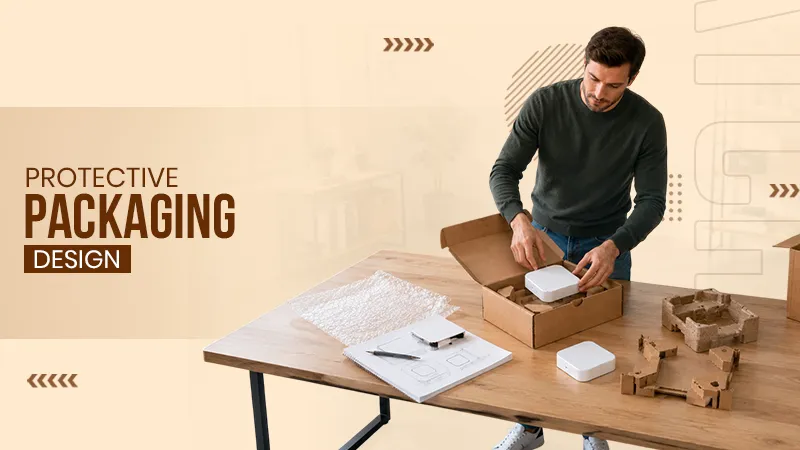

“Form ever follows function” – Louis Sullivan (Architect)
The aesthetics of the packaging box should always be of lower priority than how efficiently the container can package the actual product. As per research, emerging packaging systems propose 98% utilization of container floor area. Besides area usage, the packaging should also protect the product so it’s transported to the customer harmless and spotless.
It becomes even more important in the case of fragile electronic items, family monitoring hubs being one such product. The outer container, inner carton, cushioning, and compartments all play a role in transporting the delicate device from warehouses to customers.
KEY TAKEAWAYS
- Electronics with their microscopic construction are fragile items that need to be handled with care.
- Structurally strong and impact-absorbent packaging can withstand transit drops and vibrations.
- Ideally, a foam cushioning of 50mm (2 inches) is recommended inside all six sides of the container.
- Test the packing with prototypes and label the actual containers properly.
The microscopic construction of electronics is the reason for their fragility. Inside, tiny semiconductor pathways and microscopic pixel arrays are encased in ultrathin layers.
These components are highly sensitive to even minuscule structural defects. Temperature fluctuations, moisture, and environmental hazards like static electricity can also damage them significantly.
So, protecting delicate electronics like family monitoring hubs (i.e., IoT sensors, medical monitors, or cameras) during transit becomes really difficult. These devices are getting popular as parents are getting digitally literate in this hyperconnected world.
A protective carton that is used for transporting family monitoring hubs must combine structural rigidity with dynamic shock absorption. It should prevent “bottoming out”, decouple the device from external impacts, and eliminate internal resonance.
Utilize a double-wall construction featuring B-flute (for puncture resistance) and C-flute (for shock absorption). The design of the carton should be such that the load can be handled by the corners and edges. The carton flaps should meet perfectly instead of bowing inwards. That transfers the pressure to the equipment.
For better shock absorption during drops, use a crash-lock or auto-bottom design in inner cartons. Extended dust flaps and 45-degree angle corner locks prevent the top lid from caving in with external impacts.
A professional packaging design agency in Austin keeps all these aspects in mind while packaging items.
The cushioning material must absorb mechanical shocks. The hub’s weight should be equally distributed.
The cushioning material can either be polyethylene (PE) or polyurethane (PU) foam. PE foam is a closed-cell foam. It is non-abrasive and offers superior protection from multiple impacts. PU foam, on the other hand, is a soft, open-cell foam. This one molds perfectly to irregular shapes.
Additionally, make sure it’s ESD-safe (Electrostatic Discharge safe) to prevent electrical shorts and static buildup.
The cushioning foam must be at least 50mm (2 inches) wide on all six sides, between the device and the outer box.
MARKET STATUS
The Global Packaging Inserts and Cushions Market is $3.56 billion and is estimated to grow to $6.34 billion by 2034.
For prototyping, utilize CAD software to draft the exact dieline. Then create physical prototypes using flatbed digital cutters. This allows testing fold quality, tab-locks, and product clearance before committing to bulk die-cutting.
ASTM International has set many standards for testing prototype packaging design. Conduct drop tests with samples on all edges, corners, and faces, from a height of about 30-48 inches. To simulate vehicle and transit vibration, expose the carton to 200Hz frequency and ensure no internal components experience resonance. For environmental tests, pass the carton through varying humidity and temperature extremes.
Estimate G-force impact through shock transducers placed inside the cartons. Increase the foam thickness if it’s over the fragility threshold of 40-60 Gs. Keep adjusting the dielines and foam density as damage inspections go through.
The regulations around parental monitoring are evolving rapidly as AI is entering the picture with AI parental controls. But for the time being, the outer packaging must be compliantly labelled with:
Unboxing is the first impression of your product for customers. So incorporate thumb notches or tear strip perforations instead of heavy taping to reduce unboxing friction. The monitoring hub should be the focal point during unboxing. Keep other accessories in under-box compartments or pull-out trays. For a premium unboxing experience, use magnetic closures or friction-fit hinged rigid boxes. The quick start guide should be one of the first things to come out of the box.
Keeping fragile electronics like a family monitoring hub protected through transit and delivery is extremely difficult. However, things are getting better with AI ecommerce platforms.
Regardless, a structurally strong and impact-absorbent carton design makes it possible to package the equipment appropriately.
The security of the family is dependent on the security of the equipment used for it.
The four Cs of packaging stand for Clarity, Creativity, Consistency, and Consumer-Centricity.
The seven functions of package design are protection, containment, preservation, communication/information, convenience, security, and branding/marketing.
The 5 Ps of packaging are Promote, Position, Present, Provide, and Protect.