For clean, single-speaker audio, yes, most modern tools land in the mid-90s to high-90s percent accuracy range. For noisy, multi-speaker, or heavily accented audio, expect more riff and plan to spot-check important sections.


Quick Answer: Speech-to-text AI is now roughly 95-98% word accurate on clean, single-speaker audio. But real-world recordings have background noise, accents, overlapping speakers, and technical jargon, which can still produce significant errors. And the bigger challenge in 2026 is no longer simply converting speech into words, but turning those words into structured, usable data with speaker labels, timestamps, punctuation, and export options. So, even as accuracy improves, the quality of the final output still depends heavily on the audio and what you need to do with the transcript afterward.
Under the hood, most speech recognition tech runs on a pipeline of two connected models: an acoustic model that maps sound waves to phonetic units, and a language model that predicts which sequence of words those sounds most likely form. Older systems handled these as distinct stages. Most voice-to-text models built since 2023 use end-to-end neural architectures that learn both steps jointly, which is a big part of why accuracy has climbed so quickly in the past few years.
At the industry level, the metric measuring this accuracy is called Word Error Rate (WER), the percentage of words a system gets wrong compared to a human-verified transcript. On clean, single-speaker audio, the best audio transcription engines now land in the 95-98% word accuracy range, as per AssemblyAI’s 2026 benchmark analysis. That number sounds close to solved. In practice, it depends heavily on the conditions the audio was recorded in.
Lab benchmarks seldom reflect real-world recordings, and this is where a lot of AI transcription software quietly underperforms:
None of this makes the technology unreliable. It means results vary a lot more by use case than the marketing numbers tell.
Accuracy earns most of the attention, but for anyone actually using this technology daily, the bigger issue is what happens after the words are on the page. A flat wall of text with no structure is only marginally more useful than the original audio file.
This is where the gap between basic ASR and a genuinely good workflow tool shows up. Three things tend to separate the tools people keep using from the ones they abandon after a week:
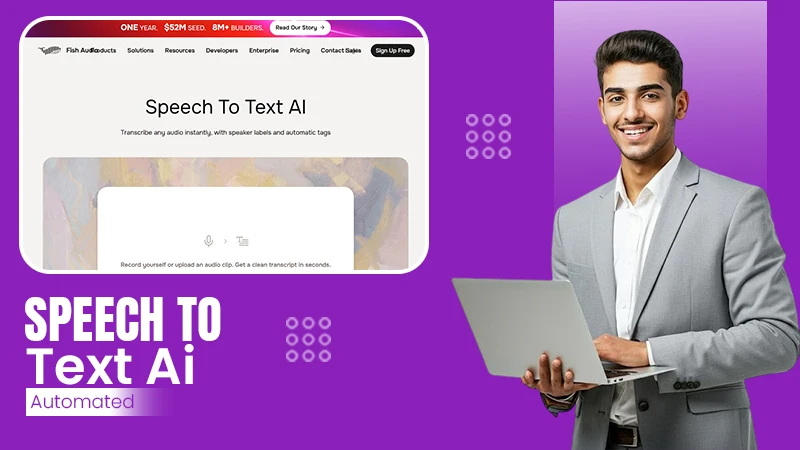
Fish Audio is a platform that closes this gap rather than merely optimizing raw word accuracy. Its speech-to-text tool automatically detects individual speakers in multi-person recordings, tags emotional and paralinguistic cues like pauses, laughter, or emphasis directly inline in the transcript, and exports to SRT, VTT, or JSON depending on whether the work is headed for video subtitles, a website embed, or another piece of software. It’s a useful illustration of where the category is heading: fewer standalone transcript files, more structured output that plugs straight into a video, a podcast, or an accessibility workflow without manual reformatting.
MARKET OUTLOOK
The global voice and speech recognition market is valued at $31.7 billion in 2026 and is projected to reach roughly $53.7 billion by 2030, according to Grand View Research.
The use cases stretch well beyond corporate meeting notes:
In each circumstance, the actual value shows up after transcription, in how easily that text can be searched, edited, exported, or fed into the next tool in the workflow.
The subsequent phase of this technology looks less like “better word accuracy” and more like better structured output. Multilingual support is expanding well past the handful of major languages that used to dominate the space. Real-time transcription is getting sufficiently fast for live captioning and live translation. And the line between transcription and voice production is starting to blur; tagged transcripts that capture tone and delivery can now feed directly back into text-to-speech systems, closing the loop between spoken and rendered audio.
For anyone evaluating Speech to Text AI options in 2026, the practical takeaway is to look past headline accuracy numbers and test the tool against your actual audio, your actual pronunciations, and your actual downstream workflow. That’s a far better predictor of whether it’ll earn a permanent spot in your toolkit than any benchmark score.
For clean, single-speaker audio, yes, most modern tools land in the mid-90s to high-90s percent accuracy range. For noisy, multi-speaker, or heavily accented audio, expect more riff and plan to spot-check important sections.
Many now can, through a feature usually called speaker detection or diarization. Accuracy improves when you tell the tool the number of speakers in the recording rather than leaving it to guess.
SRT is a popularly supported format across YouTube and major video editors. VTT is the web-native equivalent for embedding video directly on a site. JSON is useful if you’re passing the transcript into another piece of software rather than using it as subtitles instantly.
Most platforms offer a free tier that covers light, occasional use, with paid plans scaling by minutes processed. For everyday use, it’s worth comparing per-minute or per-character pricing across a few tools rather than defaulting to the first one you try.