Yes, most tea houses in frequently visited villages provide Wi-Fi connection for which one needs to pay, though the performance is reduced with an increase in altitude.

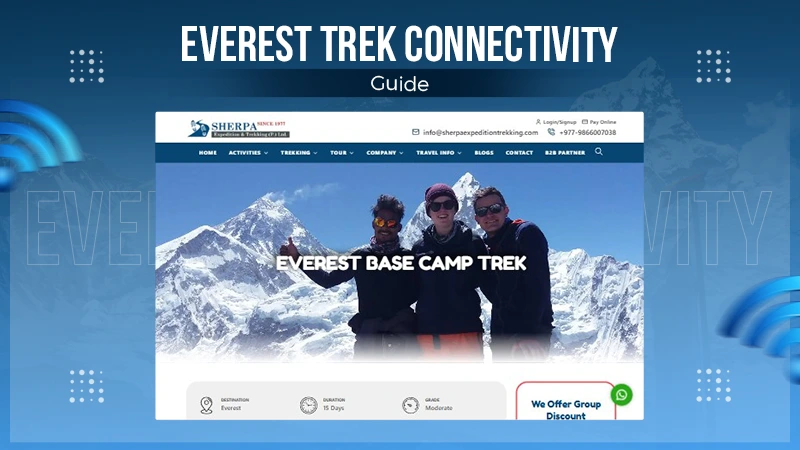
There is no shortage of spectacular views of the Himalayas, remote Sherpa villages, and adventures of a lifetime on the EBC Trek. While trekking is the ideal way to get away from the busy life and disconnect, many trekkers find themselves needing to stay connected through internet and mobile services.
Luckily, connectivity in the Everest area has been enhanced, but there are limitations due to height, weather, and other factors. This guide will provide information on what trekkers can expect in terms of Wi-Fi, phone services, electricity, and charging devices during the EBC Trek.
If you are planning your trip to the popular Everest Base Camp trekking route, then you’ll find that internet services will be much more accessible than you have ever thought before. There are tea houses on the way where trekkers can use a Wi-Fi connection to contact their family, get the latest updates, and share their experience of the Himalayas.
The problem with the internet here is that the speed is quite slow due to the poor infrastructure and satellite connection. Out towards Dingboche, Lobuche, and Everest Base Camp, it’s not as reliable. The internet should be a service that trekkers need to see as a possibility but not something they think is available all along the trek.
Mobile networks in Nepal have been growing steadily; thus, mobile networks along the Everest Base Camp Trek have been getting better and better. The two biggest providers in Nepal, Ncell and Nepal Telecom, each straddle many different regions of Everest. Yours, namely, those at lower altitudes, like the villages of Namche Bazaar, often make for much more reliable signals, but stretches of trail that are less populated can be isolated and without either phone or internet connectivity. However, weak signals at higher settlements close to Everest Base Camp are also expected due to challenging terrain and blockages from the mountain. A local Nepal SIM card may help trekkers seeking more reliable communication during their trek.
While visiting Nepal, many international trekkers usually like to buy a local SIM card since it is pretty simple and has a very cheap tariff for cellular data and voice communication services. The main networks that are common in Nepal are Ncell and Nepal Telecom (Nepal Tel), available for the Everest region but not covering all areas. Availability of the signal is heavily influenced by both altitude & location, meaning neither provider can offer full-service coverage throughout the entire Everest Base Camp Trek. While leaving the zones of better network availability, travelers should download necessary maps and trekking information.
Charging your electronic devices is an important subject for trekkers heading to Everest Base Camp. Charging services are provided by most tea houses along the trail for smartphones, cameras, power banks, and other electronic devices. Charging usually makes you pay too, and the higher you go in altitude, the higher the prices are, but dirty resources are fewer. You are limited to data until October 2023. You might not have the opportunity to charge at busy locations, especially in really remote areas during peak utilization. A good quality power bank/portable solar charger is also advised for trekking, as backup power is always better.
The electricity is getting better in terms of supply but is not comparable to what is available in urban areas yet. It runs through solar energy or small-scale hydro projects (the option of generators can be used in case of overrunning). This is much easier in lower settlements, while many bigger settlements are at very high altitudes and have shorter electricity availability.
Cold has its toll on battery performance too, especially feeling how fast your batteries die when it gets so cold that you take a step into the uncharted land of stories with gas (or rather args) computers (which you call cameras & smartphones). This would be solved with warm batteries, as well as more charging options. This enables the trekkers to make lifelong memories and stay connected during their trip to Everest Base Camp Trek.
However, if trekkers plan a bit well in advance and can leave the connectivity racket behind for the better, they can be haphazard. Things to do: download offline maps, store important files, and inform family members that your ability to communicate could be restricted.
As a strategy towards homogeneity, carrying your electronic devices as an example, carrying collectibles or electronics that have a battery or adopting power-saving modes and restricting the overloaded statistics usage, why do they want me to present my devices every 8 days? Since climate and technical considerations play a major part in the provision, tourists should not entirely keep to internet services. You are out of touch with the day-to-day life in the Everest region; lack of connectivity becomes a part of the experience rather than a major disturbance.
You read it right; because of the lack of internet and mobile networks, you have another option for emergency communication on the Everest Base Camp Trek. In more remote areas, trekking agencies, guides, and tea houses have also frequently faced barriers in terms of communication.
On the other hand, SAT phone equipment could be established for emergencies. Training on data until October 2023 means the help of an experienced guide can offer additional support since local teams are familiar with the geography, weather, and available resources. For the safety tips throughout that trek, make sure to tell someone who you are going with and what your plans of action are.
The Everest region is now developed enough to have Internet, Wi-Fi, power banks, and mobile phone connectivity in most places, which makes this trek easier today compared to how it was 10 or 15 years ago. Despite this, travelers can still expect slow internet speeds, fewer points of sale, and larger fees than at everyday destinations. These mountains blend modern connectivity with an old passion: finding the Himalayas. A good plan, reliable equipment, and realistic expectations can still allow trekkers to take on the amazing journey of Everest Base Camp with a little prep work for this trek while remaining reachable when necessary!
Yes, most tea houses in frequently visited villages provide Wi-Fi connection for which one needs to pay, though the performance is reduced with an increase in altitude.
Ncell and Nepal Telecom (NTC) serve as the best networks, though their performance varies according to location and elevation.
Yes. Most of the tea houses provide charging services in exchange for money, and the rates increase according to elevation.
You can download maps offline, carry important documents, a backup power bank, and tell your family that there will be limited connectivity on some parts of the trek.