It sends an SMS location request to the person’s phone. When they approve it, the location is shared instantly.

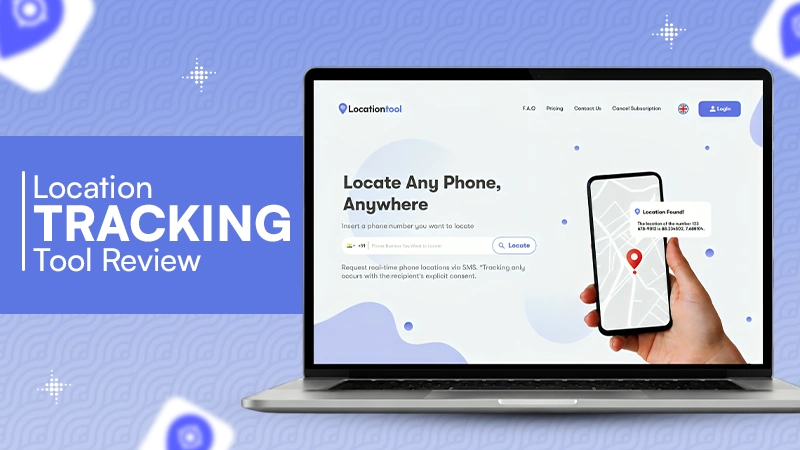
Quick answer: LocationTool allow the user to request someone’s location by SMS and without forcing them to download an app. When the receiver accepts it, the location is shared instantly.
Various tools are available for device tracking in the industry. LocationTool takes a completely different approach to phone location tracking. Unlike other apps, it does not need an additional app; it simply shares an SMS asking the recipient to share their location.
For this one, I have properly reviewed it, experienced its main features and noted the limitations associated with the pricing considerations. Here, you will get everything you should know before deciding whether LocationTool is worth considering.
Know it well, before bringing it into use…

Take a superficial understanding of its relevance and use before diving deeper:
Overall rating: 4.7/5
Most suitable for: Families, couples, parents, and other people who want to find out someone’s location without hesitation.
Main advantage: There is no software to retrieve or install.
Main limitation: A location is only exchanged when the recipient responds to the request and offers to share it.
Bottom line: LocationTool is better recognized as a location-request service than a traditional tracking application. Its consent-first design makes it simple and accessible.
LocationTool works through a web browser.
The process initially starts when you enter the mobile number of the person whose location you want to request. LocationTool then delivers that person an SMS along with a request to share their location.
The recipient must comply with the message and approve the request. Once permission is granted, location information can be presented on a map.
That means there is an important variation between LocationTool and conventional tracking software: LocationTool does not silently identify a phone’s location in the background.
The person holding the phone continues to be part of the process.
If they do not open the request, reject it, or simply choose not to respond, you will not receive their geographic coordinates.
Also, explore smart routing services – using location data to improve safety.
LocationTool’s usefulness relies less on the technology than on the person receiving the request.
When that person cooperates, the system is clear.
When they do not, there is no second tracking method built into the service.
For example, the recipient might:
In all of those instances, LocationTool cannot simply bypass the recipient and track their position anyway.
That is beneficial from a privacy angle, but it also limits the service in scenarios where receiving a location quickly is paramount.
The platform is intentionally uncomplicated.
Rather than serving users with a large monitoring dashboard, device-management tools, or extensive configuration menus, LocationTool sets its sights on a short request process.
You enter the relevant phone number, set the message, send the request, and wait for the other person to provide an answer.
There is ultimately very little technical knowledge required.
For people who dislike installing apps, putting together permissions, or connecting multiple devices, that simplicity may be one of LocationTool’s biggest appeals.
At the same time, users hoping for a full-featured family tracking platform may find the experience highly limited.
Here are the most distinctive features of the tool mentioned. Each one has its own relevance:
The foremost feature of LocationTool is its text-message location request.
Instead of placing detection software on another person’s device, the service contacts them directly and asks for their approval to access their location.
After approval, the desired location can be shown precisely on a map.
Users can change the text sent with the location request.
This is more valuable than it initially sounds.
Because the recipient needs to admire the message enough to interact with it, clearly explaining who is demanding their location and why may improve the chances of capturing a response.
A personalized message can look slightly more legitimate than a fictitious automated request.
LocationTool does not expect you to install special software on either device.
That removes a dozen steps normally associated with phone-tracking apps, such as downloading an application, creating identities, configuring background location access, or physically observing the other person’s phone.
Because the request is issued through SMS rather than a dedicated mobile app, the system is meant to work across both Android and iPhone devices.
It is also not tied to one niche mobile carrier.
The phone still needs to be functional and capable of receiving the request for the system to work.
The service can be operated through a web browser rather than through a specially designed desktop or mobile application.
Its relatively narrow purpose also means the software interface does not require much guidance.
LocationTool makes the most logical sense when the recipient already recognizes why you are asking for their location.
Imagine two family members meeting in an unknown city, a parent checking where a child is after arranging it beforehand, or two people calling for a pickup.
In situations like these, the recipient has little reason to be distrustful of the request and is likely to acknowledge it.
That is where LocationTool’s design works exceptionally well.
There is no app setup, no device pairing, and no need to maintain a consistently active tracking account between both of them.
You can easily send a request when you need one.
The same strategy can become a threat when cooperation is uncertain.
LocationTool cannot promise that someone will respond to its SMS.
This makes it less helpful for emergencies or situations involving an agitated person.
It also means LocationTool should not be equated with services that continuously share location after being configured in earlier stages.
There is no discrete tracking mode, silent location retrieval, or automatic last-known-position fallback set forth in the service model reviewed here.
For some users, that is literally the point.
For others, it might be a deal-breaker.
LocationTool is most useful when everyone around them knows that location sharing may be called for.
Some scenarios include parents and children who have already agreed on check-ins, couples coordinating travel, relatives recognizing one another, or individuals requesting a location from someone for helpful reasons.
It may also be useful in special situations involving your own misplaced phone, provided another person can examine the device and instantly respond to the request.
Small businesses may likewise find a consent-based location request useful when interacting with customers, contractors, or other contacts who have promised to provide their position.
LocationTool is unlikely to be the best choice if you ask for continuous location tracking and analysis.
It is also a problem if the person you want to come across cannot or will not respond.
People who are searching for emergency tracking, hidden monitoring, or guaranteed real-time location data should take note that LocationTool is not designed for those features.
If you want long-term family location sharing, you may prefer a unique family-safety service where everyone installs the best software and grants ongoing permission in advance.
The pricing varies based on the need and the use case. Below is how trial and subscription work:
LocationTool offers a low-cost launch trial priced at $1.25 for US customers according to the pricing specs reviewed here.
The trial is portrayed as providing access to the service rather than functioning purely as a restricted display.
That gives aspiring users an inexpensive way to see whether the location-request process mirrors their needs.
After the introductory briefing, the service moves into a yearly paid subscription.
Because trial offers and subscription prices can shift by market or promotion, it is worth checking the renewal amount and billing terms posted during checkout before completing your payments.
If you only aim to test the service, reviewing the cancellation criteria and renewal date is particularly useful.
Not every phone-location service works in the same way, so matching LocationTool directly with every tracking application can be deceptive.
Broadly speaking, there are several solutions to location sharing.
Some services offer one-time requests, as LocationTool does. Others require family members to install an application and proactively grant location permissions. Built-in services from smartphone producers may also allow users to locate their own devices or voluntarily share their location with honored contacts.
The right choice depends on whether you favor convenience, ongoing tracking, privacy, emergency security, or one-time location requests.
When considering alternatives, look intently at three things:
Also, learn how developers use time-saving methods while acquiring location information.
After considering it all, I will suggest using it as its different approach makes it unique and effective. It simply shares an SMS, takes the user’s content and gets their location without forcing them to download an extra app. This makes it relevant for families, couples and friends who want occasional location sharing.
The foundation is clear: if the user denies location sharing, the app cannot do more. Its consent-friendly behaviour makes it a perfect fit for everyone.
It sends an SMS location request to the person’s phone. When they approve it, the location is shared instantly.
No, the service works through a web browser and SMS. So, no one has to download an app.
No, it is only possible for the web to share information when another person approves the SMS request.