No. It changes what the team spends time on, shifting effort from repetitive execution toward policy setting, exception handling, and broader strategic oversight.



Quick Answer – The AI-driven autonomous endpoint management detects, prioritizes and resolves problems related to endpoint devices automatically without any manual intervention. With this capability, IT professionals can focus on implementing policies and dealing with exceptions only.
Current IT departments no longer need to handle just a few machines; they must manage thousands of machines, from laptops and mobile devices to servers and an increasing number of sensors, all of which need to be patched, monitored, and repaired independently. The traditional method, where technicians would address each ticket individually, was not meant for this kind of workload, and the mismatch is growing with time.
That is exactly what autonomous endpoint management for IT operations is designed to address. Rather than having some individual notice the problem, evaluate it, and act on it, the technology will do all three of those steps itself.
Key Takeaways
- Autonomous endpoint management uses AI and policy-driven automation to handle routine device tasks without constant human intervention.
- Gartner’s Market Guide for Endpoint Management Tools projects that adoption will climb from nearly zero in 2024 to over 50% of organisations by 2029.
- Manual patching still dominates most environments today, with over half of organisations taking five days or more to patch known, exploitable vulnerabilities.
- The shift is less about new tooling and more about a change in how IT teams spend their time and attention.
- Human oversight does not disappear; it moves from routine execution toward setting policy, defining risk thresholds, and reviewing genuine exceptions.
The device count problem is not hypothetical. Between corporate laptops, mobile devices, and an expanding footprint of connected equipment, the number of endpoints a growing IT team oversees has grown far faster than headcount. A process based on spreadsheets and scripts, which worked for a couple of hundred devices, just cannot keep up.
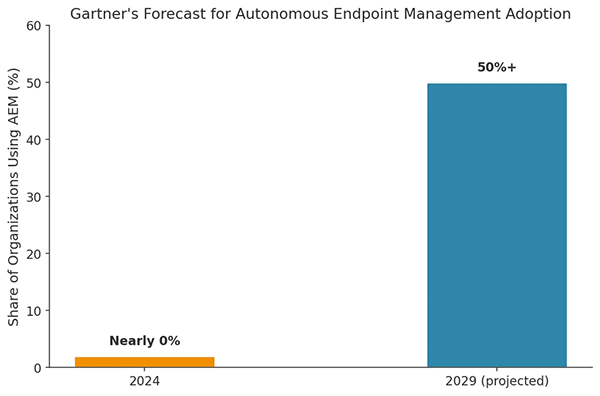
“By 2029, over 50% of organizations will adopt autonomous endpoint management (AEM) capabilities within advanced endpoint management and digital employee experience (DEX) tools to significantly reduce human effort.” — Gartner, Market Guide for Endpoint Management Tools, 2025
That forecast reflects a genuine operational strain, not just enthusiasm for a new buzzword. Manual processes still dominate most environments today, and the resulting delays carry real, measurable security consequences.
Before anything can be managed automatically, it has to be reliably discovered first. Autonomous systems continuously look out for any new or altered devices rather than relying on a periodic manual audit, closing the gap where unmanaged devices quietly accumulate over time.
Instead of pushing every update on the same fixed schedule, autonomous systems weigh severity, exploitability, and business context to decide what gets patched first. Once a vulnerability is found to be exploited in the wild, it gets patched automatically without needing a human to notice and reprioritise manually.
Many routine problems, a misconfigured setting, a failed service, a stuck update, can be resolved by a predefined automated workflow rather than a support ticket. This overlaps directly with endpoint detection and response capabilities, where automated containment and remediation already occur more quickly than a human analyst reasonably could.
Alongside security and patching processes, autonomous systems increasingly track how devices actually perform for the people using them, flagging slowdowns, crashes, or resource conflicts before an employee even files a complaint. This shifts IT departments from reacting to reported problems toward catching degraded performance while it is still a minor annoyance rather than a genuinely productivity-killing issue.
Pro Tip: Start autonomous remediation with low-risk, high-frequency issues first. Building trust in the automation of small wins makes it far easier to expand scope later.
The practical difference shows up most clearly in how long problems sit unresolved and how much of a technician’s day goes to repetitive triage rather than higher-value work.
| Factor | Manual Operations | Autonomous Endpoint Management |
|---|---|---|
| Typical patch deployment time | 5 or more days | Hours |
| Device visibility | Periodic audits, often stale | Continuous, real-time |
| Issue prioritisation | Manual triage, inconsistent | Automated, risk-based |
| Routine remediation | Ticket-driven, technician time | Automated workflows |
| IT team focus | Repetitive execution | Policy, exceptions, strategy |
Autonomous endpoint management is one piece of a wider move toward AI-assisted operations across the technology stack. The same underlying pattern, systems handling routine decisions so people can focus on judgment calls, is playing out in how AI is changing online safety for kids, where automated detection increasingly does the first pass of work that used to fall entirely on human reviewers.
The parallel extends further into consumer-facing AI tools too. Coverage of AI parental controls and the future of smart digital parenting describes much the same shift: automation absorbing the repetitive monitoring work, while a human still sets the policy and reviews what genuinely needs attention.
Autonomous does not mean unsupervised. The systems handling day-to-day execution still operate within policies a human team defines and can override at any point. Automation trends talked about in terms of how custom app developers are creating the future for streaming applications are quite similar – tools help a small team to achieve more, yet decisions are made by humans.
The technicians who once spent their days manually patching and triaging low-priority tickets do not disappear from the picture entirely. Their time shifts toward setting risk thresholds, reviewing automated decisions, and handling the genuine exceptions that still require judgment.
Not all platforms described as “autonomous” deliver meaningfully on that promise. Some simply rebrand existing automation scripts under a newer label without adding genuine machine-driven reasoning. When evaluating options, prioritise:
No. It changes what the team spends time on, shifting effort from repetitive execution toward policy setting, exception handling, and broader strategic oversight.
Smaller organisations often benefit even more, since they typically have far less IT staff capacity to handle manual patching and triage consistently at scale.
Traditional IT tools centralise visibility and manual control. Autonomous systems add machine-driven decision-making, acting on routine issues without waiting for a person to review each one individually.
A well-designed system includes rollback capability and clear audit logs, so an incorrect automated action can be reversed and reviewed quickly rather than causing lasting damage.
It is more likely to reshape roles than eliminate them, moving technicians away from repetitive ticket work and toward higher-value oversight, policy design, and strategic decisions that automation genuinely cannot make on its own.
Given Gartner’s adoption timeline, organisations that start piloting now are likely to have a meaningful head start over those waiting until the practice becomes the industry-wide default expectation.
That future is not a world without IT teams. It is one where the routine, repetitive work that consumes most of a working day gets handled automatically, freeing people to focus on the decisions that genuinely require human judgment.
That shift is already underway. The organisations moving early are not doing so because autonomous endpoint management happens to be trendy. They are doing so because it just doesn’t work any other way.