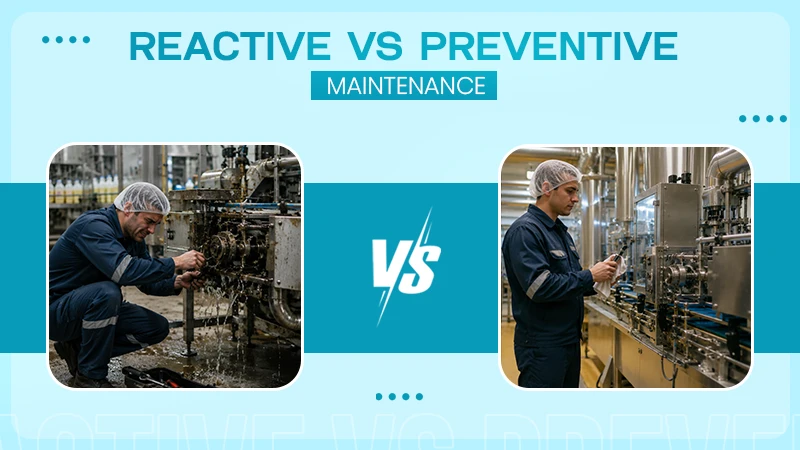
The reactive approach fixes things only when they go wrong, while the preventive approach involves inspections for better risk management.

Industry owners do not realise the importance of maintenance until it actually shows its effects. It does nothing, but simply stops the production either with a major issue in the equipment or by damaging it. And when such a condition takes place, production stops.
Every single second counts as an hour of loss in this situation. To avoid this, learn tips to enhance the production process through investments in CMMS software for food and beverage industry. Along learn difference between reactive and preventative maintenance for seamless downtime.
Key Takeaways
- The main expense related to equipment failure is not the cost to repair it, but the production delays it causes.
- Preventive maintenance serves better schedules that allow manufacturers to avoid costly emergency repairs.
- Maintenance data turns valuable over time, allowing teams to identify repeated issues and make smarter decisi
Every food manufacturer confronts the same core challenge: keeping equipment on spot when production wants it. The differences in how facilities reply to major failures.
Reactive maintenance, also known as run-to-failure maintenance, means equipment is fixed only when it fails.
The approach is simple enough. Maintenance funds are only put forward when a service breaks down, and there is no motive to spend time on equipment that looks to be doing fine. This process can be practical for some private assets.
A warehouse exhaust fan, a secondary conveyor, or low-cost equipment that has little affect on production might not warrant much extra support. Operating these assets until collapse may be economically beneficial. The problem starts when reactive support becomes the default tactic for critical business equipment.
Preventive maintenance takes the reverse path. Rather than preparing for equipment to fail, maintenance teams plan audits, cleaning, calibration, lubrication, and feature updates at planned intervals.
The goal is not to wipe away every loss. No maintenance program can do that. Rather, preventive maintenance is designed to limit unplanned failures and detect emerging problems before they cause issues with production.
A mechanical failure in a general manufacturing setup can be expensive. In food and beverage production, the results often extend beyond repair charges. A failed mixer, packaging machine, refrigeration unit, or cooking system can result in:
The cost of downtime mostly tops the cost of the job itself. Think about a packaging line error during peak growth. While maintenance groups work on the equipment, other activities may go on to result in products. If storage capacity is tight, inventory can quickly pile up, pressuring operators to slow production or delete products all together.
The repair bill ends up being only one part of a much higher operational cost.
Emergency maintenance never happens under ideal conditions. Parts may not be on hand. Technicians may need to work after normal shifts. External service suppliers may need to be called in at short notice. These settings often have three issues going on at once-
In times when a lot is at stake, teams focus on having operations up and in motion as soon as possible. This cycle is typical in facilities that rely largely on reactive maintenance. Equipment fails, production starts up after repairs, and the focus goes back to daily operations until the next crash.
Preventive maintenance is often defined broadly, but its value lies in direct, measurable upgrades. Predictability is one of the biggest benefits.
Scheduled maintenance allows buildings to perform critical work during planned intervals, rather than while the plant is running. This serves you with an operational ability that reactive maintenance simply can’t deliver.
Typical advantages include-
These perks are likely to grow over time. You rarely see amazing results from only one checkup or service job. The real gain comes from months and years of solid maintenance habits.
Food processing equipment marks a vital capital investment. Cooking systems, fillers, pumps, refrigeration equipment, conveyors, and packaging machinery are likely to serve safely for many years.
Yet equipment life is typically limited by several small maintenance defects. For instance, poor lube can foster component wear, or a twisted conveyor can place unwanted stress on nearby systems.
Preventive maintenance fixes these issues before they grow worse.
At the end of the day, no manufacturer can ensure there will be no issue in the equipment. But they can definitely decide how prepared they will be when things go wrong. This gives much positive confidence and reduces the downtime as much as possible.
While people find a reactive approach a great way to resolve things, it often results in increased costs and production delays. Opposite to this, a preventative approach allows employees to stay ahead and keep production going on with greater confidence.
The reactive approach fixes things only when they go wrong, while the preventive approach involves inspections for better risk management.
Critical production assets, such as filling machines, are the ones that benefit the most.
Yes, when the main concern is price, reactive maintenance can serve as a great strategy with required safety.