The geofencing market size is forecasted to reach almost $7 billion by 2031, highlighting how location-based automation is becoming a critical part of modern operations.
Geofencing has evolved from a simple GPS feature into a core operational tool for field service businesses. In 2026, companies use it to verify job-site arrivals, automate time tracking, reduce payroll errors, improve dispatch decisions, and provide verifiable proof of service.
The strongest adoption is occurring in industries with mobile workforces, route-based operations, fixed job locations, and high service expectations. From HVAC and utilities to construction, security, logistics, and home healthcare, organizations are increasingly relying on geofencing to gain real-time operational visibility.
The shift is about far more than tracking location. It is about creating reliable, automated proof that work happened where and when it was supposed to.
KEY TAKEAWAYS
Geofencing has evolved from a tracking tool into a core operational technology for field service management.
Logistics, security, construction, utilities, HVAC, and telecom are among the industries seeing the strongest adoption.
The biggest business benefits include improved time tracking, faster dispatching, stronger proof of service, and better job costing.
AI makes systems more effective when supported by accurate location intelligence data.
What Geofencing Means for Field Service in 2026
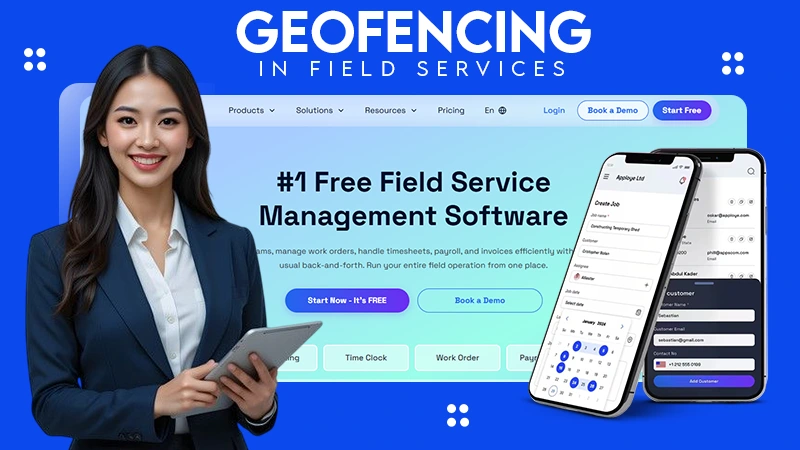
Essentially, a company creates a virtual boundary around a job site, service zone, customer property, warehouse, depot, or restricted area. When a worker or vehicle enters or exits that area, a field service management software like FieldServicely, triggers an action like:
Clock-in/clock-out
Arrival alert
Route update
Job status change
Safety warning
Customer notification
This ability to trigger automated actions from location events makes geofencing valuable. A technician does not need to call the office to say they arrived. A cleaner does not need to manually prove attendance. A dispatcher does not need to guess which worker is closest to the next urgent job.
In practical terms, location data is turned into workflow data.
The 2026 Market Signal
The adoption signal is strong because three connected software markets are growing at the same time.
The field service management market is expected to grow to USD 9.87 billion by 2031. That shows steady demand for scheduling, dispatching, mobile workforce management, route optimization, and field reporting tools.
The active geofencing market is expected to grow to USD 6.97 billion by 2031. That growth rate is much higher than traditional field service software growth, which suggests companies now want more location-aware automation.
The wider location-based services market is even larger. It is expected to reach USD 210.54 billion by 2031.
Together, these forecasts point to a clear industry shift toward location-driven automation. Instead of being separate, field management software, geofencing, and location intelligence now overlap in daily operations.
Why Adoption Is Rising Across Field Service Industries
Adoption is rising because field service teams face the same pressure in different industries.
They need faster response times. They need cleaner time records. They need better job costing. They need fewer missed visits. They also need proof when customers question service delivery.
Manual updates cannot support this level of demand. A dispatcher handles hundreds of jobs per day. A supervisor manages technicians, guards, cleaners, installers, or inspectors across several sites.
Geofencing helps eliminate those visibility gaps by automatically connecting field activity with operational records.
It gives companies a simple way to connect a person, place, time, and task. That connection improves accountability without adding more admin work.
Field Service Industries With the Highest Geofencing Fit
Geofencing fits best when location matters to the service outcome.
That is why adoption looks stronger in industries where workers must reach a specific property, route, gate, room, asset, or service zone.
1. Logistics and Fleet-Based Field Service
Logistics is the most mature and impactful use case.
Fleet operators use geofences around depots, customer locations, loading zones, delivery areas, and restricted routes. This helps track arrival times, dwell time, route adherence, and proof of delivery.
In addition to tracking vehicles, firms use geofencing to improve dispatch planning, reduce idle time, and support customer updates.
The strongest value comes from automated arrival and departure records, reducing disputes over delays, missed stops, and delivery windows.
2. HVAC, Plumbing, and Electrical Services
HVAC, plumbing, and electrical companies use geofencing to improve technician accountability.
These companies often run many short jobs across a city. Managers need to know:
When technicians reach a customer site
How long do they stay
Whether the job time matches the invoice
Geofencing helps automate job start and job completion records. It also helps dispatchers assign urgent calls to the nearest available technician.
This matters as response time and first-time fix rate impact customer satisfaction. A technician who arrives with the right part, at the right location, and on time creates a better service experience.
INTERESTING STAT A study revealed a 300% increase in sales results using geofencing technology.
3. Utilities and Energy Services
Utilities use geofencing for:
Field crew tracking
Outage response
Safety zones
Asset maintenance
A utility company may send crews to power lines, substations, water systems, telecom towers, or gas infrastructure. These job sites often involve safety rules and high service urgency.
Geofencing helps confirm whether a crew reached the correct asset or work zone. It can also support restricted-area alerts and emergency response workflows.
Adoption will increase as utilities need real-time visibility. Aging infrastructure, grid modernization, and customer outage expectations all increase the need for accurate field data.
4. Construction and Contractor Services
Construction companies use geofencing for site attendance, crew time tracking, equipment movement, and job costing.
A construction site contains many:
Workers
Subcontractors
Vehicles
Assets
Manual timesheets can create payroll errors and billing disputes.
Geofencing provides a verifiable record of site attendance, helping managers track workforce activity with greater accuracy.
The biggest benefit is labor cost control. Construction margins can shrink fast when hours go to the wrong job code, or workers record time away from the site.
5. Security Guard Services
Security companies have a very direct use case.
A guard must be at the assigned post. If the post is empty, the service has failed.
Geofencing helps confirm site arrival, shift start, patrol presence, and clock-out location. It gives supervisors better proof of coverage across office buildings, warehouses, gated communities, retail stores, hospitals, and construction sites.
The adoption fit is high because location is not just an admin detail in security. It is the service itself.
6. Cleaning and Janitorial Services
Geofencing helps verify service visits at client locations.
This industry often works after hours. Supervisors may not be present when cleaning crews arrive or leave.
Geofencing helps confirm whether teams reached the right property at the right time. It also helps reduce disputes about missed cleaning tasks, late arrivals, and billed hours.
The best use case is recurring contract work. When a cleaner visits the same office, school, gym, store, or medical facility every week, geofencing creates a cleaner service record.
7. Facilities and Property Maintenance
Besides attendance, it supports work order routing, asset checks, safety alerts, and contractor access records.
This helps property managers know whether a technician reached the right building or unit. It also helps maintenance firms prove service delivery to clients.
The adoption fit is strong because many facilities teams manage repeated visits across multiple properties.
8. Pest Control and Lawn Care
They heavily rely on route-based service.
Technicians visit many properties in one day. Customers often ask for proof that the visit happened, especially when they were not home.
Geofencing helps confirm arrival, departure, service duration, and property-level job records. It also supports route planning and dispatch visibility.
This industry benefits from it because the work is repetitive, location-specific, and easy to verify through arrival data.
9. Home Healthcare and Mobile Care Services
Home healthcare uses geofencing to verify caregiver visits and support visit compliance.
Caregivers must reach the patient’s home at the scheduled time. Missed or delayed visits can have direct consequences for patient well-being and continuity of care.
Geofencing helps confirm visit start, visit end, and location accuracy. It can also support electronic visit verification workflows in regions where care delivery requires stronger documentation.
This industry has high adoption potential, but it also needs careful privacy controls. Patient location, caregiver data, and healthcare records require stricter handling than normal field service data.
10. Telecom and Internet Service Providers
Telecom companies use geofencing to manage installation teams, tower crews, repair technicians, and network maintenance workers.
A technician may visit homes, business sites, towers, street cabinets, fiber routes, or network hubs. Geofencing helps confirm arrival and improve dispatch planning.
The main benefit is better coordination. Telecom teams handle urgent outages, planned installs, and repeat visits. Location-aware workflows help reduce wasted travel and missed appointments.
2026 Adoption Maturity by Industry
The adoption level varies by industry.
Some industries already treat geofencing as a standard field operations feature. Others still use it only for time tracking or supervisor visibility.
Industry
2026 Adoption Maturity
Main Use Case
Business Value
Logistics and fleet service
High
Depot, route, and stop tracking
Better ETA, lower idle time, proof of delivery
Security services
High
Post attendance and shift verification
Stronger coverage proof and fewer missed posts
Construction
High
Site attendance and job costing
Cleaner payroll and project cost control
HVAC, plumbing, electrical
Medium to high
Technician arrival and dispatch
Faster response and better time records
Utilities and energy
Medium to high
Crew tracking and asset zones
Safer field work and faster outage response
Cleaning and janitorial
Medium
Client site attendance
Better proof of service and fewer billing disputes
Facilities maintenance
Medium
Work order and property tracking
Better contractor and asset visibility
Pest control and lawn care
Medium
Route visit verification
Stronger proof of recurring service
Home healthcare
Medium
Visit verification
Better compliance and care delivery records
Telecom
Medium to high
Install and repair tracking
Better routing and appointment control
This table should not be read as the exact market share. It shows operational fit based on how strongly each industry depends on location, time, route, and service proof.
The Main Operational Benefits
Adoption accelerates when organizations can directly link geofencing to measurable operational and financial results.
The most common benefits fall into five areas.
1. Better Time Tracking
Geofencing improves time tracking as employees clock in from the right job site.
This reduces buddy punching, early clock-ins, false attendance, and manual timesheet errors.
For hourly field teams, this benefit alone can justify adoption. Payroll mistakes create cost leakage every week.
2. Faster Dispatch Decisions
Geofencing helps dispatchers see which worker or vehicle is closest to a job.
This improves urgent job assignment. It also supports smarter routing across cities, territories, and service zones.
The best field service teams do not dispatch based on guesswork. They use location, skill, availability, inventory, and job priority together.
3. Stronger Proof of Service
Geofencing gives companies a better record of service delivery.
It helps answer basic questions. Did the worker reach the site? When did they arrive? How long did they stay? Did they leave before the job ended?
This matters in contract-based industries. Security, cleaning, pest control, facilities maintenance, and home services all face customer questions about service completion.
4. Cleaner Job Costing
Geofencing helps companies assign labor hours to the right job, site, or project.
This improves job costing because recorded hours match actual work locations more closely.
Construction, facilities maintenance, and contractor services benefit strongly from this. Labor cost errors can distort project profit and make pricing decisions harder.
5. Better Safety and Compliance
Geofencing can support safety zones and restricted-area alerts.
A company can flag entry into a dangerous area or confirm that a worker reached a required checkpoint.
This works well for utilities, energy, construction, security, and lone-worker roles. It does not replace safety training, but it gives managers a stronger operational signal.
The Data Behind the Business Case
Field service performance data supports the move toward location-aware operations.
Benchmark data shows that top performers can reach much higher first-time fix rates than bottom performers. Better tools, real-time information, and stronger field visibility help close that gap.
Avoidable truck rolls also remain a major cost problem. Field service benchmark data shows that about one in seven on-site visits could have been avoided with better troubleshooting tools and training.
This highlights where geofencing fits within the broader ecosystem. It does not solve every service problem by itself. However, it improves the location layer that dispatch, routing, time tracking, and customer updates depend on.
The stronger view is this: geofencing becomes more valuable when it connects with scheduling, work orders, payroll, mobile forms, fleet tracking, inventory, and customer communication.
Why AI Is Increasing Geofencing Value
AI adoption in field service is also raising the value of geofencing.
To make useful decisions, it provides one of the most important operational inputs for AI systems: accurate location context.
Geofence data improves route suggestions, detects late arrivals, flags unusual time entries, predicts travel delays, and recommends the nearest qualified technician.
In 2026, this matters because field service companies want automation that improves real operations. A smart system won’t work well without knowing:
Technician location
Job location
Travel time
Service zones
Geofencing gives AI cleaner input. That makes dispatch automation more useful.
What Slows Adoption
Adoption still faces barriers.
The first barrier is privacy. Location data can feel invasive if companies track workers without clear rules.
The second barrier is a poor setup. A tight geofence around the wrong building entrance can block valid clock-ins and frustrate employees.
The third barrier is weak mobile behavior. Workers may disable location access, carry low-battery phones, or work in low-signal areas.
The fourth barrier is integration. Geofencing works best when it connects to payroll, scheduling, work orders, routing, and reporting. Standalone tracking often creates another data silo.
The fifth barrier is management culture. If a company uses geofencing only to punish workers, adoption will face resistance. If it aims to improve proof, fairness, safety, and planning, workers accept it more easily.
Privacy and Compliance Will Shape 2026 Adoption
Privacy will become a bigger adoption factor in 2026.
Companies need clear policies that explain what they track, why they track it, when tracking starts, and when tracking stops.
The safest model is simple. Track during work hours, for work purposes, with employee notice and limited data access.
Companies should avoid tracking workers after hours unless a clear legal and business reason exists. They should also avoid collecting more location data than they need.
This matters because geofencing can improve operations and still damage trust if used badly.
Long-term adoption depends on transparency, trust, and clearly defined data governance practices.
Best Practices for Field Service Companies
The best geofencing setups follow a practical pattern.
Organizations typically see the fastest return on investment when they begin with a single high-impact use case. For many teams, that means geofenced clock-ins, job-site arrival alerts, or proof of service.
Companies should also test every geofence in the real world. Maps do not always match entrances, parking lots, basements, gates, or service yards.
Managers should keep geofence boundaries realistic. A radius that looks strict on a screen may fail in the field because of weak GPS signals or building interference.
Teams should train employees before enforcing the system. A short training session can prevent many support issues.
Companies should also review exception reports often. Late arrivals, failed clock-ins, and location mismatches can show real operational problems.
Most importantly, geofencing should support better decisions. It should not become a surveillance habit.
What 2026 Adoption Says About the Future
Geofencing will keep spreading across field service industries because it solves a simple problem.
Field work happens away from the office. Managers need accurate field visibility without slowing workers down.
The next stage will be connecting with AI dispatch, workforce scheduling, customer ETA updates, asset tracking, and compliance reporting.
The strongest adoption will come from companies that use geofencing as part of a full workflow. The weakest results will come from companies that use it as a basic tracking tool with no process change.
The difference matters.
Geofencing works best when it improves time, place, cost, safety, and service proof at the same time.
Conclusion
Geofencing is rapidly becoming a foundational component of modern field service operations as the business case is clear.
Companies want better proof of attendance, cleaner payroll, faster dispatch, stronger route visibility, and more reliable service records.
Logistics, security, construction, utilities, HVAC, telecom, cleaning, pest control, facilities maintenance, and home healthcare all have strong use cases.
The best view is balanced. Geofencing is not a complete field service strategy by itself.
But it is becoming one of the most important data layers in modern field operations.
FAQs
What is geofencing in field service management?
It’s a location-based technology that creates virtual boundaries around job sites, customer locations, service areas, or facilities. When a worker or vehicle enters or leaves the defined area, the system can automatically trigger actions such as clock-ins, arrival notifications, or job status updates.
Which field industries benefit most from geofencing?
Industries with mobile workforces and location-dependent operations benefit the most, including logistics, HVAC, utilities, construction, security services, cleaning, facilities maintenance, pest control, telecom, and home healthcare.
How does geofencing improve workforce productivity?
It automates attendance verification, reduces manual reporting, improves dispatch accuracy, and provides real-time visibility into field operations. This helps managers make faster decisions while reducing administrative work.
Is geofencing safe from a privacy and compliance perspective?
Yes, when implemented responsibly. Organizations should clearly communicate tracking policies, collect only necessary location data, limit access to authorized personnel, and avoid tracking employees outside of working hours unless legally justified.