The common problem in including setting up multi-factor authentication systems, ensuring that your business software is always up to date, teaching employees how to recognize fraudulent emails, etc.

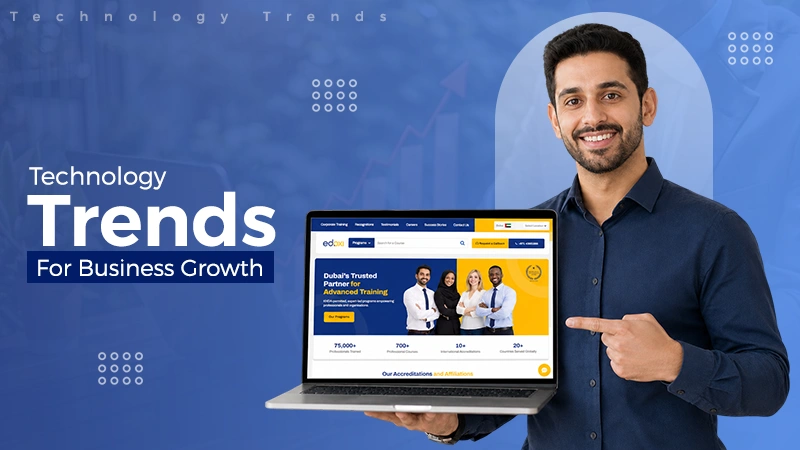
A business becomes successful when it moves forward with the technologies. Corporations also need updates on time that will describe their potential.
In today’s world, AI is also helping businesses to grow; it provides specific software, tools, application that an organization can use. Employees’ work is getting easier; they are growing the company with their potential by using the right tools and AI software.
In this article, you’ll see some top technology trends that businesses are using for their growth.
Ten years ago, a small or medium-sized enterprise might have trusted on an email application, a spreadsheet, and perhaps some basic accounting software.
But today, even a small organization must manage various tools, including
The reason for this increase in the number of applications that are used in the office is not because of the technological captivating of modern organizations.
There is an explanation behind the development of each software tool that simply contributed to solving an issue that first took a long time to solve.
The corporations that are successfully proceeding do not include those that use multiple applications to support their business management. In fact, they are the corporations that realized it is important to connect their applications together.
During incorporation, it became possible for data about sales, customers, and costs to reconcile in a single database and help people make faster decisions without missing essential information.
Dubai is advancing the process of moving to consolidate digital ecosystems. Thereby, it connects business services, data, and platforms rather than running them independently.
This calls for businesses to combine their tools so they can achieve continuous digital workflows across the GCC.
Sharafudhin Mangalad, CEO and Founder of Edoxi Training Institute mentioned that “The true essence of technology is not in having a variety of tools, but in using them to link different tools for better business efficiency.”
In short, it’s not the number of tools a company uses that matters. What’s more important is if the use of the tools is simplified so they form a single balanced system.
Ask any entrepreneur how time is spent, and most of the answer will consist of ordinary tasks:
None of these activities contribute to the company; however, they somehow need to be achieved.
This is where automation becomes operative, and now instead of a person performing these activities, a machine takes care of everything.
A client is registered, and at the same time, an email with a welcome message is sent, CRM data is updated, and a reliable employee is notified about this. What people are likely to overlook is that companies that use automation technology the best are not necessarily using the most complicated tools.
Most of the time, they do nothing but try to write down each of the identical tasks they faced and how to automate those tasks in the process.
AI talk used to live mostly on meeting stages. Currently, it appears in significantly more common scenarios like:
What changed is access; tools that once needed a data science team are now completely folded into the software a business already uses, including email platforms, customer service tools, and accounting systems.
There is no need to create your personal AI to obtain its benefits. Gaining knowledge on identifying the applications of artificial intelligence that will bring about savings in terms of time and the areas where AI will require a human for verification is all you need, and that’s really the shift worth noticing.
AI isn’t taking charge for the people running growing businesses. It’s clearing away the slower, more repetitive parts of the day, so there’s more scope left for the decisions that actually need a human brain behind them.
They used to be a real cost to scaling, such as buying servers, hiring IT staff, and crossing your fingers that nothing shattered under pressure. Cloud software quietly did away with most of that.
A growing business can now reach for the same kind of tools a much larger company would use:
The software just aligns with the business. Whether you add ten employees or ten thousand customers, the system expands smoothly, usually without a full rebuild.
This has mattered most for smaller companies that used to be beyond budget for competing with bigger players on technology alone. That gap has narrowed a lot, a five-person startup can now run on more or less the same collections as a five-hundred-person company, just smaller and cheaper.
Every business that is successful is simply sitting on data-intensity, whether it knows it or not. For years, much of this data has been lying around, immersed somewhere in a spreadsheet that nobody opens twice.
That’s changing; the dashboards and reporting tools have gotten simple enough to set up without a dedicated analytics hire.
A business owner can actually see:
It’s not the businesses collecting the most data that pull ahead, either. Asking questions of the already existing data will make one move faster and more confidently in their undertaking.
Small businesses have traditionally thought of themselves as too worthless to attract hackers, but this has proved to be a costly result. In fact, smaller businesses are now more likely to be targets now that they have improved their security than they were before.
With companies disclosing themselves online to the collection of increasingly more data about their customers, payments, and operations, security cannot be treated as a future problem. And security doesn’t naturally mean investing in expensive corporate systems.
It is often about implementing simple measures, like:
What’s really shifted is the opinion; security used to feel optional. Now it’s closer to a basic requirement for doing business online, not unlike locking the front door of a shop before you go home for the night.
Customers desire speedy responses, personalized communication, and trouble-free interactions irrespective of their channel of communication (like emails, live chats, or social media). But as organizations scale up, the manual execution of this task becomes increasingly inefficient.
This is where customer experience tools come in:
In a growing business, this is not just a bonus but a critical factor that separates a customer who feels taken care of and one who feels just like one of the numbers. As competition becomes more progressively intense in almost every industry, this starts to bring more benefits than the product itself.
Remote and hybrid work didn’t just change where people sit, but it transformed the concept of hiring for a developing company. Now companies are not limited to hiring people who are living within a reasonable distance from the workplace; they hire excellent candidates from anywhere in the world thanks to these technologies.
All the effort is executed with modern tech:
The companies are using the technology effectively and don’t consider it a replacement for in-person meetings anymore.
They use them to build actual processes, so work doesn’t quietly disappear between time zones and inboxes.
For a growing business, this trend isn’t only about where people work from. It’s about building something adjustable enough to hold a team that’s in one city today and spread across five by next year.
With this many trends competing for attention, it’s appealing to just adopt everything at once; that almost always rebounds. Collecting tools without a plan usually creates more confusion, not less work.
The businesses getting real value are likely to do something simpler. They start with an actual problem: slow response times, data that doesn’t talk to itself, nobody wants busywork, and look for the smallest, most responsible fix for that one problem. Before adding anything new, they ask how it fits with what’s already there.
That’s really the difference between growing with technology and just collecting it. The goal was never to have the most software sitting in the toolbar. It’s having the right software, and actually using it well.
None of these trends live in their own small case. Automation only works as well as the data behind it. AI tools get better when the systems beneath them are actually connected. Customer experience improves once security is solid and information moves cleanly between departments.
Businesses that handle technology as a compatible system rather than a variety of separate tools generally adapt more readily to changes.
Companies that are likely to flourish are the ones that are most aware of their business needs, are able to pick the technology that will solve real problems, and are flexible enough to adapt to changes.
It is unlikely that the speed of technology development will decrease. The key is using technology wisely rather than simply because it is available.
Tausifali Saiyed
Tausifali Saiyed is a high-profile AI and technology expert at Edoxi and has admirable experience of about 12 years that covers various fields such as artificial intelligence, machine learning, deep learning, Python development, software engineering, and technology training. His experience not only entails the above-mentioned skills but also includes Java, PHP, MERN, mobile and web development, databases, and software engineering. He attributes a wholesome theoretical background and practical experience that he uses to teach professionals in a way they can apply their knowledge in practice.
The common problem in including setting up multi-factor authentication systems, ensuring that your business software is always up to date, teaching employees how to recognize fraudulent emails, etc.
The top 3 trending technologies include AI, Cloud Computing, and Cybersecurity.
Tools that small businesses are using for growth include a CRM, Project Management Software, Marketing Applications, etc.