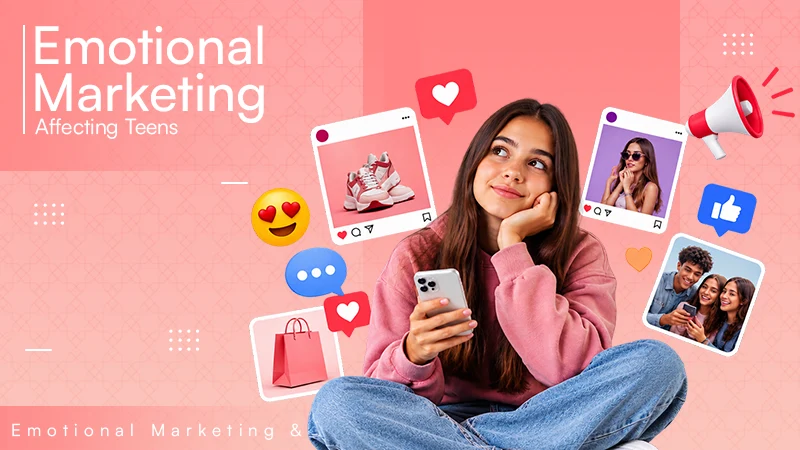
It uses feelings such as excitement, insecurity, belonging, or fear of missing out to influence consumer decisions. Teens may encounter these appeals through social media ads, influencer promotions, and personalized content.


Quick Answer: Teens don’t need much convincing, like adults, to market a product on its usefulness. Sometimes, an ad only needs to make them feel that they need it. From influencer recommendations to personalized social media promotions, emotional marketing uses feelings such as insecurity, excitement, and fear of missing out to shape purchasing decisions. The Federal Trade Commission has noted that some teenagers may see as many as 1,260 ads/day, highlighting the scale of their exposure to commercial messaging. As advertising becomes more personalized and blends into everyday content, understanding these tactics is essential for helping teens recognize when their emotions are being used to sell something.
Teen brains process social risk and reward more intensely than adult brains. Part of the reason is biological. The prefrontal cortex responsible for weighing long-term consequences isn’t fully developed until the mid-twenties. That means an ad built around fitting in, standing out, or evading embarrassment lands harder on a teenager. It hits differently than it would on someone twice their age. Adolescence is also when identity formation is at its most active. Messaging that promises belonging or status taps directly into a developmental necessity, not just a passing want.
Teens are also still learning to separate a friend’s genuine recommendation from a paid promotion. That gap makes emotionally framed marketing especially effective, and quite hard to spot. Many teens retreat into more private digital spaces partly to escape this constant exposure. Private Instagram profiles teens create largely for privacy from parents still sit inside the same ad-supported platforms. Avoiding parental view doesn’t mean stepping away from targeted marketing.
Teens look for answers online at exactly the moments they feel worst. That timing is not lost on advertisers. Search and social platforms both track behavior closely. They can tell when someone is:
A teen who feels overwhelmed often decides to go online to look for answers. The same platform behavior that helps a mental health resource find that teen can just as easily show a brand instead. That brand might promise relief through a product rather than genuine support. The mechanics are identical. Only the intent behind them differs. A skincare brand, a diet product, or a mood-boosting supplement can reach a struggling teen through the same targeting signals a genuinely helpful resource would use. That overlap is part of why the line between support and marketing has become so blurry.
A few emotional levers show up again and again in advertising aimed at teen audiences. The common patterns include:
None of these tactics require deception to work. They rely on emotional timing and replay. That combination is exactly what makes them effective on an audience still learning to recognize persuasion when they see it.
SURPRISING STATS
Forbes says campaigns with purely emotional content perform about twice as well (31% vs. 16%) as those with only rational content.
Contemporary ad platforms don’t show every teen the same message. They build a profile from search history, watch time, and likes. Even how long someone pauses on a specific type of content feeds that profile. Then the platform serves an emotional appeal tailored to it. A teen who watches fitness content sees different ads than one who lingers on gaming content, even if they follow the same accounts. This kind of personalization is part of a much larger shift in how children’s digital environments work. The same AI systems reshaping kids’ online safety more broadly are the same powering this level of ad targeting. The tools built to protect teens online and the tools used to market to them increasingly run on the same underlying technology. That overlap is exactly why parental awareness counts as much as any single app setting.
Digital literacy for parents in this hyperconnected world is extremely important to regulate child digital behaviour. But blocking every ad a teen sees isn’t realistic. Rather, reducing exposure and building awareness both help. Talking through specific ads a teen has seen turns an abstract concept into something concrete they can point to. Ask what specific feeling the ad was attempting to create, and let the teen name it themselves. Adjusting platform-level settings also cuts down on how much personalized targeting a teen’s account receives in the first place. Restricting screen time and adjusting parental control settings for TikTok caps more than just how long a teen spends on the platform. It also limits how much data the algorithm collects to refine its emotional targeting over time. Neither step eliminates emotional marketing. Together, they reduce both the exposure and convincing power behind it.
Regulators have taken formal note of exactly this problem. The FTC’s staff perspective on blurred advertising aimed at kids found that many young consumers, including teens, lack the cognitive tools to reliably separate advertising from entertainment. The same is true for real peer content. The report specifically flagged influencer marketing, unboxing videos, and content woven into games and virtual spaces. In each case, the line between persuasion and content has become too thin for teens to navigate confidently by themselves.
The FTC’s recommendations focus on clearer separation between ads and other content. They also call for better-designed disclosures, since research shows disclosures alone usually fail with younger audiences. None of this makes emotional marketing illegal. At a federal level, it confirms that the concern parents have about it is grounded in real, documented research.
Teens who realize affective marketing patterns tend to become measurably harder to persuade. A simple habit helps. Before a purchase, pause and ask whether the urge came from a genuine need. Or did it come from an ad that made a feeling worse just minutes earlier? That question produces real awareness over time. Following fewer accounts that constantly promote products also helps. Following more that just share information or humor reduces the volume of emotionally charged marketing a teen sees day to day. None of this means teens need to distrust every ad they encounter. It just means building the habit of noticing when a feeling, not a product feature, is doing the persuading. That skill gets easier with repetition, and it tends to stick once a teen has caught the pattern once or twice by themselves.
How emotional promotional tactics affect teen audiences ultimately comes down to timing, personalization, and a developmental stage built for exactly this kind of persuasion. None of that means teens are powerless against it. Awareness, honest talk, and a few adjusted settings all chip away at how effective these tactics can be. Sit down with a teen this week and look through their feed together. Talk out loud about which posts are trying to sell something, and which feeling each one is aiming for. That single exercise does more to build lasting awareness than any single parental control setting ever could on its own.
It uses feelings such as excitement, insecurity, belonging, or fear of missing out to influence consumer decisions. Teens may encounter these appeals through social media ads, influencer promotions, and personalized content.
Digital advertising platforms use signals such as browsing activity, engagement, and interests to tailor promotional content. Depending on the platform and applicable privacy rules, these signals can influence which ads a teen encounters.
Parents can discuss specific ads with their teens, encourage them to identify the emotions an ad is targeting, and review relevant privacy and parental-control settings.