A reliable internet connection with built-in security features can help block malicious websites, detect suspicious traffic, and protect connected devices from certain cyber threats.


Serving high-speed, reliable internet service, all-day convenience, and especially digital safety is what people demand from an internet provider.
Cases of digital threats in the United States are increasing like never before. People are facing cyberattacks, phishing emails, and hacking events more often, but the US has built-in security systems that can help connected users stay away from cyberattacks.
This article discusses how a reliable internet connection can offer digital safety for its connected users and brings some light to importance of digital literacy. Let’s get started!
Smart firewalls are like a digital security guard for any internet connection.
Traditional firewalls can only block listed threats, but a smart firewall is powered by artificial intelligence that constantly monitors the traffic over the internet in real time and operates 24/7, looking for online threats that can harm a user’s device.
It studies the regular online behavior of a user to spot and block suspicious activities. This can be prevented with digital safety wearables.
Think of a user going to a website that is suspicious and unusual compared to their browsing behaviour; it will take some time to load, and during that time, it will check the person behind the device using different methods.
By automatically analyzing threats before they even reach a user’s phone and computer, a smart firewall keeps their personal data safe without any technical support.
Many internet providers in the US, like Xfinity, Spectrum, or AT&T, have the latest AI technologies that can help users stay away from cyberattacks.
Xfinity internet includes built-in advanced security features that automatically scan network traffic in real time and block malicious sites and phishing emails.
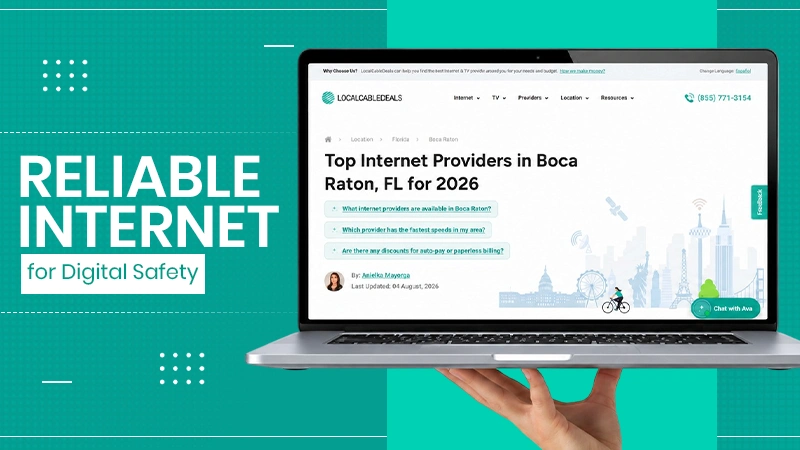
If you want to look for other options, you can simply check a platform like LocalCableDeals, where more than 20 internet providers in the US are listed. You can visit their website and choose the one that fits your needs.
Users can also enable modern security protocols like WPA3, which is one of the most effective ways to protect your home and office network from cyberattacks.
WPA3 is the smartest WPA technology and restricts hackers from invading users’ personal data or guessing their password.
One of the main advantages of WPA3 is that it blocks guessing attacks.
A hacker can sit outside your home and could easily crack the data with different software in case of traditional protocols. But WPA3 stops this by using a new connection method called Simultaneous Authentication of Equals (SAE).
SAE allows hackers to interact with the router for every single password guess. The hackers can only make one live guess at a time, so guessing the password becomes almost impossible, which keeps the connection safe even when the password is weak.
Smart home devices are very common for people in the United States, like security cameras, smart plugs, and even Wi-Fi-enabled bulbs. These devices are easy to hack, but users can pair their smart devices with WPA3 encryption to prevent such issues. This will protect their devices from cyberattacks.
Moreover, to make sure that your home network is completely safe, you can log into your router’s admin page, which is provided by the manufacturer, and switch your wireless security setting from WPA2 to WPA3.
Zero trust architecture is built on a simple rule: never trust, always verify. Previously and even now, computer security networks were like giant castles with high walls.
Once someone passed the main gate, they could access almost everything inside it.
Zero Trust architecture is changing this tradition too. It works like a super cop who never trusts anyone. When a person logs in from their regular device and enters the right password, it still does not like to trust them entirely.
The architecture is constantly analyzing the person’s behavior and the system. It works by looking at different clues.
It checks the number of times a person has entered the correct password, then it also checks which device the person is trying to log in from. It also analyzes the location from where the person is trying to log in.
When a person logs in successfully, the least privilege access is activated. It means the user will be given access to minimal files and tools to do their job. Nothing extra will be offered to them to entertain them.
Zero trust architecture can be easily blended with your everyday internet connection. It can be used through special software tools.
Instead of directly connecting a computer to the public internet, the connection can be routed through special software tools.
So every time a person opens their browser, Zero Trust instantly checks their website safety and device health. If the device is missing a security update, the system blocks the internet from reaching the device until it is fixed.
An internet provider has a lot more to offer than providing a reliable connection, given the increasing number of cyberattacks.
I believe that the best internet service is not only that which offers high speed and reliable connectivity, but it is the service which also protects the user’s data over a connection.
A reliable internet connection with built-in security features can help block malicious websites, detect suspicious traffic, and protect connected devices from certain cyber threats.
WPA3 is a modern Wi-Fi security protocol that strengthens encryption and makes password-guessing attacks more difficult, helping protect personal data.
A zero-trust security approach that verifies every access request, monitors user activity, and grants only the minimum permissions needed to reduce unauthorized access.