The Chief AI Officer bridges the gap between technical capability and business value, managing governance, ethics, and the financial ROI of AI investments.

According to the St. Louis Federal Reserve, as of 2026, 43% of the people working in the United States are utilizing Generative Artificial Intelligence as part of their everyday tasks.
Unfortunately, executing on those projects has proven to be quite difficult; research performed by the RAND Corporation shows that AI implementations have an average failure rate of 80.3% when moving from pilot to full implementation.
In the following article, we will detail the leading programs focusing on Data Analytics and Chief AI Officers that will help to resolve this disconnect and ultimately enable true AI Transformation.
KEY TAKEAWAYS
- Successful AI transformation begins with fundamental data literacy, enabling non-technical leaders to vet data integrity and ask the right questions.
- Elite programs focus on leveraging proprietary data assets to create competitive advantages that generic, off-the-shelf models cannot replicate.
- Specialized CAIO tracks now emphasize the “finance-first” approach, teaching leaders how to quantify ROI and justify massive AI budgets to the board.
From the initiative only these were our tactics that included:
This is an overview of the best data analytics and CAIO courses. You can comprehend and compare them.
| # | Program | Provider | Primary Focus | Delivery | Ideal For |
| 1 | Data Analytics Essentials | The McCombs School of Business at The University of Texas at Austin | Data Literacy | Online (5 months) | Non-Tech Founders |
| 2 | AI for Business Leaders | Stanford | Strategic Moats | Hybrid | Senior Executives |
| 3 | Chief AI Officer (CAIO) Program | Duke University’s Fuqua School of Business | AI Strategy & Leadership | Blended | C-Suite & Senior Executives |
| 4 | Chief AI Officer Program | UPenn (Wharton) | Financial AI Strategy | Online | Aspiring CAIOs |
| 5 | Executive Program in AI Strategy | UC Berkeley | Org. Transformation | Hybrid | C-Suite Leaders |
| 6 | AI: Business Strategies & Apps | Columbia | Implementation Risk | Online | Innovation Heads |
| 7 | Leading with AI and Analytics | Northwestern | ROI & Outcomes | Online | Product Managers |
From the pool of renowned data and AU leadership skill programs, we have got these 7 selected ones for you:
To effectively lead complex AI initiatives, executives should have some fundamental data literacy.
This data analysis course by The McCombs School provides essential grounding, allowing non-technical founders and directors to understand the “raw material” of AI—data and to ask the right questions of their technical teams.
Key Outcomes / Strengths
Stanford is focused on “Creating a competitive moat” as it’s increasingly difficult to differentiate yourself from competitors in the marketplace.
The students will learn to use their unique datasets to gain a competitive advantage over others using similar baseline models. Thus, strategic thinking will be crucial, as you will already be the captain of your ship.
Key Outcomes / Strengths
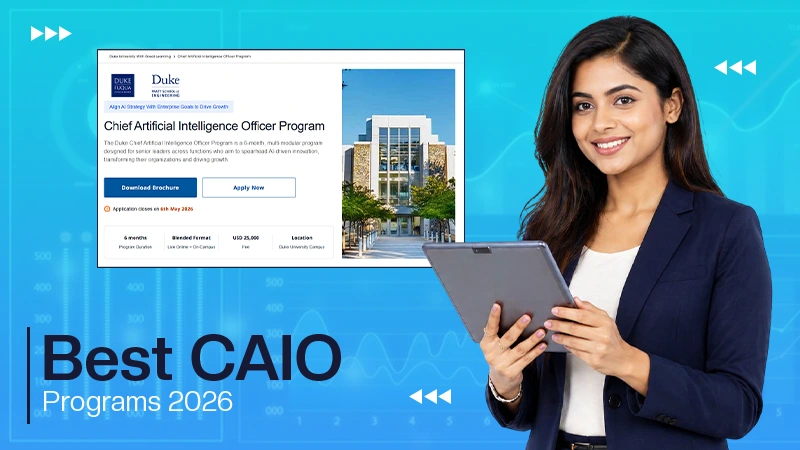
This CAIO Program by Duke University’s Fuqua School of Business is designed to empower executives with the expertise needed to leverage AI for organizational value.
The program will also teach you how to develop a strategic perspective that allows for leading and transforming your enterprise into an AI company.
Key Outcomes / Strengths
Wharton takes a quantitative, finance-oriented approach to the role of Chief Artificial Intelligence Officer (CAIO). The CAIO must be able to justify his or her large budget to the CFO, and therefore this program has a strong emphasis on the economics of AI and algorithmic pricing as well as on demand sensing in a volatile marketplace.
Key Outcomes / Strengths
Berkeley’s Haas School of Business teaches the cultural and psychological aspects of implementing AI initiatives.
As technology is often not the primary cause of failure, this course will focus on the culture, people and processes that must change in order for your AI initiatives to succeed. This course is designed for those who are going to be leading through “pilot purgatory” in 2026.
Key Outcomes / Strengths
Columbia’s curriculum is concerned with addressing the execution gap for leaders in finance, legal and service industries where there is high-stakes involved. This program will provide students with a technical background while remaining grounded in risk management and operational efficiency.
The program provides a technical foundation while remaining grounded in risk assessment and operational efficiency. It’s perfect for those who need to get their hands dirty with data without having to code the model.
Key Outcomes / Strengths
The Kellogg School of Management takes an approach to developing future leaders through their Leadership Development programs that is exclusively focused on achieving measurable outcomes vs. the traditional academic way of doing things which involve teaching abstract theoretical concepts first then eventually applying those concepts in practice.
The leadership development programs are focused on identifying and developing the “little wins” through rapid efficiency improvements, while at the same time creating a solid foundation for longer-term success.
Key Outcomes / Strengths
To be successful by 2026 will require more than a passing knowledge of Large Language Models (LLMs). You must also have undergone a major transformation in the way you execute as a leader and operate your organizations’ structures.
The space between the people who experiment and those who execute continues to grow; therefore, the best chance for success in 2026 will be based on solid strategic foundations of execution.
The top-ranked Data Analytics/Immersive Learning solutions and CAIO Programs identified in the attached report will position you for sustained success as you build transformational, sustainable, and high-impact programs for 2026.
The Chief AI Officer bridges the gap between technical capability and business value, managing governance, ethics, and the financial ROI of AI investments.
Most of these executive-level programs focus on “Data Literacy” and “Strategic Oversight” rather than hands-on coding, though some involve basic SQL for verification.
Durations vary from 2-month intensives to comprehensive 12-month tracks, depending on the depth of the strategic roadmap required.