
“Understand End-to-End Testing in DevOps in the Most Simplest Way”!
Imagine you place a large order from an online retailer, comprising items from various departments (e.g., electronics, groceries, clothing) and potentially from varied warehouses or even third party vendors.
Such a massive, everything-included order like “I’m redoing my entire house, life, probably karma” kind of order that of course you expect it all to work flawlessly without hiccups such as losing that much-liked dress.
Similarly, in DevOps, end-to-end is that final sigh of relief or say sanity check making sure that the whole system performs seamlessly.
And, that’s a brief introduction of E2E for you!
So, If you’re keen in mitigating risk, maximising customer satisfaction, and rejuvenating your delivery cycles, this valuable guide will prove a reliable sidekick for you.
It will walk you through E2E testing in DevOps, integration with CI/CD pipelines and tactics to achieve effective continuous testing and much more.
Therefore, stay tuned till the end!
End-to-End is a methodology that validates the complete user overflow of an application in a DevOps environment, ensuring all the integrated components work as expected including UI, backend, databases, third-party services, APIs, and more.
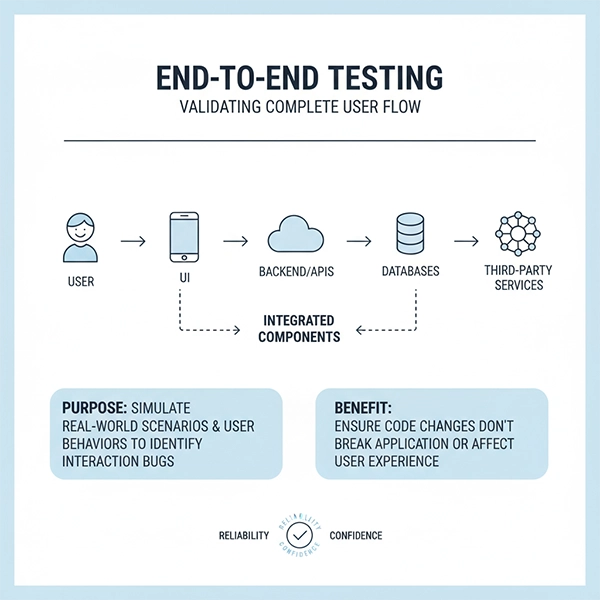
Simulating real-world scenarios and user behaviours to identify bugs that pop up from the interaction between different layers of the application is the primary purpose of end-to-end testing.
With regards to the above, to ensure that code changes don’t break the application or affect the user experience.
End-to-End testing plays an indispensable role in DevOps.
But why? You may ask!
See, DevOps promotes “shift-left” testing, where testing begins early and is continuous throughout the lifecycle contrary to the traditional software development practices where testing commences at the end of the cycle.
Hence, to ensure system reliability, speed up releases, improve customer experience and empower continuous delivery, end-to-end testing is imperative.
CI/CD pipelines are the linchpines of devOps environments that travel code from commit to deployment hence, incorporating E2E testing into this workflow mandates careful and conscious blueprint and the right apparatus.
In the pipeline, unit and integration tests run early whereas E2E can be timed at later stages especially prior to staging or production deployment.
While unit and automated integration testing typically run early in the pipeline, E2E tests can be scheduled at later stages, particularly before the staging or production deployment.
However, it is advised not to delay E2E testing too far down the pipeline. You can also make end-to-end tests fast and efficient with parallel test execution and optimised scripts.
| Unit Tests | Integration Tests | End-to-End Tests |
| Unit test validates individual functions/components. | It is responsible for making modules work together efficiently | The respective tests validate the complete user journey. |
To make sure that the respective environment corresponds with production as closely as possible and eliminates flaky tests occurring by environmental inconsistencies, utilize containers (via Docker or Kubernetes) that allows teams to create consistent and isolated environments for testing.
On code merges or before release deployments, E2E testing should be triggered automatically. CI tools such as Jenkins, GitLab Cl, CircleCl, and GitHub Actions, can be optimized to automate these triggers.
If you’re wondering that continuous testing is all about automation then you have to put your mind to a break as continuous end-to-end testing is about making quality checks an integral part of the developmental cycle.
But how to notch that? Don’t worry as the following strategies will usher you to continuous and reliable E2E testing!
| Emphasizes Critical User Journeys: You may not know that all user flows are created equally. So, it is crucial to identify the most frequently used or mission-critical journeys in your application and focus on them for E2E testing. For instance, logging in and logging out, adding items to the cart and checking out, and submitting forms or payments. Applying this risk-based testing approach ensures maximum coverage with minimal test scripts. |
| Arrange a Clean Test Data Strategy: E2E testing heavily relies on data consistency, therefore, to ensure test reliability and validity, using mock data and dynamically generated data becomes imperative. To maintain clean test environments, potent tools like FactoryBot, Faker, or even pre-seeded databases can be a reliable companion. |
| Parallelize Test Execution: As end-to-end tests are usually slower than in contrast to unit tests due to the number of components involved, the best way to speed up is parallelize the test execution. You can speed up end-to-end tests by running them in parallel leveraging tools like Selenium Grid, Cypress Dashboard, or cloud-based test platforms that promote distributed testing. |
| Utilize Headless Browsers and Simulators: Exercise browser-based tests in headless mode as it reduces test execution time. For instance, Chrome or Firefox can perform UI tests without rendering the GUI, leading to faster processes and appropriate CI pipelines. |
| Monitor and Debug Failures Effectively: Organize a comprehensive logging and screenshot to assist developers quickly determine the root cause of failures. To visualise the test results over time, you can also incorporate tools or dashboards. |
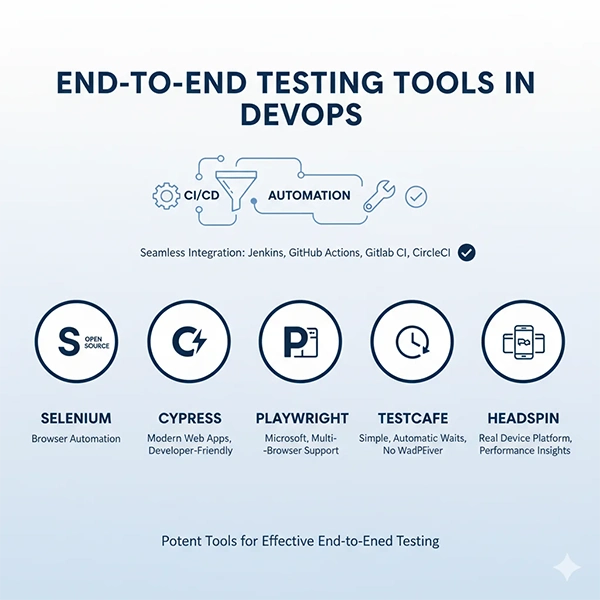
For implementing a fruitful and effective end-to-end testing, choosing the right tool is something that can’t be skipped or trivialised.
These vigorous tools can seamlessly blend with CI/CD tools like Jenkins, GitHub Actions, GitLab Cl, and CircleC, making automation streamlined.
So, without any further delays, let’s explore the best tools for end-to-end testing in DevOps.
So, these are some potent tools for a healthy end-to-end testing in DevOps. Now, it’s time to uncover what most write ups swept under the rug or skirt around, the achilles heels of end-to-end testing.
You may have heard that “Perfection is an illusion” because even end-to-end testing bears the blemish.
In simple terms, while being robust, E2E testing comes with its own share of challenges that might be overwhelming but you also may have heard that “every cloud has a silver lining”.
So, in this respective section, we will shed light on the challenges in end-to-end testing and how to overcome them.
| Challenges | Solution |
| Flaky Tests: result of timing issues, asynchronous operations, or unstable environments. | Apply retirements, adequate wait times, and stable tests environments. |
| High-Maintenance Cost: Due to multiple tests caused by UI changes. | Try to lower test fragility by leveraging robust selectors and page object models. |
| Slow Execution time: Run-across-the-stack tests are slow in nature. | Emphasis tests, run in parallel, and shift less serious checks to post-deployment tests. |
In conclusion, End-to-End testing has become the cornerstone in modern DevOps that acts as a safety net, ensuring all the integrated components operate in the right order, from beginning to end.
Additionally, as you know now that end-to-end testing is incorporated into automated workflows and executed frequently as a part of the CI/CD pipelines, it makes sure that the code changes don’t break the application or dampen the user experience.
Therefore, to reduce errors, improve user experience, and streamline your delivery routines, integrating E2E testing into your CI/CD pipelines and adopting continuous strategies is required.
You can also leverage headSpin, a vigorous real-device testing platform that supports automated end-to-end testing across mobile and web applications.
It empowers Devops teams to test real user experience at a scale with global device infrastructure, performance insights, and seamless CI/CD integration. So, whether, you’re contemplating mobile apps, or browser flows, HeadSpin take complete accountability of flawless development to production of your application.