Cryptocurrencies have transitioned from a fringe concept to a worldwide financial powerhouse. In 2024, the aggregate capitalization of the total crypto market has reached $3 trillion, which is a clear demonstration of adoption and growth on an unprecedented scale.
Ethereum (ETH), in particular, remains a cornerstone of the crypto revolution because of the vast ecosystem of decentralized applications (dApps) and smart contracts being built on top of the protocol. Nonetheless, a common barrier for folks entering this crypto world remains: achieving financial privacy.
Major government agencies, like the IRS and the FBI, are now routinely partnering with blockchain analytics firms to trace transactions and correlate public wallet addresses with real-world identities, effectively diminishing the anonymity that was once promised by digital assets.
Given this, this article covers the basic ways to purchase Ethereum while protecting your financial privacy.
KEY TAKEAWAYS
Any transaction related to ETH holds your details, which could be vulnerable to your privacy.
You may apply some strategies to protect against those data leaks.
Understand the trade-offs before purchasing.
Going through legal compliance and taxation procedures is critical.
The Public Ledger Reality Check
There is a blockchain in Ethereum, which is an immutable and transparent public ledger of all transactions. Although your real name and other personal details are not directly tied to a wallet address, this is quite tractable.
Once one transaction from your wallet interacts with a regulated platform that holds your KYC identity data. That is the wallet’s entire transaction history that can potentially be linked back to you: hence, the inherent paradox of a transparent digital currency.
Why Centralized Exchanges Kill Your Privacy
Most users acquire ETH from a Centralized Exchange (CEX) such as Coinbase or Binance. These are essentially digital banks. Design is a single point of failure that leads to the breakdown of any private protection for you.
They comply with global Anti-Money Laundering (AML) and KYC regulations. This means you must reveal your government-issued ID, address, and a host of other personal information.
Core Strategies for Private ETH Acquisition
If you want to avoid being surveilled by Centralized Exchanges (CEXs), you can instead focus on losing the link between your personal identity and your crypto wallet address.
Peer-to-Peer Trading—Direct Approach
In P2P trading, you purchase ETH from someone else directly and do not use an exchange. This means you completely bypass the KYC.
You communicate with a seller via a peer-to-peer platform or community group and agree on a sale price. The exchange of fiat currency, for example, and ETH takes place directly between you and the seller.
Decentralized Exchanges—On-Chain Route
Decentralized Exchanges enable you to exchange one cryptocurrency for another directly on the blockchain, managed by smart contracts.
You connect a self-custody wallet to the DEX and conduct a trade. Your identity is not associated with the exchange, but the trade is still visible on the public ledger. A safer method for privacy coins is to swap a coin that already has a strong anonymity aspect for full privacy.
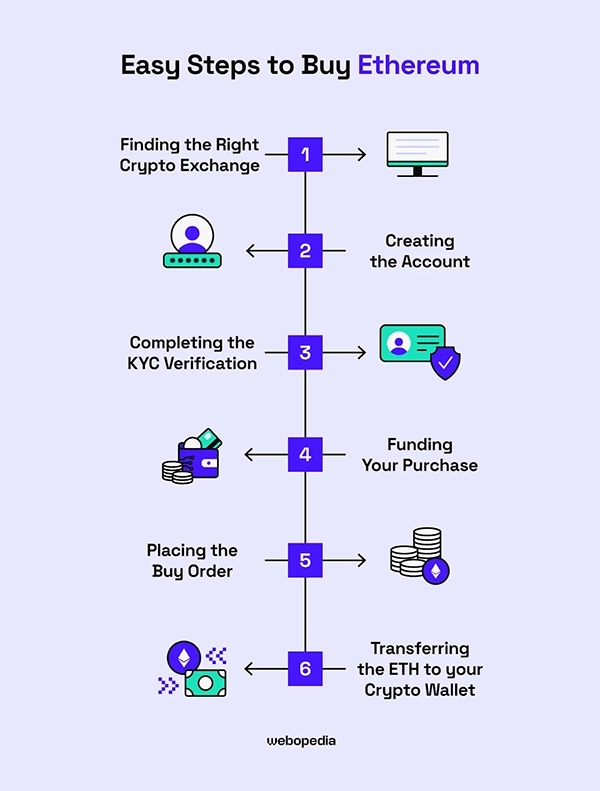
Check out the easiest steps to buy Ethereum with the help of the infographic below:
Advanced Privacy Techniques
For users who want the greatest amount of privacy possible, this procedure adds layers of obfuscation.
Using Privacy Coins as Intermediaries
A very effective method involves utilizing a dedicated privacy coin — such as Monero (XMR) or Zcash (ZEC) — and using it as a bridge asset. Purchase a privacy coin, then use a DEX to swap the privacy coin for ETH.
The method of transaction from one asset to another is untraceable from the public standpoint, leveraging a privacy coin.
Self-Custody Wallet
No matter how you acquire them, it is necessary to have a self-custody wallet. A self-custody wallet refers to you exclusively owning the private keys. If you leave your funds in a CEX wallet, the exchange effectively manages your assets and the data associated with them.
Network-Level Protection
Basic digital security can obscure your online footprint even more. Whenever you conduct a transaction, using a VPN or the Tor browser will hide your real IP address. It makes tracking you by location on the blockchain much more difficult.
Crypto Mixers (Proceed with Extreme Caution)
Crypto mixers are services that take the funds of various users. It pools them and mixes the funds by sending them back to the users, which makes it exceedingly difficult to track a specific coin. Before using a mixer, you must first understand the potentially devastating legal consequences that may arise.
Understanding the Trade-offs
Trade-offs can go beyond mere convenience when pursuing maximum privacy in crypto. At a centralized exchange, there is full identity exposure due to low privacy.
Most people consider person to person meetings and cash transactions to get the highest privacy. Besides other strategies like DEX Swap, crypto mixers provide the highest privacy support, along with some risks.
Even More Legal and Tax Considerations
Smoothly managing digital footprints does not mean that you will get an escape from legal compliance and taxes. Besides using privacy methods, it is mandatory to report all the taxes under applicable regulations.
More importantly, taxation laws can vary from state to state; thus, understanding the proper guidelines based on your location is critical. You can ask for professional help to clarify what’s legal and authentic for your trade.
A Step on Your Path to Financial Privacy
Achieving financial privacy is a bit complicated process, which needs patience and strategic implementation. In the case of cryptocurrency privacy, integrate self-custody, strategic purchase, and strong network protection.
When you acknowledge the trade-offs that work according to the goals, you get convenience, privacy, and cost-effective results. Just take a step ahead and start your digital trading journey.
FAQs
Is it legal to hide the digital trace during purchase?
If you are doing it to protect your data, then it is completely legal. Just avoid indulging in inauthentic online activity.
What is the most common method used to increase privacy?
Most people prefer Decentralized Exchanges (DEXs) or Peer-to-Peer (P2P) exchanges.
Can I avoid tax filing by deleting digital traces?
No. Even if you have eliminated digital carbons, you still need to follow tax regulations.
Are crypto wallets safe?
If used with proper caution, wallets can be a secure option.