Asking for help from an adult, waiting for turns, overcoming failure, and sharing experiences with parents. These things are also noticed at preschool before it becomes a concern.

When is your child ready for kindergarten? What should be the right decision for your kid to explore? Most parents have several concerns.
The things you should focus on are expressing needs, seeking help, overcoming frustration, and handling crowds well instead of writing, speaking, numbers, and color patterns, which most schools miss teaching.
Parents should introduce their child to an environment where social signs can trigger their behaviour to learn communication, solve problems, and build relationships.
Here are some of the social signs you must keep in mind before starting kindergarten. I’ll take you to follow the path to consider important signs that can improve your child’s skills:
Key Takeaways
- Around three-quarters of children often reach the benchmark at their given age, while under 5 years old, 25% usually lack the behaviour of that milestone.
- In several cases, teachers usually notice before it appears and harms their social skills.
- Signs of tears rolling depict the unusual activity of an individual.
- If rolling persists, consult a child specialist without delay to prevent future incidents.
School readiness is way more than knowing numbers, writing the alphabet, identifying objects, and sharing spaces.
The CDC’s 2026 report states that around 5 years of age, children can participate in fun games, follow rules, more often simple chores among groups. The benchmark where one-fourth struggle is in the zone to achieve the goals at a given time, not a line that needs to be crossed.
The concept of kindergarten is not to enhance every skill but to involve children in activities that matter. Basic skills include understanding patterns, rules, goals, conversation, and such small social relations that builds foundation stronger, and the teachers know their jobs well and monitor your child’s mental health regularly.
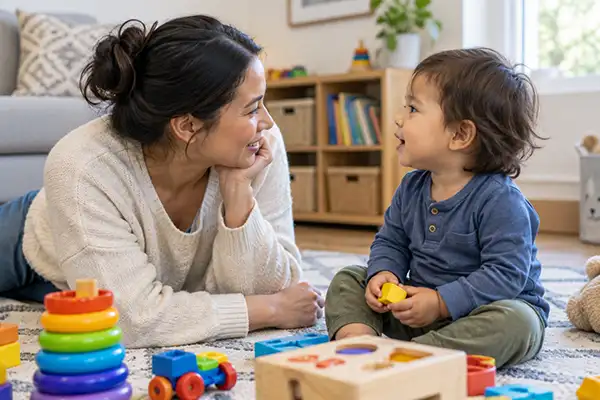
Harvard University’s Center on the Developing Child describes back-and-forth interaction, which supports children’s social skills and helps in later learning.
A simple concept where you communicate the child’s vocal patterns in your voice can influence cognitive behaviour to understand and react to words that have some meaning. This repeated response creates a support system to further verbal communication.
The turn-taking machinery becomes visible in toddlers. Somewhere around 18- 24-month-old kids start combining words and following two-step instructions, which is the same reciprocal skill in a more obvious form.
Parents should start adding skills before kindergarten is expressing through gestures and directions, which are more than conversational babbling. Around 5 years, these should be included in the kid’s routine.
Signs that cover all the signals to understand the child’s pattern are just seen at a playschool or outside playground, not in a technical assessment.
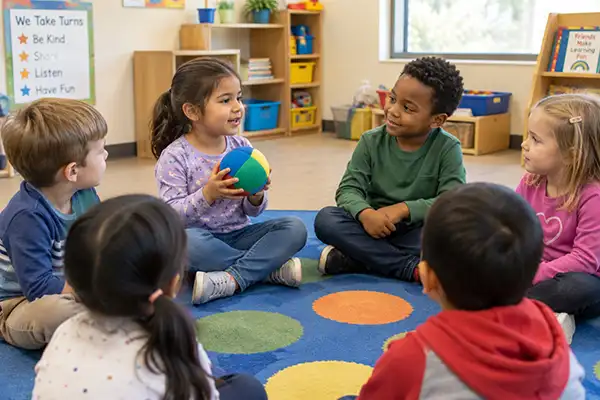
One of the CDC’s five year social benchmarks is to understand the rules and sense to wait for your turn to act; this is one of the most critical behaviours where children face difficulties managing.
These skills build your patience and respect the value of sharing choices, not always winning.
When a child turns 24 to 30 months old, they play next to peers or with them. This habit of sharing activities builds the child’s involvement in team building on specific goals.
Example: passing a ball, handling items, and passing words.
Small gestures like snatching items, wrong color, losing items, and choosing a path for competition may influence the urges to fight or an upset mood.
The whole point is that crying for about ninety seconds is normal; if it happens more than usual, then it’s a sign to pay attention.
Most of the time, dropping off is the moment when parents are frightened and feel distressed; the instructor doesn’t explain a fixed reason for the child’s behaviour. Teachers usually explain the pattern when crying stops or the time taken to normally participate with others.
This is a major sign that your child’s skills to seek help from others, except parents and family members. If a preschool has a bunch of people, then it should try to use other adults to share hands for help in activities where a child faces problems.
Reaching five, CDC explains that the child should share memories with parents in their absence. It gives an advantage to express such feelings, whether a good or bad experience.
Small activities like buttoning a shirt, zipping, opening a box, and using the washroom are considered basic skills for five-year-olds that they should be trained in, according to the CDC.
This activity at home to preschool is different, where seeking help from others is limited. They feel independent and more focused.
The kindergarten has different meanings in various regions. In the United States, the first type of formal education is known as kindergarten before turning five, while in Victoria, Australia, it starts before preschool, around three to five years.
A family seeking kindergarten Melbourne program’s confirms the age criteria and enrollment, as in the States, kindergarten is declared after five for a social-emotional, cognitive approach to a child’s mental development
This is basically same all around every regions, but the developmental stages may differ; some principles are taught earlier than five and some after five. The children’s behavioural learning remains the same.
You have noticed that every single child is different in learning behaviours; some learn faster than others, and some need time to recover from obstacles they are facing; it’s just a matter of time.
In CDC’s opinion five years child who lacks more than one benchmark can feels struggle to compete, and this issue remains over time; or if a child loses skills they previously had is worth considering; parents should consult a pediatrician or professional for missed skill development.
If you have faced some issues repeatedly with your child, it’s not that your child is lagging in normal development. But proper medication or practicing in screening development can help; only verbal make a major impact on improvement.
Teachers or staff members of preschool also help children and parents to overcome this situation and can recognize it earlier than it happens.
The overall essence of this study is to understand kindergarten and preschool for social development and making children ready to behave properly in different situations. No need to be perfect in every situation; just social maturity to connect with others.
CDC’s seven signs should be present in your child; lagging in one or two is acceptable. This will cover when time passes and practicing with the child or when joining new sessions in September for grade one.
You should understand as a parent that your child can communicate better, share his experience, feels connected with others; these are basic necessary should a chil learn before five. Radarro publishes parent-focused resources about controls and safety try-outs with real-world social skills.
Asking for help from an adult, waiting for turns, overcoming failure, and sharing experiences with parents. These things are also noticed at preschool before it becomes a concern.
Typically not. In kindergarten, they can develop reading skills where the teacher gives every child a chance to perform.
Absolutely not. If your child makes conversation with you or seeks help from other members is good. Shyness is not part of social sign.
When your child has missed more than two milestones or forgets existing skills can raise concerns with a pediatrician or a specialist. Don’t panic; it’s just a matter of time.