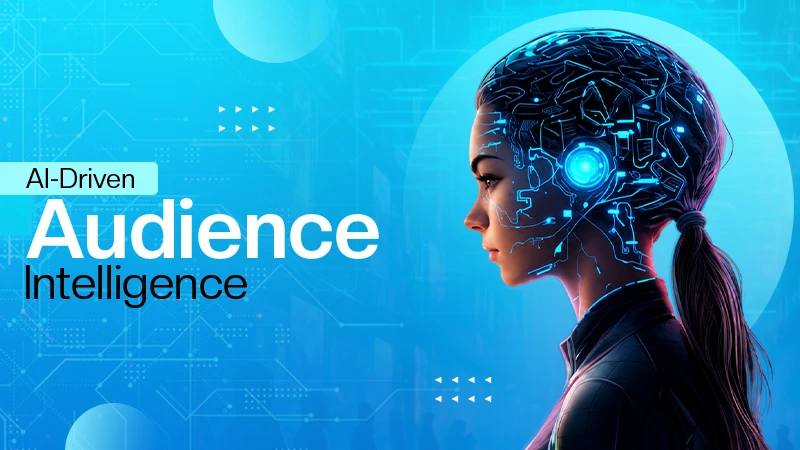
Audience intelligence means using the power of AI to process real-time behavioral cues such as clicks, pauses, and navigation rather than sticking to demographic profiling. It will help your brand to understand real user intent.

Quick Answer – Audience intelligence powered by AI allows brands to track the actual intent of users using dynamic signals rather than fixed personas. The friction is identified when the user is actually engaged, allowing the brand to take actions based on live insights.
Marketing loves the idea of making up people. A name, a birthday, an order of coffee, some podcast preference — and suddenly the spreadsheet looks like a person. But it doesn’t. This “Anna” created for you never clicks an ad, but the whole campaign is designed around this fictional person.

The real problem here is that almost all analytics measure what is already done. A bounce rate shows that people went somewhere else; it doesn’t tell you anything about their doubts or the process of hesitation that made them leave.
Intelligence works in a different way. The platform, like NEXUS, reads live signals like a hover of a mouse, repeat visits to the refund page, and abrupt breaks in user behavior.
The behavioral indicators reveal the actual problems that need solving. The 20-year-old college student and the 60-year-old CEO seem like polar opposites on paper. But at 2:00 AM, their click patterns while shopping for a winter tent are identical. Machine learning catches those quiet, weird behavioral patterns hidden deep inside messy data – the exact signals human analysts scroll right past without ever noticing.
Capturing these fleeting moments relies on a few fundamental layers:
When all of these layers are used in combination, target segments stop being frozen lists in a database. They turn into dynamic, self-updating user clusters.
You purchase boots right now, and retargeting will follow you with the exact boots for the next four weeks. It wastes ad spend, pisses off customers, and proves the algorithm has zero clue what actually just happened.
Sophisticated algorithms are forward-looking rather than backward-looking. When someone spends twenty minutes reading API documentation while toggling enterprise plans, don’t wait for a contact form submission. A responsive UI should instantly trigger a relevant case study or technical chat option while the user is still hooked.
Neural networks may have made many advances, but entrusting them with complete control may be a bad idea. Algorithms do exactly what you reward them for – nothing more, nothing less. Tell a model to chase raw clicks, and it will resort to trashy clickbait and aggressive pop-ups every single time.
That’s why solid platforms keep humans in the driver’s seat. The data science team and product managers will be the ones to make difficult decisions while leaving all the dirty work to the algorithm.
Deploying this architecture typically follows a three-stage path:
Real, long-term performance doesn’t come from pure automation – it happens when you blend the brute force of algorithmic speed with old-fashioned human intuition.
For twenty years, digital marketing felt like a trap: dropping cookies, forcing people down funnels, and squeezing out sales at any price. But users fought back. They tune out banners, run heavy ad blockers, and lock down their privacy harder than ever.
The next wave of technology is not about improving targeting – it’s about listening to the user. AI lets companies process millions of faint digital cues at once without turning human beings into cold spreadsheet numbers.
When technology captures context and respects people’s time, promotion stops annoying everyone and starts becoming a helpful, perfectly timed answer.
Audience intelligence means using the power of AI to process real-time behavioral cues such as clicks, pauses, and navigation rather than sticking to demographic profiling. It will help your brand to understand real user intent.
Analytics tells you what has already happened — bounce rate, drop-off rate. AI systems monitor live behavior so you can identify friction and intent before the user left.
Static personas tend to generalize real-life people and result in ineffective targeting. Behavioral groups defined via live data provide a much better understanding of customer needs.
As opposed to serving ads repeatedly for an item that was purchased long ago, the algorithm captures the changing behavior of the user and allows brands to react to it.