Many tools are free of cost; however, if you want a kid-safe platform, it often requires a subscription to ensure that they don’t rely on ad-tracking for revenue.

Imagination and creativity are the heartbeat of childhood. You must have watched your kid drawing a character and immediately begin giving it a funny voice; however, we are standing at a new frontier where the hand-drawn dragon or the AI-generated space actually speaks back.
As a parent, you might have mixed feelings about AI, but AI is now a paintbrush that allows you to do things that can never be dreamt of. Providing your kids with tools that can make their images talk is like giving them a new language for storytelling.
Key Takeaways
- AI has the potential to turn kids from passive viewers to active Digital Directors.
- Making an image talk needs three aspects: animation, voice synthesis, and lip syncing.
- Using image AI talking tools builds narrative skills, technical literacy, and empathy.
- Always go for a COPPA-compliant platform and maintain ‘Co-Pilot’ supervision.
The digital landscape now prioritizes ‘generative play’ that allows kids to instantly turn their imagination into animation. The AI tools, like AI Talking Photo Generator, act as a bridge between technical skills and creative ideas. This turns kids who were just passive viewers into active creators, enhancing their technical ability to express their internal imagination.
Animation is the heart of this magic; this technology identifies the several parts of a picture, such as limbs, background, etc. For a child, it is a moment of amusement seeing the cat they drew actually flick its tail.
After moving, comes the talking part; the voice synthesis has now evolved beyond the robotic sound. Modern AI can transform a string of text written by your kid into a voice that sounds exciting. In addition to this, some tools even allow kids to record their own voices, eliminating the gap between physical and digital selves.
Facial movement is the most fascinating part; the AI analyzes the phonetics and moves the character’s mouth to watch the words. It can also add subtle eye blinks and head tilts so that the interaction feels real to the child.
When we talk about making an AI image talk, we don’t only talk about the technical trick, but we are teaching your child character development, we are making them wonder if the robot would speak, what could it possibly say.
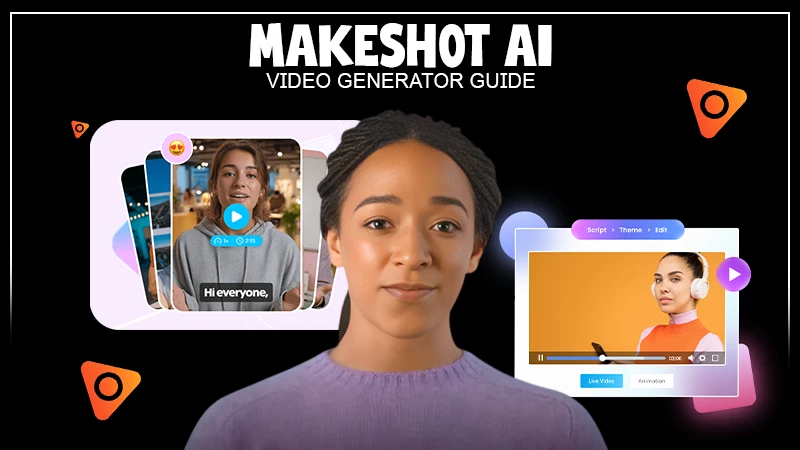
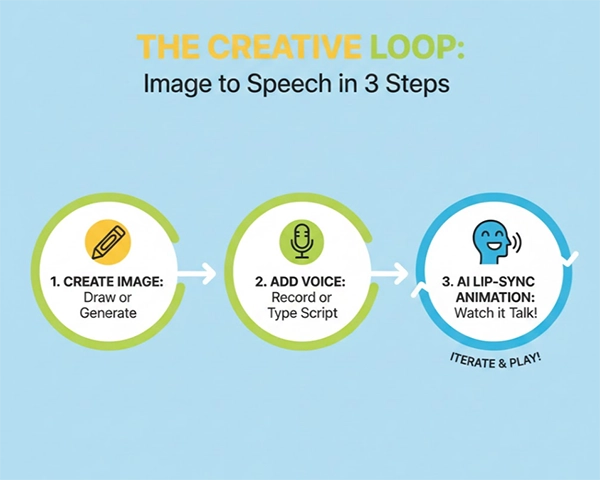
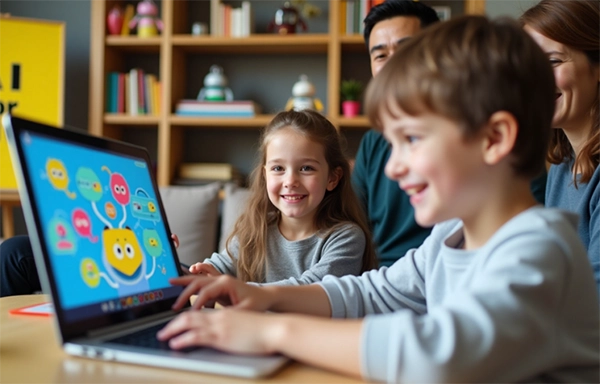
This process places the kid into the shoes of another person, turning them into a digital director, and they transform a static screen into an interactive theatre using AI tools to make images talk. To make an image talk, first you need to create an image, add a voice to it, and then use AI lip-sync animation, as visible in the image. Using a free AI lip sync generator can be the perfect starting point to begin experimenting.
Navigating through the world of AI can feel like going through a maze of complex software. Fortunately, there are several platforms that have been designed keeping simplicity and safety in mind.
There exist apps that help kids build a character from scratch, select their hair, outfits, eyes, etc, and then finally hit the speak button. These apps are often simplified ‘Puppetry’ AI, where characters mimic the facial expressions of the child.
Fun Fact: ELIZA was the first AI program designed to mimic human conversation in 1966!
Some platforms offer the feature to upload an image and a script, following which the AI handles the heavy lifting of animating the mouth and eyes, which are perfect for school projects. Imagine your child’s history presentation being delivered by a talking animated Abraham Lincoln!
Platforms that are COPPA (Children’s Online Privacy Protection Act) compliant are best for kids. These are safe and secure platforms where kids can use generative AI without the risk of coming across inappropriate content.
The primary concern with AI is privacy; therefore, the ‘Parental Panic’ button can’t be ignored. When a tool asks to access the microphone or to access the camera, it is essential to know where the data belongs.
In addition to this, the kids at a young age should be taught that just because an image can speak, that doesn’t mean it is real. Integrating digital literacy in kids becomes essential. Lastly, AI creation is mentally stimulating, but it is still sedentary; hence, the goal should be to use AI as a supplement to physical play.
If your kids are using AI creativity tools, there should be certain boundaries and guidelines you set, such as:
Did You Know?
AI doesn’t know what a ‘face’ actually is! It only recognizes patterns such as two dark circles (eyes) above a line (mouth) and uses it to predict how the pixels should move when a sound is played.
Our next generation is growing up in a world where the line between static and alive is very thin. Introducing your kids to AI talking image tools is good; however, it should be in a controlled, creative, and curious way. This way, you are preparing them for a future where AI is a standard. So, the next time your child shows you a drawing, ask them what it might be, wondering what it has to say.
Many tools are free of cost; however, if you want a kid-safe platform, it often requires a subscription to ensure that they don’t rely on ad-tracking for revenue.
Yes! You can click a picture of your child’s drawing and upload it to an AI tool.
No, on the contrary, AI provides a platform for your child to focus on storytelling, character building, and scriptwriting.