Shopify and Wix are typically the most user-friendly tools providing integrated AI to create content, product recommendations, and stores without the need for technicians.



Artificial intelligence is no longer a “nice-to-have”. Even in the e-commerce space, it’s now the engine behind it. Today’s AI platforms don’t just build online stores. They predict customer behavior, personalize shopping experiences, optimize inventory, automate marketing, and help businesses increase revenue with less manual effort.
It’s now the needle-in-a-haystack problem. The challenge isn’t finding an AI-powered ecommerce platform. Nearly every platform claims to use AI. The real question is which one actually solves your biggest business problem.
This guide compares the best AI ecommerce platforms of 2026, what each does best, and which type of business they’re built for.
KEY TAKEAWAYS
- AI ecommerce platforms now specialize in different areas, from storefront creation to personalization, search, analytics, and customer retention.
- The best solutions combine real-time personalization, predictive analytics, and native workflow integration.
- Smaller businesses benefit most from platforms like Shopify Magic, Wix AI Studio, and Squarespace, while enterprises gain greater flexibility from Salesforce, Adobe Sensei, and VTEX.
- Retention-focused tools such as Klaviyo and Yotpo often generate faster returns than investing solely in customer acquisition.
Not every platform advertising AI delivers meaningful automation. While evaluating AI technology for ecommerce businesses, we considered three aspects:
Toolkits that tick all three boxes cut down on the operating cost that comes with running AI as a bolt-on, which is crucial for teams that do not have personnel with dedicated data analysts.
In the context of selling and shopping, the 10 best AI e-commerce platforms taking over in 2026 are:
Yotpo combines AI-powered reviews, loyalty programs, SMS marketing, and referrals into a unified customer retention platform. The company’s predictive analytics flag at-risk customers earlier and trigger automatically customized win-back campaigns, making it the perfect tool for use with each of the above storefronts.
Best for: Retailers to build loyalty programs and referrals with retention triggers.
Feedonomics is a program incorporated within BigCommerce, which is able to automatically modify feeds for products across marketplaces, including Amazon, Google Shopping, and TikTok Shop, in real-time, with statistics on performance.
Since BigCommerce’s structure is more flexible than many other competitors, it can be integrated with third-party AI software without any restrictions on platforms that exist elsewhere.
Best for: Multi-channel sellers that manage catalogs with large sizes on marketplaces.
Einstein is Salesforce’s tool that can predict the sorting, dynamic pricing, and next-best-action recommendations. The main benefit is the fact that the AI algorithms that personalize a customer’s shopfront can also be fed by customer service as well as marketing automation tools elsewhere in the Salesforce system, making Einstein among the most integrated enterprise configurations that are available. Businesses looking to unify AI-driven personalization with digital storefront management can also explore Salesforce Commerce, which brings together commerce, customer data, and AI across the entire shopping journey.
Ideal for: Large enterprises that have invested in Salesforce.
Sensei is the Adobe machine-learning software to provide product recommendations, visual search, and automated content tagging inside Magento’s user-friendly backend for developers.
It requires more technical resources than tools that are hosted fully; however, it rewards the investment with a deep level of customization to more complex catalogs.
Ideal for: Companies that require large customizations and complicated B2B catalogs.
This one can generate an entire online store, including layouts, product descriptions, images, and SEO content, from a simple prompt. It will continue making progress on projects like SEO meta descriptions and automating emails to follow up with customers.
It’s one of the quickest methods to take an inexperienced founder from concept to a live shop. Here’s the breakdown of how much time it would exactly take to build your own e-commerce site:
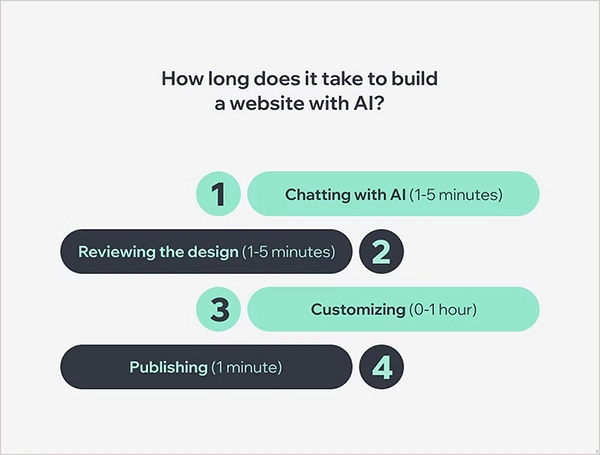
Best for: Solo entrepreneurs and small groups that want to build stores quickly.
In the ranks of best customer retention systems, Squarespace’s tool is a standout for brand-focused merchants. Although it was initially focused on designing and generating content, its 2026 update included inventory forecasting and abandoned-cart messaging driven by predictive models.
This is a less heavy tool than Shopify or BigCommerce and is perfect for companies that value the appearance and branding initially.
Ideal for: Brands that are design-conscious and focus on aesthetics at the cost.
VTEX is a composable commerce tool with AI in the search engine, merchandising, and order management. Intelligent search tools adjust the results immediately in response to shopper behaviour and are particularly important when it comes to massive marketplaces and multi-vendor companies that have to manage hundreds of products.
Best for: Marketplaces and huge multi-vendor e-commerce operations.
Bloomreach is designed specifically to aid in personalization as well as product discovery. It makes use of machine learning to power site searching, merchandising, and recommendations for content.
In contrast to being a replacement for a storefront, it integrates into the platform a company already has, which makes it one of the easiest to add tools without the need for a complete transfer.
Best Choice: For large-sized retailers who want more personalization without having to switch platforms.
Klaviyo has evolved beyond email marketing into one of the strongest AI-powered customer retention platforms. Its predictive capabilities: risk scoring churns, customer lifetime value forecasting, and segmentation that automatically adapts when the behavior of shoppers shifts.
Stores are trying to maintain loyal customers instead of constantly trying to find new customers; this feature typically has more power than other features on the storefront.
Best for: Brands that prioritize repeat purchase rate and lifetime worth.
Shopify’s AI tool, Sidekick, functions like an embedded analyst. It will create product descriptions, draft email campaigns, and respond to plain-language queries such as “which collection is underperforming this month.”
Shopify Magic extends this into the editing of images and creating content within the administrator panel. If you are a merchant who wants AI technology for e-commerce businesses without the need to hire data staff, it eliminates the majority of the repetitive administrative work.
Best for: small- to medium-sized DTC brands looking to incorporate AI to be integrated into their current workflow.
The best AI ecommerce platform isn’t necessarily the one with the most features. It’s about matching the right instruments to the specific gaps in operations. It is important to recognize that the best customer retention systems are typically an element of this specific stack.
Shopify, Wix, and Squarespace create storefronts and the generation of content quickly for smaller teams, as Salesforce, Adobe Sensei, and VTEX cater to enterprises that have complex catalogues and multiple-vendor requirements.
Bloomreach improves search and discovery without needing a complete switch of platforms as well. Klaviyo and Yotpo show that retention-focused AI generally delivers faster and better-than-average returns over spending on acquisitions by itself.
The most successful sellers create layers of stacks with one tool for each challenge, and make sure to check real-time personalization, predictive analytics, as well as native integration before implementing any new technology.
Shopify and Wix are typically the most user-friendly tools providing integrated AI to create content, product recommendations, and stores without the need for technicians.
A majority of the major platforms offer the basic features for retention, specific tools such as Klaviyo and Yotpo offer significantly more sophisticated predictive retention modeling, making these tools worth incorporating into an AI-powered storefront.
Prices vary widely depending on the tool. Shopify and Wix offer AI features within current subscriptions, and the more enterprise-oriented tools, such as Salesforce Commerce Cloud and Adobe Sensei, usually require specific pricing, based on transaction quantity and the feature’s scope.
Yes. Tools such as Bloomreach, Klaviyo, and Yotpo are compatible with the majority of big platforms. They allow merchants to implement Artificial Intelligence-led personalization or retention functions with no full-on move.
A tool for retention, such as Klaviyo, usually provides the fastest returns because maintaining an existing client costs much less than buying an entirely new one. Additionally, the predictive scoring of churn produces usable data nearly instantly after being established.