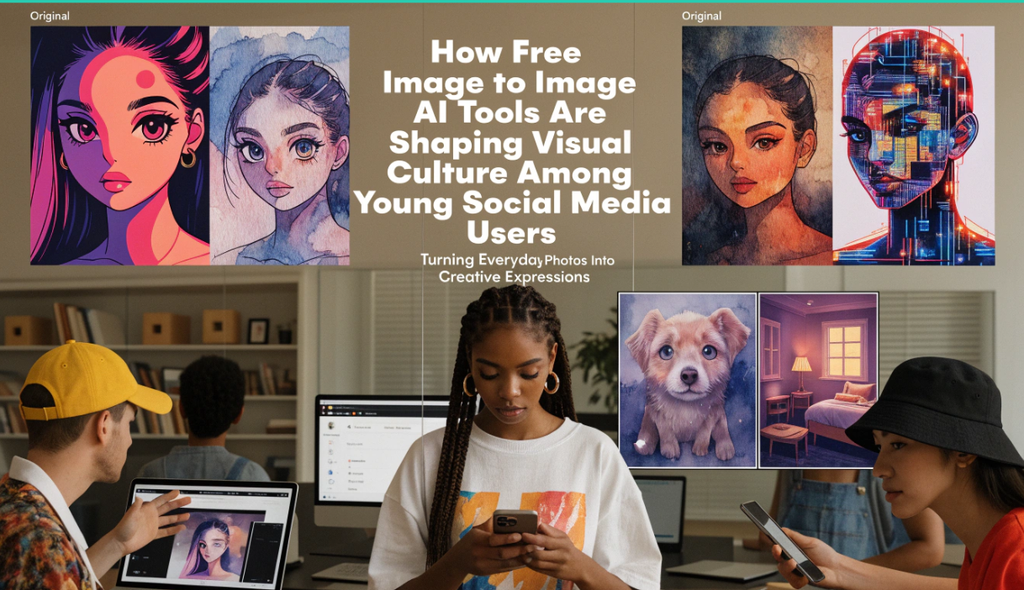
Quick Answer – Free AI tools for image-to-image manipulation allow youth on social media to create artworks, avatars, and edited images without paying for professional software. This is helping to democratize visual trends, encourage self-expression, and spark discussions about privacy, authenticity, and responsible image sharing.
There are many unique ways to modify photos on social media nowadays. One can convert a normal selfie to a cartoon picture, make an image of one’s pet similar to a movie character, or even give an ordinary picture some other meaning.
What used to require editing expertise and expensive software can now be done with a prompt and one photo. This makes it easier for young people to create and share their content without having to spend any money on software.
The free image-to-image AI technologies are making a big difference in how users create and share their visuals, but at the same time raise concerns regarding privacy, authenticity, and the influence of manipulated photos on self-perception.
From Posting Images To Reworking Them
Social media used to be about capturing and sharing things by default. You took a photo, maybe applied a filter, and posted it. Image-to-image AI adds a middle step: transformation. You start from an existing picture, describe what you’d like to change, and get a new version that keeps the original’s composition and key elements while changing its style, mood, or details.
That’s a meaningful change in how images get made. This picture is no longer an accomplished document; it becomes raw material. Young creators treat it that way naturally. A single picture can become an anime-style avatar, a moody poster, a sticker, a profile banner, and a story background, each one a different expression of the same moment.
Why Free Access Changes The Culture
The word that matters here is free. When creative tools are expensive, a small group of people with skills or budgets sets the visual tone. As they become free, experimentation becomes universal, and trends develop quickly.
A free image to image AI tool like EzEditor illustrates the model. According to its site, users get five free credits per day that refresh the next day, can upload JPG, PNG, or WEBP images up to 24MB, blend multiple reference images, choose an aspect ratio before generating, and download results without watermarks. That information sounds complex, but it all influences how people act:
Daily credits encourage short, playful sessions instead of marathon projects.
Multiple references invite mashups, such as combining one picture’s subject with another’s color palette.
Aspect ratio control reflects how platforms work: vertical for stories, square for grids, wide for banners.
No watermark means results can be posted straight away, which keeps the loop between creating and sharing fast.
Three Visual Habits Taking Hold
Aesthetic experimentation. Young users are treating style like clothing: something to try on, switch and discard. One may look like a painting one day and look pixelated another day. Identity online becomes more fluid and more playful.
Collective remixing. Prompts and styles spread like memes. Someone finds a look that works, shares the description, and thousands of people apply it to their own photos. The result is a shared visual vocabulary with infinite personal variations.
Customization of the everyday. Rooms, outfits, pets, meals, and places all get restyled. The ordinary becomes a canvas, which fits a generation that has always curated its surroundings for an audience.
The Creative Upside
It is easy to get caught up in the concerns, so it is important to identify the actual positives.
Lower barriers. A teenager with an idea but no design training can now realize it. That’s a real democratization of creative expression.
Learning by doing. Writing prompts teach people to describe light, color, mood, and composition, which is the vocabulary of visual art.
Faster iteration. Having five different versions of something explained within minutes gives them an idea of what they like.
Self-expression. For those who feel awkward in front of a camera, stylized versions of themselves can feel freer than a raw selfie.
Entrepreneurship. Young sellers and creators can polish product photos, banners, and profile visuals without a budget.
The Questions Worth Asking
Wherever powerful tools spread quickly, so do their complications. These are not all grounds for avoiding the technology, but rather reasons for using it cautiously.
What counts as authentic? When every free image to image AI can be polished or reimagined, a plain photo starts to carry different weight. Some young users are pushing back with deliberately unedited posts. Others are comfortable with a clear understanding that a stylized image is art, not documentation. Labeling edited or AI-generated work helps keep that line clear.
How does it affect self-image? Seeing a restyled version of your own face or body can be fun, but it can also invite comparison with an idealized self. If editing starts to make the original feel inadequate, that’s a sign to pause. These tools work best on style, setting, and mood, not as a way to chase an altered body or face.
Whose photo is it? Posting a picture of your friend, a classmate, or someone you don’t even know can cause a lot of trouble. A simple rule works: only edit images of people who’ve agreed to it, and never use these tools to mock, impersonate, or mislead.
What about minors’ images? Young users should be especially careful about uploading photos of themselves or others under 18 to any online service. Reading the privacy policy and terms, or asking a parent or guardian to read them together, is a sensible step. Schools and families can help by talking openly about it.
Who owns the result? Copyright issues concerning AI-created images are not settled yet; copyright laws change from one country to another. Avoid using other people’s artwork or copyrighted characters as a base for work you plan to publish or sell, and check the tool’s terms.
Is it misleading? Edited images that pass as real events can spread misinformation, even unintentionally. If an image shows something that didn’t happen, say so.
What Parents, Teachers and Creators Can Do
One does not have to be an expert to contribute. A few conversations go a long way:
Ask young people to show you what they’re making, and what prompts they used. Curiosity beats suspicion.
Discuss issues of consent before technology. “Would they be okay with this?” is a good test.
Encourage labeling, such as “edited with AI,” on shared creations.
Notice the emotional effect. If someone seems more anxious about their appearance after experimenting, take it seriously.
Pair the tools with making things offline: sketching, photography, collage. The skills reinforce each other.
Where This Is Heading
Every new tool that visual culture has ever adopted, from the Polaroid camera to Photoshop to the phone app filter, has been put to use in making something personal with it. Image-to-image AI is the latest chapter, and perhaps the most flexible, because it responds to language instead of menus.
What won’t change is that culture is shaped by the choices people make with their tools. A generation that learns to remix with care, crediting sources, respecting consent, and being honest about what’s real, can use this technology to build a richer and more playful visual world. One that doesn’t may find the fun curdling into confusion and conflict.
The tools are free, and the experiments are only beginning. The right question is not whether they should use them but how to ensure that they use them effectively.
FAQs
What are image-to-image AI tools?
This kind of AI takes any given photograph or picture and edits it based on the instructions provided in the form of text prompts. They are used to edit images by transforming the style, background, colors, mood, and various aspects of the image while still retaining elements from the original photo.
Can children freely use AI image editors?
Most platforms that provide such AI image editing offer free credits or free daily image generation. However, users need to be keen with age limitations and privacy policies of each site.
Is it safe to post edited AI images online?
They can be posted responsibly; one needs to refrain from uploading private photos, editing another person’s image without their consent, and misleading people with their edited images.
What can teachers do to teach responsible usage of these tools?
They can teach students how to talk about privacy, consent, misinformation, and digital identities in general.