Ambient and instrumental music in the study temple can mask background noise and reduce cognitive fatigue, depending on individual preference.

Effective focus music for work typically shares specific musical and structural traits that support concentration without pulling your attention away. AI music generation works by analysing massive data sets of recorded songs, learning statistical patterns of sound, and predicting the next element of a track to build new audio from scratch.
I tried something different: making your own focus music with an AI music model, then checking the result with analysis, scripts instead of trusting your ears on a tired afternoon
I used Suno V6 by the AI music API from Suno on APIMart, because a script let me send the same request various times and log every result. Each request returns two footprints and was billed $0.05, so the 13 requests below (26 tracks) cost $0.65 in total. Production took 36 to 93 seconds per request, with a median of 58 seconds.
This is the request I used, in “custom” mode so I could set the style and the length:
import requests, time
API_BASE = “https://api.apimart.ai”
headers = {“Authorization”: “Bearer YOUR_KEY”}
body = {
“model”: “suno”,
“version”: “v6”,
“custom”: True,
“instrumental”: True,
“title”: “Desk Hours”,
“style”: “lo-fi hip hop, mellow Rhodes, soft brushed drums, warm bass, “
“70 bpm, instrumental, steady, no vocals”,
“duration”: 240,
“audio_format”: “mp3”
}
task_id = requests.post(f”{API_BASE}/v1/music/generations”, headers=headers,
json=body).json()[“data”][0][“task_id”]
while True:
task = requests.get(f”{API_BASE}/v1/music/tasks/{task_id}”, headers=headers).json()[“data”]
if task[“status”] in (“completed”, “failed”):
break
time.sleep(5)
for song in task[“result”][“music”]:
print(song[“duration”], song[“audio_url”])
I asked for five focus styles at five pace: ambient solo piano at 60 BPM, lo-fi hip hop at 70, fingerpicked acoustic guitar at 80, downtempo study beats at 90, and minimal electronic at 100. On top of that, I ran the lo-fi prompt various more times, made one version with vocals, and tried a few length settings. Then I measured tempo, length, loudness (in LUFS), and whether any words could be sensed.
Lyrics are the main reason most people avoid songs while reading or writing: your brain tries to follow the words. So the first thing I inspected was whether the instrumental switch held. I ran all 24 instrumental trials through a speech distinguisher. It found zero words in every one of them, including the two made from a short plain description rather than a style list.
For comparison, I asked for “a soft lo-fi hip hop song at 70 bpm with gentle female vocals about studying late at night”. Both accounts came back with full lyrics, and even the small speech confessor picked out whole lines such as “your tea is gone cold by the edge of the page”. Listen to the two side by side, and you’ll notice the difference after a few seconds:
Lo-fi, 70 BPM, instrumental (60-second excerpt):
Same style with vocals (60-second excerpt):
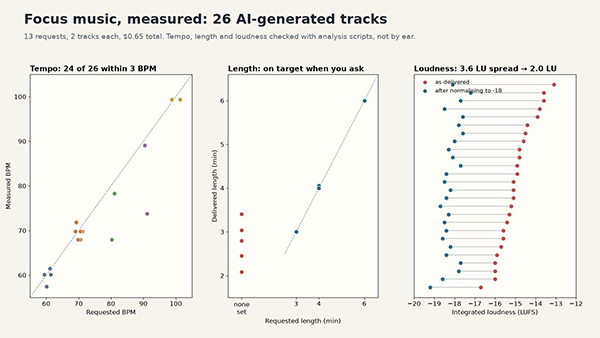
Choosing a tempo is useful only if the model sticks to it. I approximate the tempo of each track with a beat-detection library. 24 of 26 tracks landed within 3 BPM of the number in the prompt. The two misses were a downtempo track that came out closer to 74 BPM than 90, with a pulse so loose that different tempo indicators disagreed about it, and an acoustic guitar track that settled around 68 BPM rather than 80.
Here is the 60 BPM piano, the slowest setting I tried:
When I set the length (3, 4, or 6 minutes), all 20 tracks came back within 4 seconds of the request, including two full 6-minute keyboard pieces. When I left the length out, tracks ran between 2 and 3.4 minutes, which means a song change every few minutes. My advice: always set a duration, and for a 25-minute work block make six 4-minute tracks instead of depending on default lengths.
This was the most useful finding. As delivered, the tracks ranged from -16.7 to -13.1 LUFS, a spread of 3.6 LU. In a playlist, some tracks feel distinctly louder than the one before. 23 of 26 tracks also peaked at or above -1 dB, and nine went somewhat above 0 dB, which can cause small distortion on some players.
The fix is free. I ran every file through a loudness filter set to -18 LUFS with a peak limit of -1.5 dB. After that, the spread decreased to 2.0 LU, and no track peaked above -1.6 dB. I also counted sudden swells inside each track, where the level jumps by more than 6 LU within three seconds. The quietest, most even tracks had none; the 6-minute piano pieces had about two per minute, as quiet passages gave way to fuller harmony.
One small inspection: the two tracks where I added negative tags (“vocals, humming, choir, vocal chops, spoken word”) were the most even of all, with loudness ranges of 3.6 and 2.4 LU. That’s only two tracks, so treat it as a hint, not a rule.
Fatigue is personal, but two numbers help. First, diversity: running the same lo-fi prompt six times gave me 12 tracks centred on five different keys, with different surfaces each time, so a playlist made from one prompt doesn’t feel like one song on repeat. Second, how loop-like a track is. In the minimal electronic tracks, 57 to 91 percent of four-bar sections strcitly matched an earlier section, compared with 0 to 12 percent for most piano and lo-fi tracks. If you get bored, exchange those for piano or guitar.
I counted a track as serviceable if it was instrumental, within 3 BPM of the target, and had an intensity range under 8 LU. 20 of the 24 instrumental tracks passed. At $0.60 for the instrumental requests, that’s about 3 cents per practical track, or $0.60 for about 70 minutes of fresh focus music.
If I had to keep only one lesson from these 26 traces, it would be this: the style matters less than you’d think, and the levelling step matters more. A playlist where nothing instantly jumps out is a playlist you can stop noticing, and that is the whole point of focus music.
Ambient and instrumental music in the study temple can mask background noise and reduce cognitive fatigue, depending on individual preference.
Ownership depends on the platform used. Stage ties on those like Suno and Music Deputy typically grant commercial rights, while 3DRYERS may have restrictions.
No dynamic wear, lack of certain vocal changes, repetitive or looping structures. And a tempo between 60-90 beats per minute works best for brokers.