It depends on the platform you are using and the model you prefer, with licensed terms. If an image has commercial permission, then it doesn’t mean it covers copyright protection and third-party involvement.

You think its simple yes or no for depending upon what model, LoRA and reference images consume, and the subject your finished designing really impact how you can commercially create images.
It basically depends on the platform you use to create, like PixAI, where the model, LoRA, and reference image are used. A LoRA contains certain limitations, and image specifications raise further queries.
You should consider extra work in your AI-generated workflows on products for a specific client or building a new business.
Make sure you are aware of what went into creating images for such cases.
When you generate your printing images or create posters, these are simple examples of commercial use. But artwork that covers game assets using AI workflows also resembles commercial use.
Even if you don’t prefer to sell your image, taking help for monetised thumbnails on YouTube, Patreon, advertising, and business-related campaigns. You also use these to brand social media, which is considered commercial use.
If you are exploring the artwork or creating unique images for your personal use, it can be considered in a different category. It’s important to be sure about what and where you use such art.
Usually, you face difficulties sometimes when using a particular model or resources for your intended usage. This just means you have to adjust your artwork for better performance.
When you create using AI-generated images for commercial purposes, this does not mean you own the copyright for everything in your image displayed.
This issue can cause you real pain when you use this image for your business or payment transactions.
There are several platforms that can allow you to use such images for commercial use, but copyright stands in the way and makes the situation more complex.
All this depends upon creativity applied to the image and the laws that govern creating images.
If your image includes elements that belong to someone else, then you will not have authority. Even considering permission allotted using an AI platform and not owning any of the characters used, with logos, photos, and any such descriptive elements, explains the original art.
When you try to create your art, the simplest thing you often overlook is the model. Many creators start to assume that all models have similar terms and regulations on the platform. But most of them work on their own models and models upgraded by their own community.
Every model has different terms some of them allows you to use commercially but another restrict providing limitation on basis of licencing terms.
Similarly, some models allow you to use them freely, but its not permitted you to use them commercially. Basically, some of them are paid, such as PixAI membership offers.
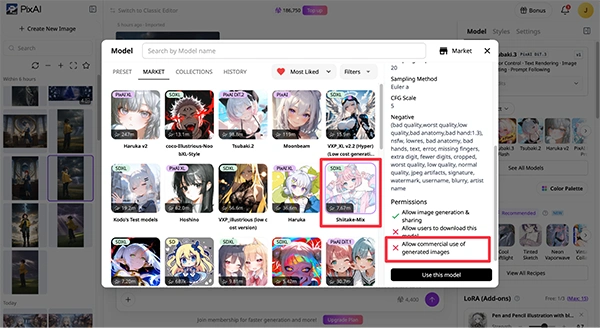
Some of the models are popular, like Shiitake-Mix, used to generate over 7.67 million images on PixAI. As the provided description doesn’t allow you to use commercially, and this makes you pay attention when working on paid projects.
There are many models on the platform that are used for commercial purposes, including the flagship model Tsubaki 3.
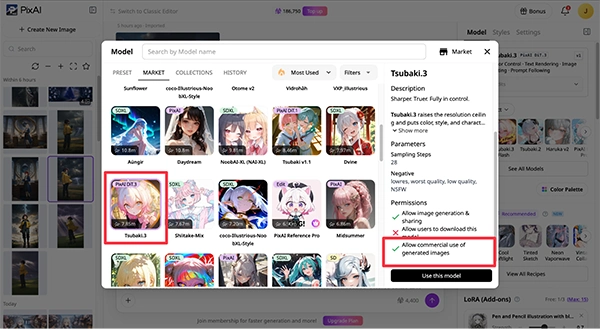
You should cross-check every model’s terms and conditions before considering it in your project.
Simply adding LoRA to your workflow means you should consider where it came from and what you can use it for.
LoRAs will help you to guide creating youe own model with specific characters, styles, clothing appearance, and facial expressions. Considering other features is also an advantage and helps with building characters for anime creators.
You have to understand where the LoRA came from; it’s just introduced under several terms or uploaded by the community members. For using commercially free for such conditions while some of them have certain limitations.
Using a LoRA on an AI platform doesn’t signify the commercial purpose of your artwork.
While considering multiple LoRAs, it is usually very helpful to understand what resources are used. This is possible when using a model with multiple community LoRAs based on existing fictional characters. Make sure the source is confirmed.
If you are using community LoRAs on PixAI, keep confirming which LoRAs you are referring to for commercial usage. Especially when your art is used in paid projects or is intended for merchandise. It is important to consider terms related to the model for publication.
Reference images can sometimes cause issues with rights in an AI workflow. It is important to understand who created the image, where you got it from, and what you were allowed to do with it.
A performed sketch that you generated contains licensed stock art, a public domain image, material provided by a client, an illustration from another artist, or a screenshot from an anime or game.
All the provided sources also carry different conditions, even if they all work perfectly well as references inside the same AI tool.
Using an image from another prospective doesnt necessary gives reference what you can perform with your final artwork. It simply means the online presence doesn’t give you the authority to use it commercially.
If you use an illustration from an artist’s portfolio to guide your paid project. You also face some problems, as the image contains source material that still exists outside the AI generation process.
If you are using your own images, it is usually an easier task to keep track of. While knowing where your character sketch came from and what the rights you have to follow.
Licensed stock also needs to follow the correct license. If you use the images that are provided by the client, you should always check for the required permissions.
Franchise material should also be considered. If you are using an anime character, a frame of a character from a game, or simple artwork from a published series, always remember your rights. Even if you have to put it in the AI workflow, the character or image used still has rights to use.
When you create your final output to sell, you have to use various resources to compile a single image. If you seek help from a model, then LoRA always help you to shape the image with your reference image, and you can edit it manually. Then it is ready to place this artwork into your project.
You also consider an anime creator designing a T-shirt graphic. The model is allowed to use it commercially, but they adopt help from a community LoRA and a screenshot from an existing anime to guide the pose. They manually edited the image before finalizing it for print.
The finished character resembles an established character or franchise. Manually editing can add human creativity, but it doesn’t replicate the fact that you have the rights attached to the material in the workflow.
Even if you have followed the terms for all the AI resources, you may end up with an image of an existing character from a franchise. This also does not create any problems with the AI resources but with the image around the generated characters.
When you are creating artwork for commercial use, it’s important to verify the terms of the images before you create them. What you have done during the creation has an impact on whether it is suitable or not.
You should keep track of a description where it can help you to make AI artwork for used commercially easier and effective. In a situation where you use multiple models, LoRAs, and references.
When starting your project, note down what platform or model you are going to use. Save preferred commercial-use information if present. If you are adding a community LoRA or other resource, record its name and where it came from. This way when you are ready to publish your art, you need not to memorise everything.
Also note down the references, where your image was fetched from, and whether it contains a licence or requires permission.
If you are using your own sketches and photos, this is a simple and solved solution. Licensed sketches may require a bit more attention, particularly if the license has conditions around commercial use or modification.
When you are working on bigger projects, providing a simple note with what model, LoRAs, references, date created, terms, and edited information are really useful.
You also don’t need to produce complicated documents; you just need to know what is used when creating an image. Before you go for publixhing you art, then think about what you are going to do with the produced output. If it is the character description for a personal modification, then it’s different from using it on specific products. While advertising or providing to a client is important.
If you consume more time to create check the relevant terms again mankind an assumption that nothing changed.
PixAI can help you to create your anime artwork. You can select your model, integrate LoRAs with references and edits. If you are seeking to generate a character or a specific image with multiple iterations, then this is the best choice to adopt.
While performing under several circumstances to understand what you have created is always beneficial. You can choose a single model and use options to seek help from LoRA and modify it. You also use references to complete your character or an image; several edits are to be performed. It is usually a difficult task to perform, but always remember the sources you have used.
For considering commercial use verify the current terms for Pix AI and follow the rules which attached to individual models, LoRAs and community resources.
Take consideration of the idea used in creating the images for a paid project, with all terms followed and executed correctly.
Whether you can use your AI artwork for commercial use can depend on more than the platform that helps in creating the final image. The model, LoRAs, references, and subject of the image can all impact what you need to check before selling the work or using it for a client.
There is also a difference between having permission to use the image for commercial use and owning the copyright. This is not always the case when you use third-party images.
If you are looking to turn your AI anime art into products, commissions, client projects, or some digital tools, then the best option is to know what resources you are using to create them. Trace what is used, where it belongs, and what you use it for.
PixAI can help with the process of choosing models, LoRAs, reference tools, and editing for generating images.
It depends on the platform you are using and the model you prefer, with licensed terms. If an image has commercial permission, then it doesn’t mean it covers copyright protection and third-party involvement.
It may. Review the LoRA’s own license and the rights connected to its training material. Do not assume that permission for the base model also covers every add-on.
Having access to an image does not automatically give you permission to upload, adapt, or commercially use it. The answer depends on the rights involved, the license, the jurisdiction, and the specific use.
No. A subscription may grant certain usage permissions under the platform’s terms, but copyright protection depends on applicable law and the nature of the human creative contribution.