Use the final product as your guide. If your first online course produces a desired, measurable result, price ahead of the value of that result.

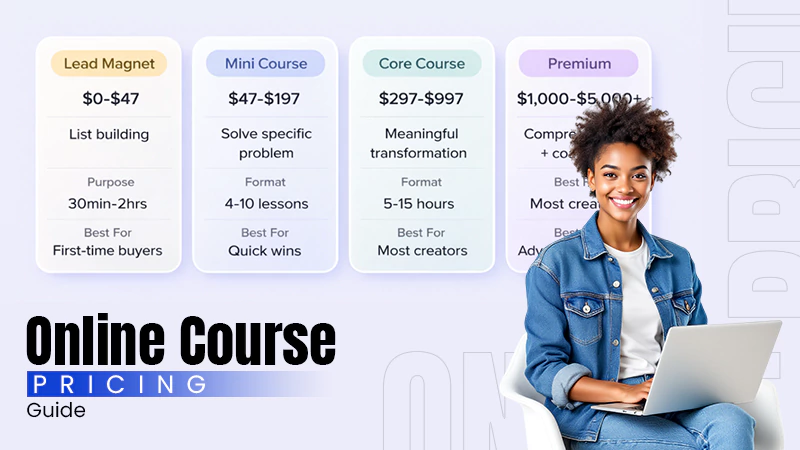
Quick answer: The best way to define a price for an online course is to set the base price on the real-world value and credibility it provides, rather than based on its duration and the market price. Use a clean payment process, avoid underpricing and offer various payment plans to improve sales.
This online course pricing guide will reveal the 6 common mistakes that often become the reason for low sales.
Price is not merely a number. It is your first line of marketing copy.
Before a visitor reads your title, watches your intro video, or scans your testimonials, they have already crafted an opinion based on your course price. That thought process shapes everything that follows.
The trap: Most course creators price low because it feels better for them. Fewer people will object to a $47 price highlight. That is true. But the people who do buy are less proactive, have lower completion rates, and generate fewer testimonials. The low-priced course motivates browsers, not customers.
The fix: Price based on the guaranteed outcome, not the creator’s comfort level. A cheap course that no one fulfils is not a bargain for anyone.
A ten-hour course is not considered more than a two-hour course just because it is longer. This is one of the most frequent pricing mistakes in the industry. Creators mark their modules, estimate their hours, and set a course price that indicates the amount of content they produced. The buyer does not even think about that metric. They have concerns about the result.
A focused, two-hour self-paced course that solves a special problem at exactly the right moment is worth more to the right buyer than a cluttered course that takes twelve hours to say the same thing multiple times.
The trap: Overpacking a course to account for a higher price actually reduces imagined value by making the course feel overwhelming. Completion rates are declining. Refund requests have increased. Testimonials thin out.
The fix: Price based on the outcome’s accuracy and value. A mini-course that offers immediate value on a narrow, painful issue can command a remarkably high price point. It can be priced up to $197. A core course that assures a complete transformation should be priced at the level of that switch, not at the length of its video runtime.
Also, explore the top 7 AI courses to understand AI agents in 2026.
A competitor’s price tells you nearly nothing useful about what you should charge.
The trap: Seeing that three other people charge $197 for courses on the same subject and concluding that $197 is the right price for yours. This method usually leads to undervaluation. It collapses all the variables that actually influence course sales into a single data point that may not even be correct.
The fix: Use competitor pricing as one proving point among many, not as a goal. Your target price should be set by the outcome you give them, the target audience you serve, and the perceived value your placement creates. A well-positioned course in the same field can command two to three times a competitor’s price if the reward is clearer and the production quality is top-notch.
Your first price sets a market baseline. Set it too low, and it follows you.
The audience that pays for your first online course at $47 will resist paying $497 for your next one, even if the next course is distinctly more valuable. You have trained them to demand a certain price range from you.
The trap: Considering that a low first price is a great pricing strategy. It is not. It is a positioning action that creates a ceiling you will have to work tirelessly to break through later.
The fix: Think about your first course as the jumping point to a larger course business, not as a standalone experiment. Price it at a level that takes into account your market positioning and the real value you provide. If you legitimately need a low-cost entry point for audience growth, use a low-cost mini course and pitch it explicitly as a lead-in to your flagship course at a slightly greater price.
Not offering payment plans is turning away loyal buyers who simply seek flexibility.
Once your online course price reaches $300, a meaningful percentage of your aspiring buyers will not convert on a single upfront payment, not because they cannot bear it over time, but because the instant commitment feels too big.
The trap: Thinking that payment plan option buyers are lower-quality or less passionate. The data does not confirm this. Buyers who choose periodic payments are often just as engaged and just as likely to successfully finish the course as full-pay buyers.
The fix: Offer payment intervals on any higher-priced course (above $200). Structure them so that the total payment plan amount is 15-20% higher than the single-price full-pay choice. This portrays the full-pay option as a way to save money while allowing the instalment option to feel like real flexibility.
A payment plan option does not affect your actual price. It alters who can access your course without adjusting the value you deliver.
You can have the right price, the right offer, and the right target group, and still leave moldy revenue on the table if your checkout is not designed to convert.
Most course creators put their energy on the course creation process and their sales page, then use a basic checkout tool as an additional component. The checkout is where revenue is actually earned or lost. A slow page, a deceptive form, or a checkout that does not offer payment plans or order bounces can cost you 20 to 40% of potential course sales.
The trap: Interacting with the checkout as a utility rather than a revenue tool.
The fix: Use a checkout platform crafted precisely for selling courses and digital products, one that supports payment plans, order bumps, upsells, and tax management without requiring plugins or third-party extensions.
ThriveCart is a checkout and course business platform prepared for course creators who want to price their online course precisely and capture every dollar that their offer calls for.
Unlike most programs that charge monthly, ThriveCart is a one-time purchase. No constant cost eating into your course sales margins as your course business progresses.
Moreover, every pricing model is executed natively. Payment plans, single payment, subscriptions, and pricing tiers are all plugged in. Offer payment plans with automatic instalment settlement, failed payment recovery, and no third-party tools needed.
ThriveCart covers any sales volume without additional per-transaction fees. Whether you are marketing your first course or running a premium program at scale, the platform adapts with you without further increasing your costs.
Also, explore the 5 best online platforms to improve Korean speaking with online tutors.
At the end of the day, one needs to ensure their course price reflects its real value to ensure a better pitch in the market. Avoid common mistakes such as underpricing, trying to match the competitors or focusing too much on course length.
Test your pricing, provide flexible buyer options to people, and make the checkout process easier. A thoughtful process can definitely help you attract more customers while improving the real-world business potential.
Use the final product as your guide. If your first online course produces a desired, measurable result, price ahead of the value of that result.
Common signs include no objection to the price, poor completion rates and if the sales page conversion rate is above 5% on warm traffic.
There is no prescribed number. You can raise prices as soon as you have enough testimonials that illustrate the outcomes your course delivers.