In e-commerce, Artificial intelligence helps with chatbots, visual search, inventory management, and even fraud detection.



“If you don’t have an AI strategy, you’re going to die in the world that’s coming.”
— Devin Wenig (Former eBay CEO)
Most e-commerce platforms have already integrated AI but there is still some scope to go further deep.
AI is helping them in logic, search, risk management, and of course, operational efficiency. And all of this is integrated with each other so it looks like a unified system rather than some ML modules patched up as plugins.
All this has made the experience of customers and merchants considerably easier.
This article is helpful to consumers but essential for merchants as choosing an e-commerse partner is an important decision in your long-term strategy. Artificial intelligence is going to be big in the future so a platform that gives comparable importance to it should be on top of your list.
KEY TAKEAWAYS
- Application of AI in E-commerce holds immense benefits though there are some challenges as well.
- Integrading Artificial intelligence on the fundamental level will always trump patching it on top or just coming up with some AI feature every week.
- In the future, most e-commerse operations will be handled by the Artificial intelligence with no human intervention needed.
- Choose the AI-powered e-commerce partner based on your business model as a merchant.
Adding an smart feature every week doesn’t make any difference anymore. You need to embed it in workflows of your operational layers: merchandising, search, customer experience, operations, and risk controls working together as a coherent system.
This is a meaningful departure from the bolt-on model, where merchants assembled AI capabilities through third-party apps and plugins. The market is shifting toward AI-native platform capabilities, where GenAI, machine learning, and platform-managed intelligence are part of the core product rather than optional additions.
For merchants evaluating platforms today, this shift reframes the decision entirely. The question is no longer which individual tools a platform supports, but whether the platform itself is built to evolve alongside Artificial intelligence at the infrastructure level.
Latest platforms are coming prepackaged with storefront creation, automation, and AI workflows. These are usually built using tools like Runner AI Ecommerce Builder which help with platform-level AI architecture that replaces the need to manage multiple separate integrations. Understanding which specific capabilities this architecture enables is the natural next step.
Personalized product recommendations have moved from differentiator to baseline expectation. McKinsey research on personalization revenue impact shows that getting personalization right generates meaningful revenue lift, while getting it wrong incurs measurable costs.
Intelligent search now incorporates natural language processing so shoppers can describe what they want rather than guess the right keyword. Platforms that handle this well return relevant results even from vague or conversational queries.
Generative content tools are also becoming a standard part of the ecosystem, helping merchants produce product descriptions, category copy, and merchandising assets at scale. Tools like ChatGPT have popularized this capability broadly, and platforms are now building comparable generation directly into their workflows.
Dynamic pricing, demand forecasting, and inventory management are converging into a single operational layer inside modern platforms. Rather than running as separate tools, these capabilities are increasingly managed through shared data models keeping pricing, availability, and planning aligned in real time.
Predictive analytics sits at the center of this, giving merchants earlier visibility into demand shifts before they affect margins or stock levels. AI personalization in your online store also covers how this kind of intelligence connects to the front-end experience.
Conversational commerce and fraud detection represent the platform’s continuous layer, covering functions that span the entire customer lifecycle rather than a single touchpoint. Chat-driven support powered by natural language processing handles routine queries automatically, while fraud detection models monitor transactions in real time. Together, these capabilities reduce the manual overhead that would otherwise fall on merchants and their support teams.
Here’s an example of Artificial intelligence in action on an e-commerce platform:
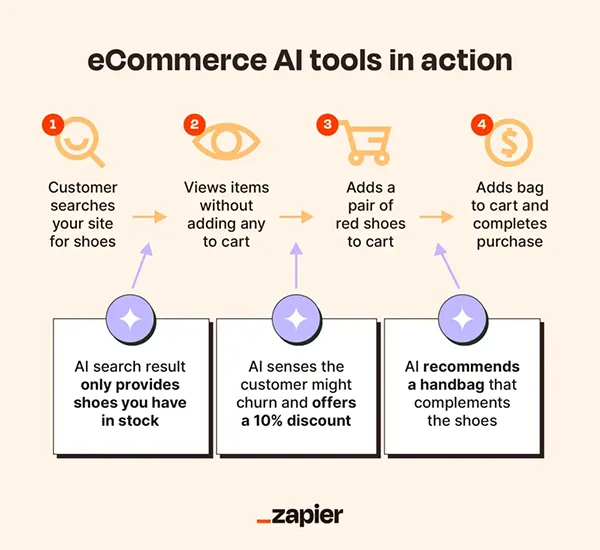
Integrating Artificial intelligence from inside rather than patching it on top not only gives a stronger grounding but also bestows you with multiple times the benefits.
Adding AI tools on top of an existing platform sounds practical, but the structural limitations become visible quickly. When catalog data, customer history, pricing rules, and fulfillment logic all live in separate systems, each tool ends up working from an incomplete picture.
App sprawl compounds this problem. A merchant might run one tool for product recommendations, another for dynamic pricing, and a third for support automation, none of which share a consistent data layer. The result is conflicting outputs, slower response times, and maintenance overhead that grows with every integration added.
Inconsistent workflows create a similar drag. When AI decisions made in one part of the stack don’t inform decisions in another, merchants lose the compounding accuracy that makes machine learning genuinely useful over time.
Platforms designed around shared data environments operate differently. When catalog, customer, pricing, support, and fulfillment information all exist within the same environment, AI models can draw on the full context rather than a fragment of it.
Shopify and Amazon have both moved in this direction, building intelligence into the platform layer rather than offering it as an optional add-on. Salesforce has taken a similar approach in enterprise contexts, embedding Artificial intelligence into its core commerce and CRM workflows.
The merchant outcomes follow from the architecture. Speed improves because decisions don’t require data handoffs across disconnected systems. Accuracy improves because models train on richer, more consistent inputs. For merchants focused on optimizing your ecommerce store performance, this structural difference shapes customer experience in ways that individual bolt-on tools rarely can.
We just discussed the situation that is. Now to what future holds. Artificial intelligence will move on from its supporting role to handling almost everything in your e-commerce.

The next shift in AI platform capabilities isn’t about generating better outputs; it’s about taking action. Agentic AI refers to systems that can monitor signals, evaluate conditions, and trigger workflows without waiting for human instruction at each step.
In practical e-commerce terms, this means a platform could:
All within the same automated loop. Guardrails keep these systems within defined boundaries, but the operational role is meaningfully different from a tool that only surfaces recommendations.
Amazon and Shopify are already building in this direction. The trajectory points toward platforms that manage campaign adjustments, merchandising rules, support routing, and inventory management as coordinated actions rather than separate tasks.
As agentic AI matures, the coordination challenge shifts from individual channels to the full commerce environment. Storefronts, marketplaces, social channels, and support touchpoints each generate data, and platforms are increasingly positioned to manage that data as a unified operational layer.
This is where GenAI and predictive analytics work together at a system level. Former can adapt content across channels while the latter routes demand signals toward inventory management and fulfillment decisions, all inside the same platform environment. The result isn’t a fully autonomous commerce operation, but it is a platform that handles significantly more coordination work than merchants currently manage manually.
AI application directly depends on your business model.
B2C commerce priorities cluster around volume, conversion velocity, and customer experience at scale. Artificial intelligence in these environments is heavily oriented toward personalized product recommendations, intelligent search ranking, and dynamic pricing that adjusts in near real time based on demand signals and competitor activity.
Content velocity matters here, too. B2C platforms need to generate and refresh merchandising assets across large catalogs quickly, and GenAI is increasingly embedded to handle that throughput. The buying cycle is short, and the optimization targets reflect that, with AI models trained on B2C transaction patterns prioritizing immediate conversion signals over long-term relationship logic.
B2B environments involve fundamentally different transaction structures. Buying cycles are longer, pricing is often negotiated at the account level, and purchases typically move through approval workflows before completing.
Artificial intelligence in B2B commerce is built around this complexity. Account-based catalogs, contract-specific pricing, and quote management require a different kind of intelligence than real-time dynamic pricing designed for anonymous shoppers. Workflow automation also plays a larger role, handling multi-step approval sequences and routing purchase requests through the right internal stakeholders.
These structural differences mean that even when B2C and B2B platforms use similar underlying AI methods, their roadmaps will continue to diverge. AI maturity in each model is shaped by transaction complexity, channel mix, and buying cycle length, not by the technology’s sophistication alone.
Despite huge benefits, why aren’t platforms flocking to implement AI across their operational workflows like anything. Well, because there are numerous obstacles as well.
AI-native platforms handle enormous volumes of behavioral, transactional, and personal data, and that creates real compliance exposure. GDPR and comparable regional frameworks place clear expectations on how platforms collect, store, and process customer information, and those obligations extend to the AI models trained on that data.
Consent management, data residency, and model transparency are no longer edge-case concerns. Platform providers are increasingly expected to demonstrate how their GenAI systems use customer data, what inputs inform their outputs, and how users can opt out without degrading their experience. Trust at the platform level will depend on governance infrastructure, not just performance.
Machine learning models reflect the data they’re trained on, and e-commerce datasets carry their own patterns and gaps. Recommendation engines can reinforce narrow purchasing habits. Dynamic pricing logic can produce outputs that feel arbitrary to customers. Fraud detection models can generate false positives disrupting legitimate transactions and damaging the customer experience.
Over-automation in sensitive workflows compounds these risks. When pricing, fraud flagging, or service decisions run without meaningful human review, errors that a merchant would normally catch quickly can become systemic. Responsible deployment of generative AI and machine learning requires building in oversight mechanisms, not treating automation as a destination in itself.
Ignore the platforms with fancy AI features and look for the ones that promise deep integrations along with infrastructure stability and secure data handling.
GenAI and agentic AI are reshaping what platforms can do, but the merchants who benefit most will be those on platforms where machine learning operates across a unified data environment rather than across disconnected tools.
Customer experience quality, over the long term, will reflect that architecture. The platforms positioned to win aren’t those with the longest feature list. They’re the ones that combine customer-facing intelligence with operational reliability, meaningful oversight, and the kind of trust that scales alongside the business.
In e-commerce, Artificial intelligence helps with chatbots, visual search, inventory management, and even fraud detection.
The biggest obstacles to AI implementation in e-commerce are the huge capital investments and data security risks.
Artificial intelligence is poised to automated almost all e-commerce operations, making it a hyper-personalized and immersive shopping experience for consumers.